Foreign and Military Affairs
Confucius Institutes enhance China's int'l image
By Kelly Chung Dawson (China Daily)
Updated: 2010-04-23 09:19
 |
Large Medium Small |
|
|
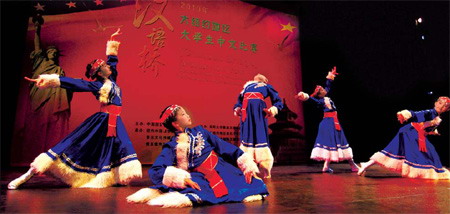
NEW YORK -- "Soft power", as defined by author and political analyst Joseph Nye, is a nation's ability to entice others through the use of positive cultural engagement. Utilizing soft power, one might convince others to "want what you want," Nye wrote in 2004.
| ||||


"Culture has become a more and more important source of national cohesion and creativity and a factor of growing significance in the competition in overall national strength," Hu said.
The Beijing Olympics was widely regarded as a successful attempt to introduce Chinese culture to the rest of the world. In a less showy manner, the government is aiming to accomplish much more by establishing language centers called Confucius Institutes in 87 countries.
The first Confucius Institute opened in Tashkent, Uzbekistan, in June 2004. Since then, 523 institutes or classrooms have been established all over the world, according to Han Ban, China's Office of Chinese Language Council International. The government aims to increase that total to 1,000 by 2020. As many as 3,000 scholarships will be given to foreign candidates to study Chinese teaching by 2013.
Each Confucius Institute is affiliated with a hosting university or cultural institution, with the partner required to match Han Ban's funding. Han Ban contributed $150,000 to Western Michigan University, which opened a Confucius Institute last summer.
In New York, the Confucius Institute operates out of the China Institute, an educational and cultural organization, which seeks to deepen American understanding of Chinese culture through language.
"We are trying to bring an understanding of the culture and language to the students. If we want high-quality Chinese teachers in America, we're going to have to train them ourselves," said Shenzhen Liao, the manager of professional development at the China Institute's branch of the Confucius Institute. "It's important to build up a pipeline," she said.
The center offers various workshops for Chinese teachers and a six-week graduate-level summer program for aspiring teachers, intended to prepare them for New York's state licensing requirements. The China Institute also houses a gallery, which next month will host an exhibit showcasing the life and teachings of Confucius.
Much has been made of the resurgence of Confucius as a national symbol, after his fall from favor in the second half of the 20th century.
"A lot of Chinese people felt that the reason China became so vulnerable to aggression from the West and from Japan was because of the Confucian system," Kenneth Lieberthal, director of the John L. Thornton China Center at the Brookings Institute in Washington DC, told China Daily.
"Now China has begun in a more serious way to think about the ethical underpinnings of Chinese society, because it's a society in a state of tremendous change," he said. "There's a desire for a stronger ethical grounding, and one of the elements of that is reaching back to the nation's Confucian heritage."
Liao believes that the Confucius Institutes have a mission to impart Confucian ideals. "We try to pass on the traditional values and philosophies of his teaching, learning, and I would say being, because Confucius was not just a teacher but also a philosopher who had a huge impact on the Chinese way of thinking and being," she said.
One Confucian value that Americans might learn is a respect for elders, Liao said. This value is "fading" but still present in China, she said.
"In America the teacher has to make a great effort to build up respect, instead of automatically being given respect for being a teacher," she added.
In the Western world, Confucius is generally associated with wisdom and ethics, an image Lieberthal believes is greatly beneficial to China at this time of growth and change.
"It's not surprising that China would want to associate with a symbol people identify with and respect and that they would use Confucius as a marketing brand, if you will," he said.
The institutes have faced criticism in some quarters, with a number of universities declining to partner with Han Ban. Most notably, India in 2009 rejected China's bid to establish language centers, calling a plot to spread soft power "unacceptable," according to The Telegraph of Kolkata.
India itself opened seven new cultural centers in Asia in 2009, and critics charge that India is simply engaging in a competitive rivalry with China. At a conference in Bangalore last year, India's minister of state for external affairs said, "It's not the size of the army that wins, it's the country that tells a better story."
Lieberthal believes that departmental politics may have played a part in some universities declining to partner with the Confucius Institutes, as well as concerns that the host institution might be forced to cater to governmental policies.
But America, Germany and Japan have established similar institutes, and some observers say that the Peace Corps is simply a form of public relations designed to exert soft power.
"My impression is that the Chinese approach has more of an emphasis on language learning, and less on a broader cultural or sociocultural angle than has been the case in US efforts abroad, or Japanese or German efforts," Lieberthal said. He cited Germany's Goethe Institutes as engaging in more extensive cultural outreach.
The government's focus on language outreach coincides with a rapidly growing interest in Chinese language study that likely reflects a growing interest in China itself.
"Languages as carriers of culture and communication tools are bridges for different civilizations," State Councilor Liu Yandong told the fourth conference of Confucius Institutes in December.
Liao believes that a realistic approach to cultural engagement is necessary. "We have to look at the reality here, and what makes sense in another culture. We are constantly having conversations with other cultures and different ways of thinking," she said. "It's a great challenge."