Society
Sichuan lessons applied in Yushu
By Hu Yinan and Cui Jia (China Daily)
Updated: 2010-05-12 08:20
 |
Large Medium Small |
In addition to CISAR, residents and media reporters in the earthquake zone also used blogs and micro-blogs to tell the world what was happening there. In an effort to reach the largest audience possible - China now has more than 400 million netizens - the Qinghai government posted online appeals for relief materials on Tianya, a popular news website.
"Increased interaction between government agencies and the public in the wake of the Qinghai tremor has been a significant progress," said Mao Shoulong, a professor of public policy at Renmin University of China. "Not only did the government proactively release information in a comprehensive manner, but the public was also able to forward their inquiries and advice to the government in a more efficient way."
|
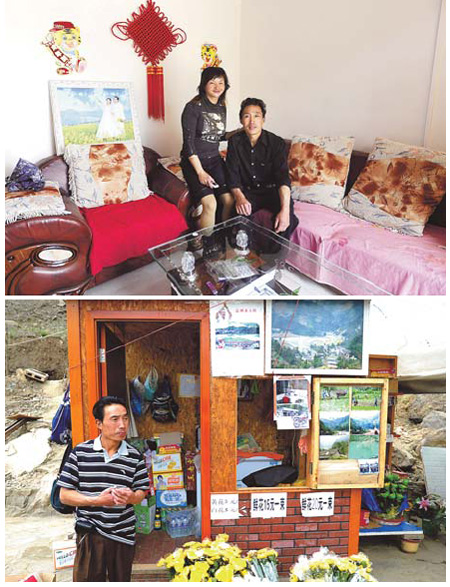 Top: He Xiantong and his new wife in Qingchuan. Below: He Xiantong sells chrysanthemum beside his collapsed house, where his first wife died. [Xinhua] |
The rising influence of social groups is also regarded as another vital legacy of the Sichuan earthquake.
In a pioneering move, the State Council's Leading Group for Poverty Alleviation Office last year incorporated Oxfam - an international non-governmental organization (NGO) aimed at finding long-term solutions to poverty, hunger and social injustice - into Sichuan's reconstruction plans.
"They (State officials) endorse our global experience and financial management mechanisms," said Wang Binbin, a press officer with Oxfam's Beijing office.
But even in the face of phenomenal development, political concerns and bureaucratic obstacles still stifle the growth of NGOs in China, say experts.
Zhai Yan, director of the volunteers' support center at YouChange, a private foundation involved in reconstructing the city of Mianzhu, warned of the dangers of becoming "institutionalized".
The volunteers should represent the NGO to conduct independent social work, instead of acting as additional forces to the government's human resources department, which often tends to be the case, she said. "The members in our unit are now de facto employees of the government. We were incorporated into the establishment, when in fact we were supposed to cooperate."
Tang Rong, one of YouChange's coordinators in Mianzhu, argued that it is only natural for NGOs to adhere to local government requests, since "NGOs are based in places for just that reason: To help it develop according to its own needs".
"The (Sichuan) earthquake was a test for the government when it came to dealing with NGOs," said Zhu Xiaofang, a Mianzhu government official. "That was something we had no prior experience in. There's no way we can limit the development of these (NGOs."
Rescue and recovery
One of the Sichuan disaster's most lasting legacies lies in its recovery model, say analysts.
As the direct economic cost of the earthquake was almost 980 billion yuan ($140 billion), far beyond Sichuan's economic capacity, the State Council twinned each severely affected county with one of 19 provinces or municipalities, which are required to donate at least 1 percent of their annual fiscal revenue towards reconstruction projects until next year.
That model has been recently replicated for the Xinjiang Uygur autonomous region.
Relief for previous serious disasters primarily took the form of direct fiscal transfers from the central government. Developed regions, on the other hand, have been using their fiscal revenue to provide financial support to recipient regions for more than three decades.
"An older partner assistance program had been running in Xinjiang since 1996," said Jurat Imin, deputy Party chief of the region's Hotan prefecture, which will be partnered with Anhui province, and Beijing and Tianjin municipalities. "However, this latest scenario has for the first time clearly quantified the targets for the supporting provinces and municipalities.
"In the past, there was no target of how much money they had to invest, so it was impossible to really measure how much effort they put into the program," he said. "Allocating aid to county-level administrations could help the (twinned provinces and municipalities) to better target the problems that constrain the development of the regions involved, so that the aid could be concentrated on the right spot. That's an experience gained from the Sichuan earthquake."
Sheng Yi, head of the Sichuan Academy of Social Sciences' macroeconomic and industrial institute for economic research agreed and said: "In the past, when it was hard to tell the extent of a province's involvement in a region, much of the aid was arbitrary. All similar forms of aid since (Sichuan) have used concrete indicators so that people can examine exactly what has been done and what hasn't.
"Now you can lay it all out on a table and compare things. It's only when we start comparing can we really achieve progress," he said.
Sheng acknowledged that an important lesson from the Sichuan disaster is that earthquake-ravaged cities and towns often tend to passively wait for aid.
"They should be more vocal because this is essentially a process of mutual learning, negotiation and compromise," he said. "Ultimately though, the recipient regions benefit. The fact that Xinjiang has adopted this model is testimony of its success in Sichuan."