Society
Helping athletes after the finish line
By Hu Yongqi and Sun Xiaochen (China Daily)
Updated: 2010-08-10 08:22
 |
Large Medium Small |
Zhu Dan, a retired silver medalist in women's rhythmic gymnastics at the Beijing Games, who will attend the training course at the University of Wisconsin-Madison, said she is looking forward to studying advanced concepts in training and sports management. "I'm just afraid most of my time will be spent learning English, though," she added.
Critics suggest that, as most of the athletes are far from fluent in English, the effects of the program will ultimately be minimal, while some netizens have branded the joint project "just a show".
However, program leaders at the University of Wisconsin-Madison insist there is a genuine desire to help China's former athletes achieve their post-career goals.
"It's definitely a precious chance," said professor Ji Li Li, head of the college's department of kinesiology, who originally suggested the program to officials at Beijing Sports University two years ago.
Ji, the first Chinese scholar appointed director of a sports department at a US university, said the college will provide the Chinese students with tailor-made courses to suit his or her personal profile and English skills.
They may also get the chance to meet professional American athletes and learn how local sports clubs operate, he added.
Winners to losers
"About half of (all retired athletes) have no way of finding a job that makes good money because they are not well educated and no mechanism exists to ensure their rights," Liu Guangtao, director of personnel for the administration, told Nanjing Daily.
Liu Fei, a world champion gymnast in 1998, is a prime example of the struggle faced by former stars. She retired from the Liaoning provincial training camp in 2000.
"I had nothing and the only people I could rely on were my parents," said the 31-year-old. "My parents and I didn't expect any respect, just a peaceful and relatively well-to-do life."
However, two years after enrolling at Liaoning College of Sports in 2001, Liu's father died following a traffic accident, leaving the family with medical bills topping 200,000 yuan ($29,500). Despite the setback, she eventually graduated in 2005 and was hired as a coach at the Benxi Municipal Sports Training Camp.
"I overcome the difficulties with exertion and honesty," Liu Fei said with pride, explaining that many former gymnasts fail to forge successful careers post-competition.
No further training is offered to retiring athletes at the Liaoning training camps that produce thousands of champions, she said, blaming the problem on a shortage of funds and awareness by sports authorities.
The General Administration of Sport has run more than 10 training programs annually to help retired athletes since 2007, the year it issued a regulation stating retired athletes should be paid subsidies while they search for jobs after retirement. A 38-million-yuan government program that ran from 1995 until early 2006 also helped 9,101 athletes and coaches, show official statistics.
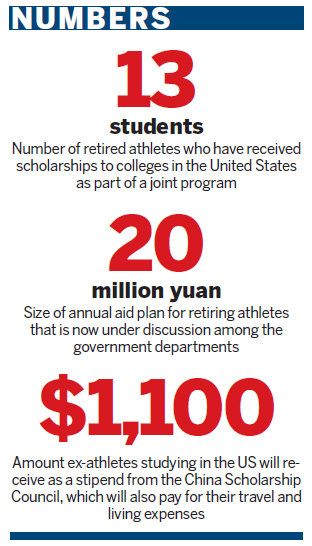
Former stars may soon benefit from an annual aid plan of about 20 million yuan too, according to plans being discussed by sports administration.
Falling from grace
With their formative years devoted almost entirely to winning honors for their country, most of China's world-class athletes face a harsh life after retirement.
In 2005, Chinese media reported that Ai Dongmei, a gold medalist at the Beijing International Marathon Contest in 1999, sold her medals to feed her family, while this year, Sang Xue, a synchronized diving champion at the 2000 Sydney Games in 2000, competed in television game shows to earn money to "cure her mother".
Chen Ying, a former world marathon champion, was killed in 1998 in an accident at a coal mine, where she had been working as a security guard, one of the few jobs she was qualified for.
Friends said Chen had attempted to get a job as a newspaper reporter but was turned down due to her poor education background.
The employment of retired athletes is a complicated issue and needs to be resolved by several government departments, said Liu Guangtao at the State sports administration, who suggested a strong network of unions and associations to help guide ex-sportsmen and women towards jobs.
"The (foreign university) program makes it easier for retired athletes to find a job or a coaching position," said Xiao Hongbo, a professor of journalism at Shanghai University of Sports. "More programs should be conducted to help more athletes facing retirement."
The lack of a well-rounded education for most athletes is a disadvantage, he said.
Liu Guangtao agreed and told Nanjing Daily: "Many training teams and coaches think athletes should dedicate themselves solely to their sport and are reluctant to give them time for study."
Poor educational backgrounds also worsen their situation. Zhou Lu, a teenage national swimming champion, was admitted to a university after retirement but could not catch up with her classmates. She ended up working as a saleswoman in a supermarket after graduation.
Xiao said the sports industry in China has a deep-rooted problem in that sports authorities continue to make almost all the decisions over professional athletes, leaving the public's voice unheard.
"We have strived for years to weaken the sole voice of the sports authorities but it is even stronger today than before," said the professor. "As long as this is the case, the situation for athletes will not improve and they will rarely have a chance to lead better lives after retirement."
A movement is now under way to raise the public's awareness of sports and athletes' struggles, said Xiao, who argued that public and private enterprises, as well as ordinary citizens, should help choose athletes for competition.
A pyramid structure exists among Chinese athletes, as it has for decades, meaning the few gold medalists are at the top and thousands of lower-level athletes are at the bottom, he explained.
"These lower-level athletes especially suffer harsh times after retirement," said Xiao. "Many athletes were born in poor families and they will totally depend on a sport when playing for a professional team. They train so hard but unfortunately just one person gets first place.
"There are too many stories of champions selling their medals for bread and medicine. They deserve better than that," he said.
Liu Ce in Shenyang contributed to this story.
 主站蜘蛛池模板:
阿克苏市|
略阳县|
山西省|
博湖县|
富裕县|
邢台市|
合水县|
横峰县|
汶上县|
织金县|
成都市|
绥宁县|
恭城|
高尔夫|
丰镇市|
山阴县|
原平市|
牙克石市|
枣强县|
乌苏市|
西乌珠穆沁旗|
大名县|
武汉市|
乌拉特后旗|
东丰县|
逊克县|
内乡县|
泾源县|
彭州市|
镇宁|
新民市|
基隆市|
阜新|
岚皋县|
蓬安县|
丰城市|
青州市|
尉犁县|
绥德县|
卢氏县|
厦门市|
六枝特区|
调兵山市|
驻马店市|
新津县|
盐亭县|
墨玉县|
洛南县|
迁安市|
昌吉市|
楚雄市|
米林县|
浦北县|
平泉县|
巴里|
满洲里市|
南涧|
紫金县|
安徽省|
饶河县|
荆门市|
鄂托克前旗|
镇平县|
齐河县|
富阳市|
黄平县|
会东县|
洱源县|
三门县|
盘山县|
普定县|
南木林县|
法库县|
镇坪县|
稻城县|
瑞安市|
洱源县|
格尔木市|
托克逊县|
咸宁市|
漠河县|
永泰县|
主站蜘蛛池模板:
阿克苏市|
略阳县|
山西省|
博湖县|
富裕县|
邢台市|
合水县|
横峰县|
汶上县|
织金县|
成都市|
绥宁县|
恭城|
高尔夫|
丰镇市|
山阴县|
原平市|
牙克石市|
枣强县|
乌苏市|
西乌珠穆沁旗|
大名县|
武汉市|
乌拉特后旗|
东丰县|
逊克县|
内乡县|
泾源县|
彭州市|
镇宁|
新民市|
基隆市|
阜新|
岚皋县|
蓬安县|
丰城市|
青州市|
尉犁县|
绥德县|
卢氏县|
厦门市|
六枝特区|
调兵山市|
驻马店市|
新津县|
盐亭县|
墨玉县|
洛南县|
迁安市|
昌吉市|
楚雄市|
米林县|
浦北县|
平泉县|
巴里|
满洲里市|
南涧|
紫金县|
安徽省|
饶河县|
荆门市|
鄂托克前旗|
镇平县|
齐河县|
富阳市|
黄平县|
会东县|
洱源县|
三门县|
盘山县|
普定县|
南木林县|
法库县|
镇坪县|
稻城县|
瑞安市|
洱源县|
格尔木市|
托克逊县|
咸宁市|
漠河县|
永泰县|