Society
China's moon goal right on schedule
By Xin Dingding (China Daily)
Updated: 2010-10-02 07:15
 |
Large Medium Small |
 Full?Coverage: China's second lunar probe |
XICHANG, Sichuan - China moved closer to its goal of landing on the moon as its second lunar probe, Chang'e-2, blasted off seconds before 7:00 pm on Friday from the southwestern city of Xichang.
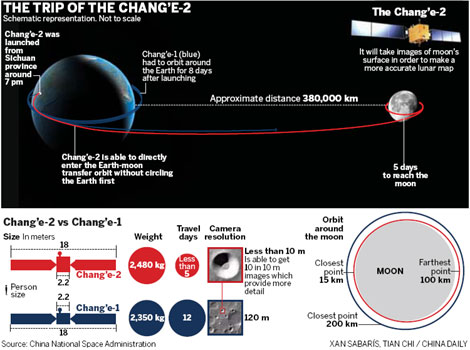
 The circumlunar satellite separated from the rocket at 7:26 pm to enter the Earth-moon transfer orbit. In less than five days, it will enter a 100-kilometer lunar orbit.
About an hour after the launch, Li Shangfu, director of the Xichang launch center, declared the launch a success to cheers and applause in the command and control hall.
The probe plans to test technology in preparation for an unmanned moon landing in 2013.
Developed with indigenous technology, the 900-million-yuan ($134 million) Chang'e-2 mission will test key components for a soft-landing on the moon.
Friday's mission marked the first time that a Chinese lunar probe directly entered the Earth-moon transfer orbit without orbiting the earth first.
"It is a major breakthrough in rocket design, as it saves energy used by the satellite and speeds up the journey to lunar orbit," Pang Zhihao, a researcher with the China Academy of Space Technology, was quoted by the Xinhua News Agency as saying.
The circumlunar satellite will be sent directly into the Earth-moon transfer orbit and travel some 112 hours before being captured by the moon's gravity and entering the 100-km lunar orbit.
Later - sometime near the end of October - it will be maneuvered to go into an elliptical orbit with the closest point only 15 km away from the lunar surface.
At that distance, it will take high-resolution photos of the moon's Bay of Rainbows area, the expected landing site of Chang'e-3.
"Once the Chang'e-2 probe relays back high-resolution photos of the Bay of Rainbows, taken from the 15-km orbit, it signals a successful mission," the spokesman said.
In addition, it will also refine scientific research results acquired in the first mission through the improved payload on board.
Whether the probe can enter and work in the 15-km orbit is regarded as the biggest challenge facing the country's ground tracking and control technology.
Yu Dengyun, deputy chief designer of China's lunar exploration program, said if the ground-tracking system fails to calculate correctly, during the probe's maneuver, it could either end in a lower orbit and crash into the moon, or take photos in a higher orbit with the quality of images suffering.
The second lunar probe has a designed lifespan of six months, but it is expected to last longer in space. The mission planners have three possible scenarios for how Chang'e-2 will end its mission.
"It might end like its predecessor and crash into the moon, fly further into deeper space, or come back to Earth," said Yu.
The decision will be up to the "condition" of the satellite, he said.
Lunar exploration is a high-risk endeavor. Since 1958, the United States, Russia (and previously the Soviet Union), the European Union, Japan, China and India have sent lunar probes to the moon. Half of the 126 missions failed.
China proved its capability to explore outer space by launching the Chang'e-1 orbiter in 2007, which ended its 16-month mission in 2009 by crashing into the lunar surface. It plans to send three spacecraft to the moon in the second stage of its lunar exploration program, including Chang'e-3, which is slated to soft-land on the moon in about 2013, and Chang'e-4, which is a backup for Chang'e-3.
The Chang'e satellites are named after a mythical Chinese goddess who flew to the moon.
China is also the third nation, after the US and Russia, to launch people into space after Yang Liwei was put into orbit aboard the spaceship Shenzhou V on Oct 15, 2003. Another three astronauts were sent into space in Shenzhou VII and carried out the country's first space walk in September 2008.
China is planning to send a module, Tiangong-1, into space to carry out China's first space docking, with the Shenzhou VIII spacecraft, both to be launched in 2011. Xinhua, AP and Reuters contributed to this story.
 主站蜘蛛池模板:
临汾市|
云林县|
荃湾区|
南汇区|
松溪县|
建湖县|
厦门市|
浦县|
余庆县|
墨江|
丰镇市|
天祝|
红安县|
隆安县|
巴林左旗|
大姚县|
商城县|
平果县|
孝昌县|
恩平市|
桐柏县|
东莞市|
江油市|
南木林县|
泰和县|
岚皋县|
建宁县|
乃东县|
石首市|
新丰县|
温州市|
腾冲县|
仪征市|
石城县|
邵武市|
乳源|
阜新市|
友谊县|
宜宾县|
来安县|
遂昌县|
双鸭山市|
深圳市|
雷山县|
治多县|
天镇县|
田林县|
临清市|
吉木乃县|
绥棱县|
诸城市|
海宁市|
荣昌县|
绵阳市|
汝阳县|
临漳县|
罗平县|
夏邑县|
宽城|
荥阳市|
射阳县|
安龙县|
土默特右旗|
乾安县|
韶山市|
镇江市|
黑龙江省|
阿拉善左旗|
遵义县|
兴宁市|
长岭县|
金坛市|
阳曲县|
平江县|
德化县|
古浪县|
塔城市|
隆昌县|
深水埗区|
芜湖市|
溧阳市|
资中县|
主站蜘蛛池模板:
临汾市|
云林县|
荃湾区|
南汇区|
松溪县|
建湖县|
厦门市|
浦县|
余庆县|
墨江|
丰镇市|
天祝|
红安县|
隆安县|
巴林左旗|
大姚县|
商城县|
平果县|
孝昌县|
恩平市|
桐柏县|
东莞市|
江油市|
南木林县|
泰和县|
岚皋县|
建宁县|
乃东县|
石首市|
新丰县|
温州市|
腾冲县|
仪征市|
石城县|
邵武市|
乳源|
阜新市|
友谊县|
宜宾县|
来安县|
遂昌县|
双鸭山市|
深圳市|
雷山县|
治多县|
天镇县|
田林县|
临清市|
吉木乃县|
绥棱县|
诸城市|
海宁市|
荣昌县|
绵阳市|
汝阳县|
临漳县|
罗平县|
夏邑县|
宽城|
荥阳市|
射阳县|
安龙县|
土默特右旗|
乾安县|
韶山市|
镇江市|
黑龙江省|
阿拉善左旗|
遵义县|
兴宁市|
长岭县|
金坛市|
阳曲县|
平江县|
德化县|
古浪县|
塔城市|
隆昌县|
深水埗区|
芜湖市|
溧阳市|
资中县|