Society
China to probe deep space
By Xin Dingding (China Daily)
Updated: 2010-10-02 07:38
 |
Large Medium Small |
|
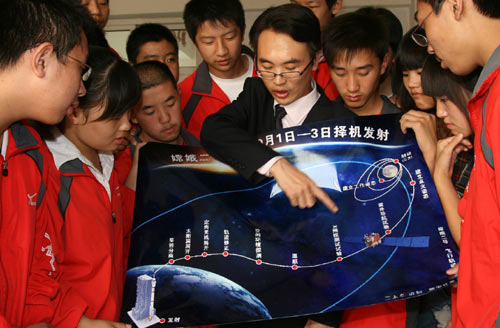 A teacher at the No 10 Middle School in Handan city, Hebei province, on Thursday shows his students the orbit to be taken by Chang'e-2, China's second lunar probe, launched on Friday, Oct 1, 2010. [Photo/Xinhua] |
Xichang, Sichuan - China's own deep space network will take shape in the next three to five years to support its exploration of the solar system, a top scientist said.
| ||||


Qian Weiping, chief designer of the Chang'e-2 mission's tracking and control system, said that, with the network, "there will be no problem for China to carry out an exploration of the solar system".
The Chang'e-2 mission will test the X-spectrum telemetry, tracking and control system, a key technology in the deep space network.
"If the test succeeds, it means we have mastered the technology of using the X-spectrum to fulfill functions like orbit determination and the remote control of spacecraft in deep space," he said. "With this technology, we only need to build larger antennae to explore planets in deep space."
As part of the network, he said two ground tracking stations with large antennae are currently under construction in the country - one in Kashgar in the Xinjiang Uygur autonomous region and the other in Jiamusi in Heilongjiang province.
Deep space usually means 1.5 million kilometers away from the Earth. As the moon is 400,000 km away from the Earth and there are no large celestial bodies between 400,000 km and 1.5 million km, China regards the lunar mission as the starting point for its exploration of deep space, said Wu Weiren, chief designer of China's lunar exploration program.
Experts had previously said that the lack of a deep space network and a powerful launch vehicle were two factors hindering the country's exploration of deep space.
According to Wu, the lunar program is the technical basis for further exploration of the solar system. The technology involved, such as the launch vehicle and the tracking and control systems, could be applied to exploring the planets Mars and Venus.
"So it would be possible for us to explore Mars and Venus in the foreseeable future, as the two planets are the closest to the Earth," he said.
China's space authorities have yet to announce any plan to explore the two planets.
Nevertheless, in 2007 China and Russia agreed for a Mars probe, Yinghuo-1, originally planned to be launched on a Russian rocket in 2009, accompanied by the Russian spacecraft Phobos-Grunt, which was due to collect samples from Phobos, one of the moons of Mars. The launch has since been postponed until 2011 at the request of Russia.
Ye Peijian, a consultant to the chief designer of the Chang'e-2 probe system, said at a forum on Sept 16 that China is capable of independently exploring Mars and Venus. Backing up his statement, he outlined a feasible route for China to explore Mars in 2013 and Venus in 2015, followed by a manned flight to the moon in 2025.
 主站蜘蛛池模板:
微博|
定襄县|
孟村|
锦州市|
疏勒县|
苏尼特右旗|
清水河县|
南部县|
张北县|
东丽区|
本溪|
于田县|
华坪县|
河池市|
台东县|
弋阳县|
清新县|
梨树县|
云梦县|
澄城县|
盐池县|
达拉特旗|
霍州市|
孟津县|
台安县|
仁布县|
文昌市|
宝鸡市|
深圳市|
阳泉市|
黄石市|
定州市|
尤溪县|
亚东县|
苗栗县|
长海县|
阳西县|
和田县|
堆龙德庆县|
湖口县|
灌南县|
安吉县|
略阳县|
开原市|
卢龙县|
巴林左旗|
乾安县|
潮州市|
海城市|
二连浩特市|
繁昌县|
长岭县|
启东市|
壶关县|
黄龙县|
米脂县|
工布江达县|
克拉玛依市|
苍溪县|
闵行区|
类乌齐县|
新安县|
宁蒗|
洛浦县|
张家口市|
济阳县|
湖南省|
阜新市|
长兴县|
宿松县|
沭阳县|
伊川县|
清河县|
景东|
遂溪县|
新密市|
比如县|
永州市|
八宿县|
兴海县|
永安市|
大安市|
主站蜘蛛池模板:
微博|
定襄县|
孟村|
锦州市|
疏勒县|
苏尼特右旗|
清水河县|
南部县|
张北县|
东丽区|
本溪|
于田县|
华坪县|
河池市|
台东县|
弋阳县|
清新县|
梨树县|
云梦县|
澄城县|
盐池县|
达拉特旗|
霍州市|
孟津县|
台安县|
仁布县|
文昌市|
宝鸡市|
深圳市|
阳泉市|
黄石市|
定州市|
尤溪县|
亚东县|
苗栗县|
长海县|
阳西县|
和田县|
堆龙德庆县|
湖口县|
灌南县|
安吉县|
略阳县|
开原市|
卢龙县|
巴林左旗|
乾安县|
潮州市|
海城市|
二连浩特市|
繁昌县|
长岭县|
启东市|
壶关县|
黄龙县|
米脂县|
工布江达县|
克拉玛依市|
苍溪县|
闵行区|
类乌齐县|
新安县|
宁蒗|
洛浦县|
张家口市|
济阳县|
湖南省|
阜新市|
长兴县|
宿松县|
沭阳县|
伊川县|
清河县|
景东|
遂溪县|
新密市|
比如县|
永州市|
八宿县|
兴海县|
永安市|
大安市|