Top News
China powers up nuke generators
By Xiao Wan (China Daily)
Updated: 2010-04-13 07:24
 |
Large Medium Small |
More reactors being built to reduce dependence on coal
Beijing - China plans to increase its nuclear power capacity by as much as 800 percent by 2020, helping it to achieve its environmental goals by reducing its dependence on coal.
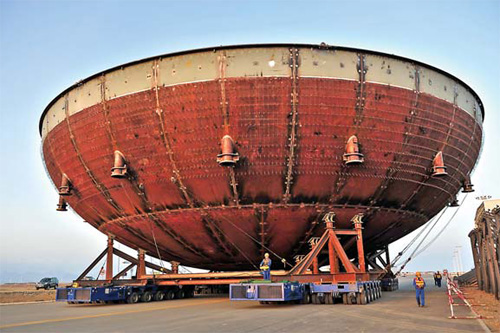 The construction site of the Haiyang Nuclear Power Station in East China’s Shandong province on Friday. [Xinhua] |
Currently, China has 11 nuclear reactors in operation, supplying 9.1 gigawatts (gW) of power, or about one percent of the country's electricity.
Another 28 nuclear reactors have been approved, of which 20 are under construction, Sun Youqi, vice-president of China National Nuclear Corp, said in March.


China plans to increase its nuclear power capacity to 70-80 gW by 2020, which will account for 8 percent of the country's total power capacity, Huang Li, an official with the National Nuclear Administration, told the 10th China International Petroleum & Petrochemical Technology and Equipment Exhibition in Beijing in March.
Given the rapid development of the industry, these figures might be conservative, she added.
Previously, China had planned to increase its nuclear capacity to 40 gW by 2020, which would account for 4 percent of its total power capacity.
"As a country which relies on coal for about 70 percent of its energy consumption, China has accelerated the development of its nuclear power industry. This is in accordance with the country's move to build an environmentally-friendly economy," explained Lin Boqiang, a professor at Xiamen University.
Coal-fired power plants are a major source of China's carbon emissions. The use of more nuclear energy can help the country achieve its goal of reducing carbon dependence as a percentage of its gross domestic product by 40 to 45 percent by 2020, Lin said.
All of the nuclear reactors now under construction are in China's more economically developed coastal areas. In addition, many inland provinces are also planning to develop nuclear projects.
The first batch of inland nuclear power plants will include the Taohuajiang nuclear project in Hunan province, the Xianning project in Hubei province and the Pengze project in Jiangxi province. At least one of these three projects is expected to begin construction this year.
Six of the nuclear reactors now under construction will be among the first in the world to use third-generation technology. Four of them will use AP1000 technology from US-based Westinghouse and two will use European Pressurized Reactor technology from Areva, a French company.
Located in Zhejiang, Shandong and Guangdong provinces, the third generation plants will have higher safety standards and longer life expectancy.
In order to promote the use of third-generation technology, China in 2007 established the State Nuclear Power Technology Corp (SNPTC), which will oversee the use of advanced foreign technology and coordinate indigenous development.
Construction of the company's four third-generation reactors is going smoothly, SNPTC Chairman Wang Binghua told China Daily. The first reactor, which is located at Sanmen in Zhejiang province, is expected to start generation in 2013.
Indigenous development is also underway. SNPTC and China Huaneng Group recently inaugurated a joint venture to build and operate a demonstration project, which uses a technology called CAP1400.
The project is located in Weihai, Shandong province. The CAP1400 technology is based on Westinghouse's AP1000 technology. Construction of the project is expected to start in April 2013, with power generation scheduled for 2017.
China Daily