China needs more public diplomacy, Zhao says
By Zhang Haizhou (China Daily)
Updated: 2010-03-11 07:54

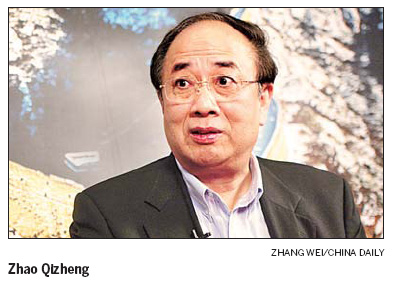
BEIJING: China needs a bigger public diplomacy campaign to better present the country to the world, said Zhao Qizheng, spokesman for the Chinese People's Political Consultative Conference (CPPCC), on Monday.
In an exclusive interview with China Daily in the Great Hall of the People, the chairman of the foreign affairs committee of the National Committee of CPPCC, said governmental diplomacy and public diplomacy are mutually complementary.


President Hu Jintao's speech to Yale University students in 2006 is a typical example of China's public diplomacy, which has existed for many years, Zhao said,
In 2001, the Boao Forum for Asia (BFA), a non-governmental international organization, was inaugurated, committed to promoting regional economic integration and bringing Asian countries even closer to development goals.
Last year, the BFA, based in Hainan province, attracted a record 1,700 participants, most of whom were leaders in government, business and academia in Asia.
Compared to governmental diplomacy, public diplomacy can better "explain" China's national condition and policies, and "present" the country to the world, Zhao said.
"In such communications, participants from both sides don't need to restrict their talks to diplomatic rhetoric, as neither is there to sign some treaty or make some announcement for their countries," he said. Participants of public diplomacy can discuss a wider range of issues with more active and straightforward expressions, he said.
Internationally, public diplomacy was first used in 1965 by Edmund Gullion, a career American diplomat, according to the United States Information Agency Alumni Association. It refers to the spreading of knowledge about a country's foreign policy via communication with foreign public audiences.
Though public diplomacy has existed in China for a long time, "the campaign is not big enough", Zhao said, when asked what the main difficulty is.
Most Chinese who currently do public diplomacy are those with rich work experience in international trade and communication, leaders of non-Communist parties, heads of China's multinational corporations, and research fellows of international affairs in Chinese universities, he said.
But during this year's two sessions of the CPPCC and the National People's Congress, Zhao has seen momentum to facilitate the country's public diplomacy.
The foreign affairs committee of the CPPCC on March 1, just two days before the annual session opened, published a new journal, Public Diplomacy Quarterly. As its editor-in-chief, Zhao wrote in the inaugural statement: "The aim and mission of this journal is to facilitate China's public diplomacy."
Foreign Minister Yang Jiechi, at his annual news conference on Monday, said Chinese diplomats are encouraged to go to the public, especially universities and media, this year.
Chen Haosu, a CPPCC member and president of the Chinese People's Association for Friendship with Foreign Countries, said the upcoming Shanghai Expo would be a "very good arena" for China's public diplomacy.
The Expo is expected to draw a record 70 million visitors from home and abroad from May 1 to Oct 31. According to the organizing committee, 192 countries and 52 international organizations have confirmed their participation.
"Case," not a "model"
In the same interview, Zhao stressed Beijing doesn't mean to export any "Chinese model", despite the term becoming an international hot issue.
He said it's better to use China "case" than "model" when terming the country's growth path over the past decades.
"Case means a fact. But when you say model, it's more or less like a sample or example. Then others may think China is propagating, or competing with other country's models," he said. "How can other countries emulate the Chinese model directly without adapting it to its own national condition?"
Following the country's continuous economic boom, there has been an upsurge in the international community to discuss a "Chinese model", or similar terms, over the past several years.
In 2004, Joshua Cooper Ramo, a former foreign editor of Time magazine, even coined the term "Beijing Consensus", meant to describe alternative plans for economic development in the underdeveloped world, so-named because China is seen as a potential model for such actions.
Francis Fukuyama, a senior fellow in international relations at Washington's Johns Hopkins University, in 2008 described "Beijing Consensus" as a mixture of "authoritarian government with market economics".
Though it's popular in many developing countries, "China's development model works well only in those parts of East Asia that share certain traditional Chinese culture values," Fukuyama wrote in The Washington Post.
David Shambaugh, a China studies expert at George Washington University, pointed out "some individual elements of China's development experience are unique, and they do not constitute a comprehensive and coherent 'model,' nor are they easily transferred abroad".
China's model is unique in that it flexibly adapts to elements imported from abroad and grafts those elements on to domestic roots in all fields, producing a unique hybrid and eclectic system, Shambaugh said. This is China's real "model," he said.
Zhao has his own definition of the "China model": "It is a summary of China's social development ideas, policies, practices, achievements and fallacies since 60 years ago, when China was founded, and especially in last 30 years since the reform and opening-up started."
But China "case" is better, he stressed, as it is still an evolving concept that may be clearer by the mid-21st Century.