Web Exclusive
Rent in peace at China's cemeteries
By Zuo Likun (chinadaily.com.cn)
Updated: 2011-04-02 07:11
 |
Large Medium Small |
|
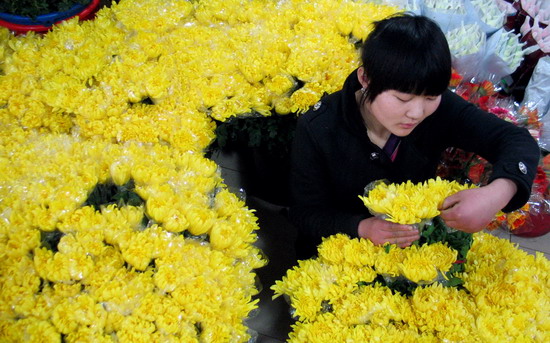 A woman tidies chrysanthemums, commonly used for mourning in China, at a flower fair in Jinan, capital of East China's Shandong province, on Monday, March 28, 2011, about a week before Tomb-sweeping Day. [Photo/Xinhua] |
* No eternal rest; burial plots come with 20-year renewal fees
* Old habits die hard as China labors to promote eco-burial
* Greed lurks in the graveyard, coveting the death industry
BEIJING - When the heavens send for the soul, the departure is for good. But as for the cinerary urns planted in China's urban cemeteries, the peace lasts no more than 20 years. For anything longer, relatives of the deceased will have to keep paying extra fees.
In accordance with government plans, China's urban cemeteries belong to the service industry and are run as operational businesses. Only those in rural areas are run by public welfare, offering free burial plots.
|
 |
In the eastern coastal resort Qingdao, the Centenarian Park cemetery put up a list of questions and answers on its website, in a matter-of-fact way explaining how to renew a lost plot license and when additional fee would be due. A cemetery in Southwest China's metropolitan Chengdu was even more business-like. According to media reports, the cemetery put up a public notice in a local newspaper and spread out the names of 127 souls sleeping in its graveyard whose "management expenses" had come overdue.
The title couldn't be blunter, "Defaulting Customer List."
The timing of such awkward notices has only invited more discomfort as the traditional Tomb-sweeping Day, falling on April 5 this year, was barely days away. The special occasion, set for Chinese to visit cemeteries and pray for their ancestors, was minted an official holiday by the Chinese government five years ago in a bid to revive the sagging heritage of traditional family values.
So, what if an august family rite turns into a sudden refusal at the graveyard?
Both cemeteries stopped short of detailing what the consequence would be if a payment was delayed. In fact, the Qingdao graveyard's Q&A was so sketchy that, when asked how much the additional fee would be, it simply said, "No directive from higher-ups yet."
Stunned relatives soon found another implausible truth. The policy of additional fee collection is hardly new. As a matter of fact, official rules have been around for so long that, at first blush, it is the public's lack of knowledge that seems to be out of place.
|
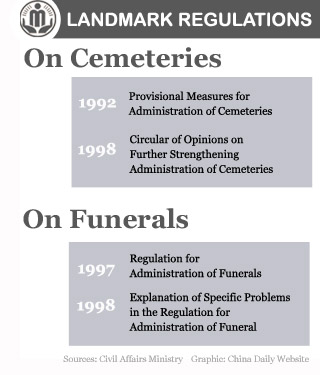 |
Thus, in practice, buyers initially have to ante up the plot expense as well as the first 20 years' cemetery fees.
The rationality of such a cycle span presumes that "20 years generally covers one generation," said Yang Genlai, professor at Beijing Social Administration Vocational College, who wrote dozens of books on China's funeral industry.
It's supposed in the rules that outdated tombs will gradually make room for new ones, especially in a hugely populous country like China where urban land is limited and precious, Yang explained.
Actually, China is not alone in introducing such a practice. In Germany, where graveyard usage usually lasts 20 to 30 years, untended tombs left behind by deceased relatives will be gently moved out for new arrivals, and then mass transferred to a new place where a monument inscribes the special purpose.
But here is the problem: So far no Chinese rules have made clear how to enforce such a highly sensitive recycling measure. As a result, the original plan of "one usage cycle of 20 years" to limit land occupation has in practice soured into "one payment cycle of 20 years" to create income, Yang said.
Although it should be noted that, at a time when many of the tombs in China's cities either have already reached or are about to reach their 20-year limit, most cemeteries have chosen to keep doing maintenance, either out of legal concerns or in consideration of social responsibilities.
"They can't possibly dump the tombs," Yang said.