Economy
China raises banks' required reserve ratio
(Xinhua)
Updated: 2011-04-17 17:45
 |
Large Medium Small |
|
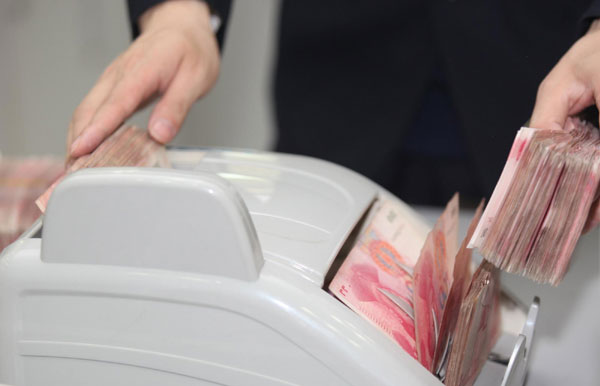 A staff member of Agricultural Bank of China conducts business in Kunming, Yunnan province in this file picture taken on April 6, 2010. [Photo/Xinhua] |
BEIJING - China's central bank announced Sunday that it would raise the required reserve ratio of the country's lenders by 50 basis points for the fourth time this year, in the latest effort to curb stubbornly high inflation.
| ||||


The move would raise the required reserve ratio for China's large financial institutions to a record high of 20.5 percent, which means they have to lock up 20.5 percent of their deposits as reserves.
The tightening measure has been widely expected after the government said Friday that the consumer price index (CPI), a main gauge of inflation, had reached a 32-month high of 5.4 percent in March.
Alongside reserve hikes, China has also raised the benchmark interest rates four times since last October to battle persistent inflation.
The increase was in line with market expectations because outstanding foreign exchange funds picked up in March and massive bills and repurchase agreements will mature in April, said Lian Ping, a chief economist with the Bank of Communications.
"Open market operations are not enough to absorb liquidity and the hike in the required reserve ratio will freeze about 350 billion yuan ($53.6 billion) again," he said.
Government data showed that China's funds outstanding for foreign exchange increased by 407.9 billion yuan in March and by more than 1.1 trillion yuan in the first quarter of this year. Further, the market will see 911 billion yuan of central bills mature in April.
The central bank reported on Thursday that China's foreign-exchange reserves surged to $3 trillion by the end of March and Chinese banks lent 679.4 billion yuan of loans in March, up from 535.6 billion yuan in February.
Moreover, the broad money supply (M2), which covers cash in circulation and all deposits, increased 16.6 percent year on year as of the end of March, 0.9 percentage points higher than by the end of February. The increase has exceeded the government's target ceiling of 16 percent for 2011 set down in the government work report released in March.
"The current cash in the economy is still ample, which prompted the hike," said Zhao Xijun, a finance professor at Renmin University of China.
The continuous tightening of the central bank seeks to remove monetary factors that are related to inflation, said Yin Jianfeng, a researcher with the Chinese Academy of Social Sciences, a government think tank.
The view echoed that of the PBOC governor Zhou Xiaochuan, who also said Saturday that "China will continue tightening monetary policy for some time" on the sidelines of the Boao Forum for Asia in south China's Hainan Province. He said there is not an absolute ceiling for the level of banks' reserve requirements.
Premier Wen Jiabao said earlier this month, during an inspection tour in the eastern Zhejiang Province, that keeping the overall price levels stable was the top priority for current macro regulation.
The government would use tools, including open-market operation, required reserve ratio, interest rates, and the exchange rate to eliminate the monetary basis for inflation, he said.
Also, the central bank again chose to increase the required reserve ratio instead of interest rates based upon concerns of an inflow of speculative foreign money into China, said Liu Yuanchun, professor with Renmin University.
China's economy expanded at 9.7 percent in the first quarter of this year, the National Bureau of Statistics said Friday.
Li Xunlei, a chief economist with the Guotai Junan Securities, said the liquidity in the economy is still excessive and China is likely to adopt more tightening measures in the future, including hikes of interest rates and the required reserve ratio.