Foreign and Military Affairs
SCO members brace for terrorist threat
By Wang Huazhong (China Daily)
Updated: 2011-05-09 07:22
 |
Large Medium Small |
|
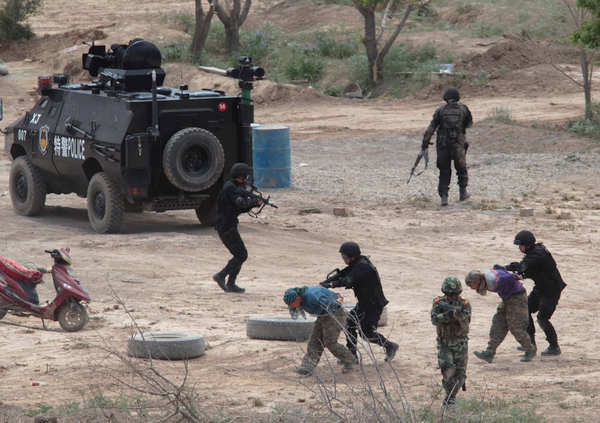 Special forces practice battling terrorists during an exercise in which they rehearsed storming a camp. The anti-terror drill was jointly conducted by Shanghai Cooperation Organization members in Kashgar, the Xinjiang Uygur autonomous region, on Friday.?[Photo/Xinhua] |
BEIJING - China, Kyrgyzstan and Tajikistan have held a joint counterterrorism drill along the border near Kashgar, in Northwest China's Xinjiang Uygur autonomous region, at a time when there are indications extreme separatists are re-entering China from Central Asia.


The drill was the second joint exercise that China's law enforcement bodies participated in under the SCO framework. The anti-terror exercise consisted of three parts - decision-making and command with an exchange of intelligence, practice in freeing abducted people by force and a cleanup operation.
The scenario called on the three countries to coordinate a manhunt for separatists who had set up a training camp on the Chinese side of the border, according to the Ministry of Public Security.
Pictures showed special police units as well as armored vehicles and helicopters were deployed to intercept a tourist bus that had supposedly been hijacked by terrorists. The units were charged with freeing the abducted passengers.
The vice-minister said the drill demonstrated the countries' determination to crack down on the "three forces" - namely terrorism, separatism and extremism - and play an active role in safeguarding stability.
A spokesman for the National Counter-terrorism Office of China said that while the region is generally stable, the "three forces" have been colluding with "East Turkistan" terrorist forces both in and out of China to involve in cross-border activities in recent years.
They wait for opportune moments to start up disturbances that have remained a common threat to SCO member states, the spokesman said when describing the reason why Xinjiang was chosen for the exercise.
In July 2009, nearly 200 people were killed and 1,700 injured in Urumqi, the capital of the autonomous region, in violence believed to have been masterminded by a separatist group based overseas.
However, experts also said the main separatist force in Xinjiang and the major terrorist force in China - the East Turkistan Islamic Movement (ETIM) - has lost much of its vitality because of crackdowns.
"The group remains but with not too many members in China," said Yang Shu, a leading Chinese anti-terrorism expert at Lanzhou University. He said the large-scale joint drill had nothing to do with the recent death of al-Qaeda leader, Osama bin Laden, whose organization reportedly helped train ETIM members in Afghanistan.
"Terrorism in Xinjiang is becoming less organized but involves individual or family-based activities that have little international support," he said.
In August 2006, law enforcement bodies and special forces from China and Kazakhstan conducted an anti-terror drill, Tianshan-I (2006), in Xinjiang.
Founded in Shanghai in 2001, the SCO comprises six member countries - China, Kazakhstan, Kyrgyzstan, Russia, Tajikistan and Uzbekistan.