Society
Chickens fed powder to add weight
By Zhou Wenting (China Daily)
Updated: 2011-05-10 07:46
 |
Large Medium Small |
|
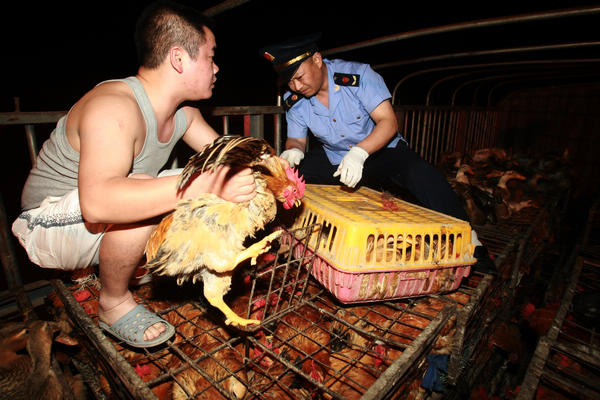 Workers with the commerce authority in Chongqing check the chickens on a truck on May 8, 2011. [Photo/China Daily] |
CHONGQING - Traders are believed to have filled nearly 1,000 live chickens with mineral powder to increase their weights, adding new spice to the country's list of food scandals.
The chickens were found in Southwest China's Chongqing municipality during a raid jointly conducted by the local administration for industry and commerce, the public security bureau and the local highway law enforcement authority. They were being transported from Guizhou province on early Sunday morning, China News Service reported.


Since April 18, the administration has investigated several poultry markets, collecting samples for testing.
The samples taken from the chicken's intestines were found to contain a considerable amount of barium sulfate, commonly known as barite powder.
And there were 110 milligrams of magnesium and 1.1 milligrams of barium for each kilogram of the chickens that were tested.
On Saturday night, law enforcement officers stopped two trucks carrying suspected chickens at the toll stations of the Chongqing-Guizhou highway. The officers noticed that the chickens' craws were abnormally plump and asked the drivers to hand over several of the chickens for testing, the report said.
The tests revealed gray powder in the birds' craws.
The owners of the livestock confessed to the inspectors that each of the birds had been fed from 300 to 400 grams of barite powder. The chickens had been purchased from Zunyi, a city in Guizhou province.
The chickens were seized, and the case is under further investigation.
Barite powder is mostly used to add weight to oil drilling mud, to deflect X-rays in medical science, as a material in the brakes of vehicles and in high-quality paints.
Regular reports of incidents involving food safety have caused much concern for the Chinese.
"I heard of someone growing bean sprouts and garlic in their balconies at home," said Tan Xuguang, a 30-year-old public servant in Chongqing. "Now it's time to raise chickens."
"The city's authorities have uncovered a series of food safety incidents, some of them having to do with poisoned pepper or water-injected beef," said Ma Xiaojun, a 26-year-old local programmer. "We must take time to rethink why these unscrupulous businesses appear endlessly."
While China is working on its largest crackdown on food safety hazards, the country's food safety authority is also making efforts to better inform the public about food safety.
Before working in the food industry, a person must be trained for a such job, said the executive office of the food safety commission under the State Council, China's Cabinet, in a five-year plan (2011-2015) guiding the country's work to teach the public about food safety.
Employers and main employees are being asked to undergo intensive training. They should take no fewer than 40 hours a year of classes on the laws, regulations and ethics pertaining to food safety, according to the plan. Food safety inspectors are also required to undergo professional training for no fewer than 40 hours a year.
Food safety experts welcomed the program but doubted it could be implemented.
"Who will be responsible for calculating the time spent in the training?" asked Sang Liwei, a food-safety lawyer in Beijing and a representative of the Global Food Safety Forum, a non-governmental organization.
"What happens if businesses find it's costly to invite experts and to provide training during work times?"
Sang further suggested that giving timely warnings about food safety is as important as spreading information about food safety.
"Local food safety committees can cooperate with mobile-phone services to promulgate warnings about food safety," Sang said. "Customers can then avoid eating questionable foods."
Wang Huazhong contributed to this story.