Society
Cultural relics discovered under sea
By Zhang Zixuan (China Daily)
Updated: 2011-05-17 07:44
 |
Large Medium Small |
 |
|
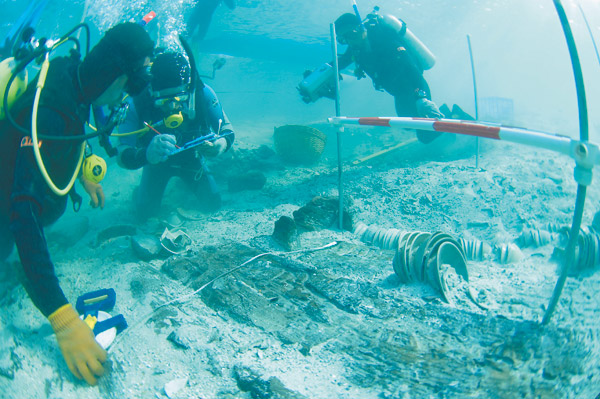
Three archaeologists check porcelain wares at the Huaguangjiao No 1 site near Xisha in the South China Sea in 2007. The shipwreck is believed to date to the Song Dynasty (960-1279). Provided to China Daily |
At a depth of 27 meters, archaeological diver Ruan Youhao found the baseline he laid along a shipwreck last July. He took a tool from his diving partner to mark several cabins in the beam of an underwater flashlight.
A few minutes later, Ruan looked at his submersion watch and gave a "go up" sign to his partner. The two divers had hit their limit for non-decompression diving. The divers finished their 25-minute dive at 9:35 am on April 27.
It was the first day of the fourth excavation of Nan'ao No 1, a sunken merchant vessel of the Ming Dynasty (1368-1644) that was found in 2007 in the South China Sea near Nan'ao Island, Guangdong province, after local fisherman netted porcelain ware.
By the time the project ends, probably in mid-July, the underwater archaeology team and the Guangzhou Salvage Bureau are expected to confirm the size of the shipwreck and the salvage of its cultural relics.
"The shipwreck looks exactly the same as last year, with no trace of illegal salvage," Ruan said, taking off his mask and wiping away the sweat that had formed quickly under his 5-millimeter-thick diving suit and from the weight of two 40-kg oxygen tanks on his back.
With China's 3 million square kilometers of territorial seas, 18,000 km of coastline and countless lakes and rivers, its richest cultural heritage may lie in the deep, like exhibits in a giant underwater museum.
A rude awakening
"Although facing many difficulties, China's underwater archaeology and cultural heritage protection has made significant progress throughout the last two decades," said Shan Jixiang, director of the State Administration of Cultural Heritage.
In May 1984, British marine explorer Michael Hatcher discovered the wreck of the Dutch ship Geldermalsen, which sank in the South China Sea in 1751, and removed 150,000 Chinese porcelain artifacts. Those relics were sold for $20 million at a Christie's auction in Amsterdam in 1986.
The sale forcibly wakened China's protection of underwater cultural heritage. The country's first underwater archaeology organization, the Underwater Archaeology Research Center, was founded at the end of 1987 in the National Museum of Chinese History, now the National Museum of China.
Since 1989 the center has trained more than 90 underwater archaeology divers in five groups. About half are still active underwater, gathering to dive on special projects when needed and working as archaeologists the rest of their time, mostly for museums and cultural relics bureaus of coastal provinces. Quite a few of the other half are in managerial positions related to underwater cultural heritage protection.
Ruan, for example, was in the third batch of archaeology divers, trained in 2004. He is 37, has 10 types of diving certificates and has participated in all underwater archaeology projects off southeastern China. He also is director of the Zhangzhou Administration Office of Cultural Relics.
Visitors can watch
On Dec 22, 2007, what is thought to be the oldest and largest shipwreck ever found in China was hauled - with its surrounding silt and water - from the South China Sea bed where it had rested for more than 800 years. The 5,000-ton Nanhai No 1, dating to the Song Dynasty (960-1279), had been found in 1987 and was loaded with 60,000 to 80,000 relics.
Six days after it was lifted from the sea, it was moved to the specially built Crystal Palace at Guangdong Marine Silk Road Museum in Yangjiang, Guangdong province. Now the ship lies in a glass pool with temperature and pressure controls to replicate its sea environment. Visitors can watch the excavation, which is expected to last about 10 years.
"The integral salvage, relocation, preservation and on-site excavation display of Nanhai No 1 is an original and unique creation," said Shan, the cultural heritage administrator. All of this will provide precious experience for future underwater archaeologists, he said.
Cultural heritage protection on land gets more attention, which does not sit well with Liu Shuguang, dean of the Chinese Academy of Cultural Heritage and director of the National Conservation Center for Underwater Cultural Heritage.
"Two scoops will be sufficient for land archaeology sometimes," Liu said, "but underwater archaeology requires huge amounts of money and the most advanced technology."
An underwater archaeology project can cost up to tens of millions, he said. Just renting the workboat for the excavation of Nan'ao No 1 costs 80,000 yuan ($12,310) every day. "Underwater excavation is significantly affected by water temperature and visibility, and it's very dangerous," Liu said.
He also said the law on underwater cultural heritage protection is less comprehensive than that for land. For example, many large-scale underwater construction projects are launched without prior review for archaeology concerns.
The third national cultural heritage census, in 2009, determined about 70 ancient shipwrecks lie in China's ocean territory, but the National Conservation Center for Underwater Cultural Heritage estimates there are 2,000 or more in just the South China Sea.