Profiles
Going back to the source
By Xu Lin (China Daily)
Updated: 2011-06-23 08:32
 |
Large Medium Small |
|
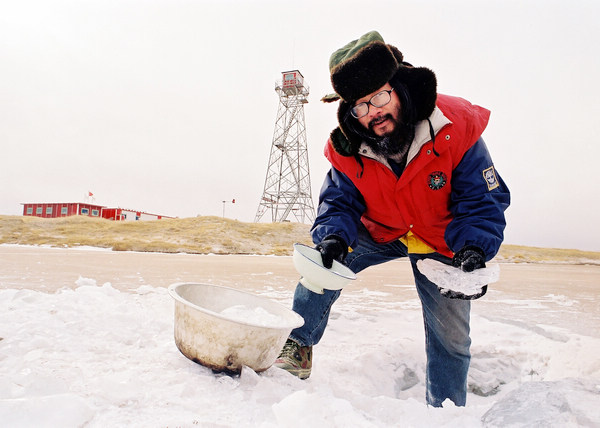 Environmentalist Yang Xin does research near a glacier at the source of the Yangtze River, where for 16 years he has been dedicated to environmental protection. [Provided to China Daily] |
BEIJING - Not many people would revel in being called a garbage collector.
Yang Xin prefers it.
The 48-year-old photographer and adventurer with his trademark black and white beard and shoulder-length hair is also an environmentalist dedicated to protecting the source of the Yangtze River.
And he likes his new moniker, "garbage cleaner at the source of the Yangtze River".
Yang, founder of Green River, one of the country's biggest non-governmental organizations dedicated to protecting the country's major rivers, started to pick up after others this year.
The Yangtze River originates from glaciers in the Tangula Mountains on the Qinghai-Tibet Plateau. Covering 158,400 square kilometers, the area consists of snow-covered mountains, glaciers, wetlands and deserts at an average altitude of 5,000 meters. Most local residents are ethnic Tibetans and Mongolians.
Garbage was rarely seen in the area about 20 years ago, Yang said, as local nomadic people led traditional self-sufficient lives, living in tents and burning yak dung. Thanks to increasingly convenient transportation, they've started to use modern products packed in plastic, which can't degrade naturally.
"They don't have a waste disposal system and just throw rubbish away like before. So tons of garbage are left on the grasslands and river ways," said Yang, born and raised in Chengdu, capital of Sichuan province.
"It's important to teach the herders to classify garbage and encourage them to bring their rubbish to the station. In return, the station will give them food, batteries and drinks."
In September, the Yangtze River Source Environment Protection Station will open in Tangula town, Qinghai province. It cost more than 1 million yuan ($155,000) with funds from different foundations and enterprises.
The aim of the station is to dispose of garbage, mainly domestic waste, such as plastic bottles, batteries and disposable lunch boxes left by tourists and local herders.
When garbage reaches the station, volunteers will sterilize, classify and pack it.
They will then ask passing truck drivers or travelers to take it to cities where proper garbage disposal is available.
The station will also help local residents to promote tourism products, such as Tibetan-style accessories and homemade yogurt.
Yang first came to the source of the Yangtze River in 1986, aiming to become one of the first to float down the whole length of the river, competing with American adventurer Ken Warren. The then 23-year-old Yang joined one of the three floating teams as teammate and photographer.
Warren quit halfway due to the strong and rapid currents. Yang survived after 175 days, witnessing the deaths of 10 teammates.
During his time on the river he also grew a long beard and long hair, which he has since kept.
"My beard keeps out the wind and rain, and my hair blocks the sun," said the adventurer, half jokingly.
After a few visits to the source river in the early 1990s, he found that the grasslands were turning into deserts and the number of wild animals had decreased compared to what he had found in the 1980s.
The death of Sonam Dhargye during a gun battle with 18 poachers carrying some 2,000 Tibetan antelope skins in November 1994 gave him the final push onto the track of environmental protection.
"I went to his house and bowed three times. By then I felt I should do something after traveling all over the source area of the river. The more I knew about it, the more I loved it and wanted to protect it," Yang said.
He founded the NGO Green River the next year, with the aim of protecting the upper reaches of the Yangtze River, organizing scientific expeditions and raising public awareness of environmental protection. He wrote his first book, Soul of the Yangtze River, which told of his adventures around the origin of the Yangtze River, and raised 200,000 yuan for the organization.
The group has more than 300 volunteers from different professions, including police, civil servants, journalists and university teachers.
In 1997, Yang and the group founded the Sonam Dhargye Nature Preservation Station in the Hoh Xil Nature Reserve, in memory of the anti-poaching hero who sacrificed his life to protect Tibetan antelopes.
Volunteers in the station now help clear a corridor for tens of thousands of Tibetan antelopes across the Qinghai-Tibet Highway between June and August when the animals migrate to propagate.
"When I first went to Beijing in 1995, few people knew about Hoh Xil or the Tibetan antelopes. After years of effort, the public are aware of the importance of protecting them," said Yang proudly.
Yang is proud that the station has not only gained recognition from the public, but also from the government. In 2003, the Hoh Xil Nature Reserve Administration took over the station and has since sustained its functioning.
"It's a good pattern that we, an NGO, initiated a program that's worth action, and then the government takes it over, either just the program itself or the idea behind it, and expand its influence," Yang said.
"I wish the same story will happen to our new station. The station is only able to clean up about 10,000 square kilometers of the source and upper reaches of the Yangtze River. We hope, with its success, the government might take over and make it happen throughout the river."