Society
Chinese parents turn to US summer camps
By Emily Cheng (China Daily)
Updated: 2011-06-26 07:42
 |
Large Medium Small |
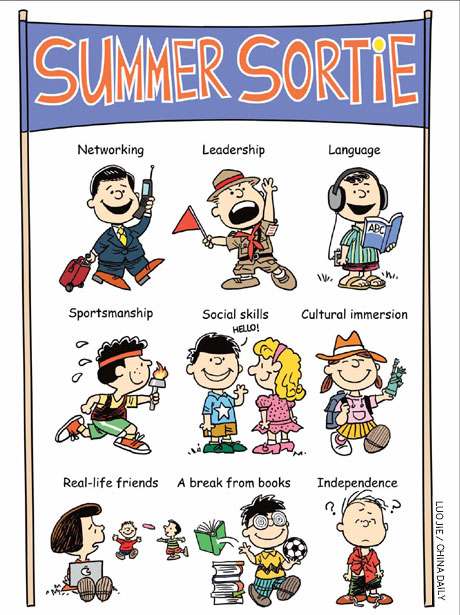
Summer camps in the US are the latest strategy for Chinese parents plotting a better future for their children. This year, more than 60,000 children will fly off for an immersion program that may, or may not, test their suitability for college abroad. Emily Cheng explores the issues.
For around $5,000 or roughly 32,500 yuan, kids are flying across the Pacific for an opportunity to play sports with US students, attend summer classes, and most importantly, speak English. They will be joining American summer camps, a mid-year ritual for many children in the United States, but still something for the privileged few in China. After two consecutive years at China-based summer camps, Lou Yong's 13-year-old son, Tim, will take the experience to the next level by spending four weeks in Baltimore, USA. "I hope to enrich his summer vacation and let him experience different activities which he is interested in, but are not available at the local schools," says Yong.
"American summer camps are a good complement to Chinese-style education. Chinese-style education focuses on academic achievement, while American-style camps allow the students to improve their overall abilities. If the child wants to study abroad in future, an American camp can help them make some adjustments beforehand," she says.
Alex Abraham, the general manager of Blue Sky Study, a Shanghai-based overseas education consultancy, also sees the camps as a way of easing a child into a culture that he or she will most likely be a part of when they join the other Chinese undergraduates in the US.
The number of students going abroad does not appear to be dropping soon so, for those who can afford it, summer camps give them a head-start.
"For parents who would one day like their child to study in the US full-time, it is a great way to introduce a foreign country to a young student," Abraham says.
As more parents plot overseas ambitions for their children, a camp itinerary that includes excursions to famous universities is popular among fee-paying parents.
Joel Lavenson, director of the Maine Golf and Tennis Academy in the US, noticed the enthusiasm among Chinese families for their children to get into American schools and introduced college visits into his Chinese-American summer camps.
"The Chinese parents look at the camps as part of their educational portfolio as a world citizen," says Lavenson.
At another US-based organization, the American Chinese Academy (ACA), the intake of Chinese students has tripled this year.
Joyce Zhao, CEO of ACA, suspects that the increased interest correlates to the parental need for their children to maximize their potential.
"It is a tradition for Chinese parents to 'sacrifice' or pay high costs for their children's education, expecting their children to be successful one day," she notes.
Zhao categorizes parents who send their kids overseas as a "wise" group which understands the importance of travel experiences for the youngster's personal growth. Nonetheless, she still thinks that there's an undeniable academic-focus in their intentions.
"The parents who send their children to overseas summer camps are still traditional in that they don't want the activities to stray too far away from academic learning. Therefore, classroom hours are scheduled," says Zhao.
It is this balance between cultural, social, and educational activities at American summer camps that appeals to Chinese parents.
Gao Ruolin, organizer of China Daily's Little Journalist Summer Camp, credits obtaining a good visa record as another major appeal of summer camps abroad.
China Daily's camp offers the usual visits to famous universities and sites but it also appeals to parents who want more specialized activities. As well as visiting the BBC and China Daily's New York and London offices, the aspiring journalists are taught the basics of journalism in an intensive English environment. After taking tests to get into the exclusive camp, students travel to countries including the UK, France, Germany, Switzerland and the States under the guidance of senior journalists from the paper.
It is a program that will appeal to parents like Emily Chan, who intends to eventually send her 6-year-old son, Nathan, to a camp in America "to learn native English and get used to life in the US."
However, putting a kid on a plane to America every year is not a luxury that many can afford. Which is why domestic, American-style summer camps are becoming increasingly attractive for parents like Chan, who sends her son to camps every summer.
Chan believes the camps groom children for their future studying abroad.
While images of a Tiger Mom may arise, the situation is nothing but. Nathan is always excited about the holiday season because he has a say in the camp he wants, "I choose only what he wants to do," Chan says of her son.
This year, Nathan will be attending a sports-oriented summer camp in Beijing.
"From the camp, he will learn values and independence without parents and ayi," she explains.
As more and more parents realize the social and educational benefits of recreational activities, an increasing number of organizations have crowded the market for more cost efficient, China-based summer camps.
Fanghua Jiang jumped on this wagon and started Longfeifei Youth Summer Camp in the summer of 2009.
"I decided that we would adopt an American curriculum supplemented by some Chinese activities, and the camp would be structured and managed in an American style. For example: employing counselors, including enrichment over academic activities and having camp staff recruited from various sources," Jiang elaborates.
As an avid member of the Fudan University Alumni Association, Jiang initially proposed the Shanghai-based camp as a way of connecting domestic and overseas children among alumni. Now it has become much more.
"The children who enroll are typically those who have different interests, who come from a family where parents pay attention to their children's character building," she says.
Carol Peng, director of the International Bilingual Summer Camp in Beijing, also employs an east-meets-west style for her camps.
"American-style summer camps have their appeals and style. The activities are rich as well as educational: various sports, arts, languages, field trips, medical skills and so on. The children can experience the joy of learning English through such creative activities," Peng says.
Improving English in an interactive environment was one of the selling points for Nancy Chen when she first found out about summer camps.
Chen has enrolled her 9-year-old daughter, Mao Ruihan, in the Beijing Playhouse Academy of Performing Arts' (BPAPA) theater camps four times now.
"She has improved her English and acting skills. She is happier, more confident and more courageous. She has also learned more about western culture and interpersonal communication skills. Overall, she has changed a lot, positively," Nancy says.
BPAPA offers bilingual theater camps for Chinese students who are less fluent in English.
The goal is to improve their spoken English. They study in English, follow the directors in English, and at the end of the camp, they are on stage performing in English.
Unlike many summer camps that offer multiple activities, BPAPA's camps focus purely on theater production and performance.
Chris Verrill, executive director of BPAPA, remembers the time when expatriate kids dominated the first camp. Seventy-four percent came from native English-speaking countries, 26 percent from other parts of the world, and none came from China.
Over the years, more Chinese children have been enrolling to learn about theater and improve their English. The most recent camp was composed of 76 percent Chinese, 18 percent English-speaking country kids, and 6 percent from other countries.
"We work hard to maintain the quality of the theater experience for all the children. So if a student is not fluent in English, then we refer them to the Broadway English theatre camp. Even for Broadway English, the student must at least have an intermediate level of English. When it comes to teaching English, our goal is not the basics. We leave the basics to other language schools," Verrill says.
But, at the end of the day, it's not always about learning and classes - it's about knowing that your child is having a good time.
The fun environment provided by summer camps is all Nancy wants for her daughter, "Sending my kid to the camp has little to do with her studying abroad in the future," she says. But it helps.
|
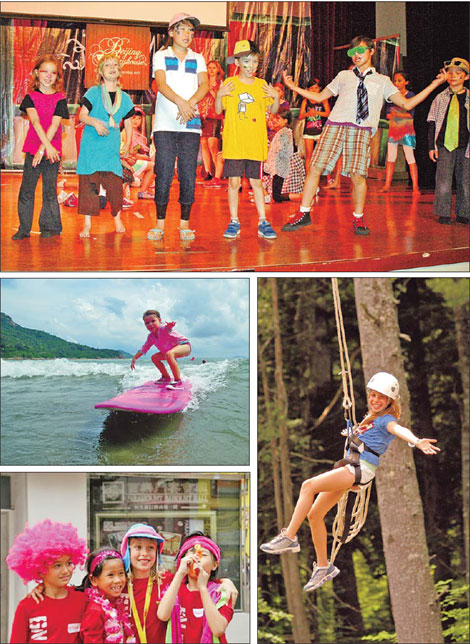
Clockwise from top: At the Beijing Playhouse camp, children stage The Wizard of Oz in English, honing both language and acting skills. Hanging free from a tree during summer camp at Stateside Adventures. Urban Discovery camps provide a fun way to learn about Hong Kong history, culture and heritage. Riding the surf is one of the attractions of the Hong Kong Treasure Island camps on South Lantau's Pui O beach which offers day and overnight camps. Provided to China Daily |
(China Daily 06/26/2011 page1)