Xinhua dictionary updated to reflect social change
Updated: 2011-07-09 21:07
(Xinhua)
|
|||||||||||


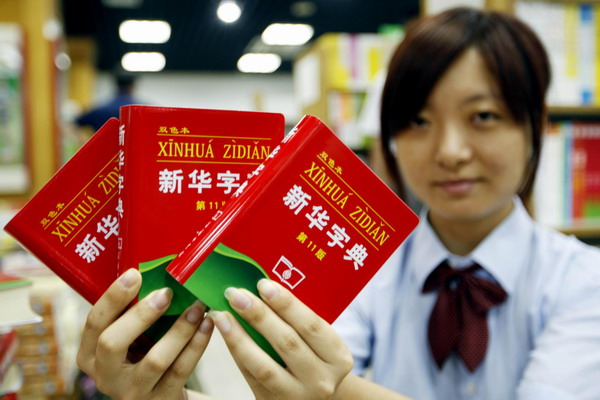
BEIJING - A new edition of the most authoritative Chinese language dictionary, "Xinhua Dictionary," or "New China Dictionary," has been published to include Internet words and reflect such concepts as animal conservation, cross-Strait exchanges and caring for people's livelihoods.
 |
|
A staffer presents latest versions of Xinhua Dictionary at a bookstore in Jinan, East China's Shandong province, July 2, 2011. [Photo/Xinhua] |
This is the 11th edition of the prestigious reference book, which has had a far-reaching influence in learning the Chinese language.
Since 1953 when the first edition of the dictionary was published, more than 400 million copies have been sold, said Zhou Hongbo, deputy editor-in-chief of the Commercial Press, the dictionary's publisher, during an interview. The two "Xinhua" are not related.
"The book has the world's largest number of readers," he said.
The latest edition, unveiled Monday after eight years of compilation, "unprecedentedly" increased its content by about one third, "highlighting social changes over the past decade," he said.
It includes new words emerging during the past few years such as "Xueli Men," or "diploma gate," referring to a scandal of using counterfeit academic degrees to gain jobs or official positions.
The usage was originated from the "Watergate scandal" in the United States in the 1970s. In current Chinese Mandarin, various words can be put ahead of the character "Men" to indicate different scandals.
The character "shai," which originally meant to bask or dry, now has a new meaning -- "to display" in the new Xinhua Dictionary, as "Shai Yin Si" -- displaying privacy, or "Shai Xing Fu" -- displaying happiness have been frequently used on the Internet by young people who like to share things with others.
"Nu" or "slave" is also added with a new meaning in words such as "Fang Nu", or "house slave," referring to people striving to earn money in order to buy an apartment at a time when housing prices soar. The case is the same with words such as "car slaves" and "credit-card slaves."
"The inclusion of these various types of 'slaves' in the dictionary shows that these new disadvantaged social groups have garnered great attention," Zhou said.
However, not all the nascent Internet words are eligible for an entry in the dictionary, he said, adding that compilers decide after discussing the words' social influence and analyzing their frequency of use in order to safeguard the "authority" of the dictionary.
"Adding Internet words into the dictionary reflects the ever-changing society," he said.
Meanwhile, characters referring to "kerosene," "horsepower" and other outdated words are removed as they have become "rarely used, " according to annual reports of the National Language Resources Monitoring and Research Center under the Ministry of Education, which analyzes word usage, Zhou said.
Keep pace with the times
The latest edition has about 13,000 entries of Chinese characters. It also added about 1,500 traditional "complex characters," officially used now in Taiwan, Hong Kong and Macao, Zhou said.
Complex characters have more strokes than simplified one and were widely used in both the Chinese mainland and Hong Kong, Macao and Taiwan before the founding of New China in 1949, but the mainland officially encouraged the use of simplified characters after 1949.
Increasing the number of complex characters in the mainland's leading dictionary will "boost cultural exchanges between the mainland and Taiwan, Hong Kong and Macao," Zhou said.
The dictionary also includes more "rare" characters, which will help parents who prefer to give their new-born babies "unusual" names, an act "showing knowledge and uniqueness but sometimes making others puzzled," Zhou said.
Moreover, the new dictionary excised definitions like "people can eat pigs" when explaining the character "pig," in order to "guide pupils to a better understanding of the importance of animal protection," he said.
The dictionary's 10th edition, published eight years ago, already deleted a few of such terms that contradicted social norms and other pervasive concepts. "In this new edition, we've deleted all improper content," Zhou said.
Meanwhile, political words such as "social harmony" and "caring for people's livelihoods" are included in the new edition.