Next up, tomorrow's weather
Updated: 2011-07-20 07:36
By Cheng Yingqi (China Daily)
|
|||||||||||


BEIJING - Human beings have attempted to predict the weather for millennia, relying on their eyes and ears, or watching the behavior of animals.
 |
|
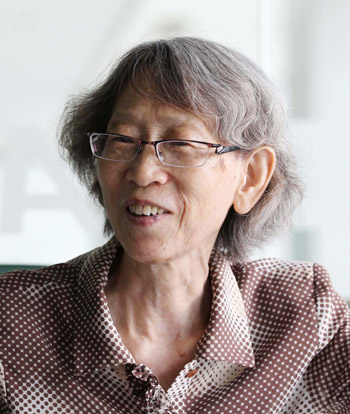
Chao Shuyi,72, is still active on the country's weather forecast desk. |
Nowadays, we have satellites, radars and other unmanned devices across the country collecting data for weather prediction.
But you'd be wrong if you thought the job of a weather forecaster is just pointing at a map and describing weather conditions.
"Experience still counts for a lot in weather prediction," said Chao Shuyi, 72, a retired meteorologist from the China Meteorological Administration (CMA), "even today when state-of-the-art modern technologies have taken over much of the data collection and processing."
That explains why Chao, who retired in 2000, is still active on the country's weather forecasting desk.
Every morning inside an open office the size of a football field, the most updated data provided by the CMA is flashed on two large screens. In front of the big screens is a conference table with about a dozen seats. It is from here that each day the two-minute bulletin which we all rely on to know tomorrow's weather is born, based on discussions among a dozen atmospheric and climate researchers, and satellite meteorological experts.
"The report we get from the CMA is in the form of a map including all the rainy areas," Chao said. "But it is up to us, the program producers, to translate the scientific terminology and maps into images and words which viewers can easily understand, for example, like when and where it will rain and how much rain they expect."
With decades of experience predicting weather before computers and satellites were used, Chao has been able to develop a hunch for future weather patterns.
"The factors that influence weather provide so many numbers that you can't tell which work and which you can neglect," Chao said. "So different forecasters are likely to give different answers on the basis of the same data."
Every morning before the National Meteorological Center broadcasts weather to the whole country, experts weigh on the report word by word in the conference room.
Some provincial-level weather stations also listen in and participate in the discussion, especially when the report includes any extreme weather in their regions.
"In most cases the experts can reach agreement on the prediction, but there are times they are divided over the amount of precipitation or the seriousness of a weather broadcast," Chao said. "After all, weather directly affects people's lives and the economy."
If the experts can't reach a consensus, the chief expert makes the final decision.
"Sometimes the moment of decision is very stressful," Chao said, as perhaps the most worrying aspect for every weather forecaster is getting the following day's prediction wrong.
Unfortunately for them, this is not unusual, Chao said. "The weather is not always possible to predict accurately."
Chao said she still remembered their failure to predict the huge flood sweeping the middle and upper reaches of the Yangtze River in the summer of 1998.
"We observed precipitation in early July, 1998, but we thought the moist air stream would move northwards, as it always did," Chao recalled. "But it didn't. It lingered around the middle and upper reaches of the Yangtze River, and caused a severe flood. And we did not find that out until July 13 or 14."
But thanks to improvement of monitoring services over the past decade, the accuracy of weather forecasting has been enhanced, Chao said.
But there are also setbacks, according to Li Qiang, deputy manager of the meteorological information department of the company. As the young generation of weather forecasters relies mainly on data collected by satellites, radars and state-of-the-art observatories, they have rare chances to tell the weather through a hunch.
"This is why the experiences of retired forecasters like Chao are so crucial for training our novices," Li said.