A prescription for health
Updated: 2011-11-22 07:56
By Xu Lin (China Daily)
|
|||||||||||


China is promoting its traditional medicine overseas but is discovering many obstacles to entering the global market. Xu Lin reports.
| ?
|
|
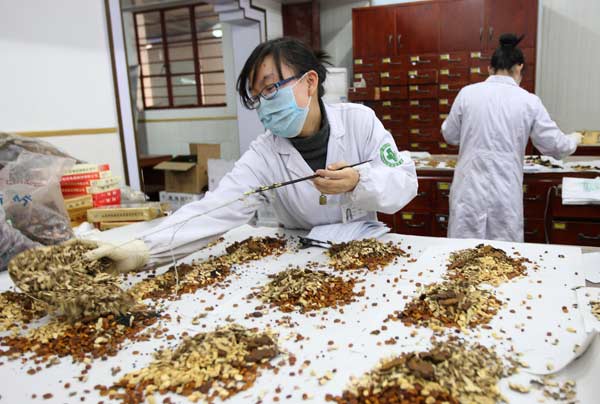
Pharmacists at a hospital in Anhui province make up a prescription. LIU QINLI / FOR CHINA DAILY |
Jiang Yuechun turned to traditional Chinese medicine (TCM) after Western treatments failed to remove dozens of flat warts coating the backs of her hands.
The 31-year-old university teacher in Beijing says the warts shriveled away without scarring after she imbibed a porridge of coix seeds (a tropical grain).
She is among many Chinese seeking TCM treatments in place of modern Western remedies at a time when her homeland is promoting the internationalization of its traditional medicine - already regularly used in about 140 countries but part of the healthcare systems of only a few.
| ||||
"Despite TCM's popularity overseas, only a handful of countries, such as Singapore, legally recognize it," the Beijing University of Chinese Medicine's former president Long Zhixian says.
"Few countries include TCM in their healthcare systems."
Artemisinin - a southernwood extract used to treat malaria - is the only TCM widely accepted abroad, mostly in Africa, Beijing University of Chinese Medicine professor Gao Xuemin says. The World Health Organization lists it in its essential medicines catalogue.
Several other traditional remedies, including those for cardiovascular diseases, are undergoing clinical testing overseas and may soon be approved for international use.
But Long believes there are many obstacles to TCM's expansion in the global market.
Perhaps the most challenging is that TCM is based on traditional Chinese culture and philosophy. These include such concepts as the balance of yin (the cool, calming side of the body) and yang (the hot, stimulating side of the body), and the relationship of the five elements that are said to constitute the universe - fire, earth, metal, water and wood.
"Western culture is totally different," Long says. "It's not easy for them to believe in TCM if they don't understand these theories."
He says another difficulty is difference in scientific views. "Westerners value experimental data in medicine, while TCM is based on experience accumulated over the past 4,000 years," he says.
"They always try to understand TCM according to the Western medical perspective. But that doesn't make any sense. In my opinion, as long as a medicine cures, it's a good one."
More than 9,000 TCM treatments were approved for sale in the market in 2008, according to the White Paper on Status Quo of Drug Supervision in China.
These TCM treatments have all passed clinical safety tests. Most have a history of several centuries, Long says.
"Current technology can't detect the active ingredients in some TCM compounds, which are very complicated," he says.
Long says it's difficult to determine the numbers and ratios of ingredients in most TCM compounds. Determining which are active ingredients is even more challenging. Artemisinin is an exception, which is why it has been successfully globalized.
TCM doctor Zhou Chaofan says another challenge to internationalization is medicine export standards vary around the world, and China's standards often can't meet foreign countries'.
"Some TCMs use heavy metals, such as cinnabar and realgar, which may not meet some foreign countries' criteria," Zhou says.
Long agrees. "Standards for heavy metals are different in countries," he says.
"It's hard to establish a global standard for TCM because of its complicated ingredients lists."
But Long remains optimistic. "It's just a matter of time for TCM to officially enter the global market," he says.
"We first and foremost must promote Chinese culture, so foreigners can understand TCM's philosophy."
The market will surely open up if TCM can cure diseases Western medicine can't, he believes. And more experiments will provide clinical evidence of TCM's usefulness and show how it works.
Dozens of Western pharmaceutical companies are currently undertaking such research in hopes of entering the Chinese market as foreign brands.
"This is a typical approach," Long says. "They first take notice of a TCM treatment and then research and finally produce it. But the impact on the Chinese market is limited."
But some don't view TCM's prospects for internationalization as so promising.
Among their ranks is Fang Zhouzi, an academic known for his opposition to "pseudoscience" and TCM.
"TCM theories are not scientific," Fang says.
"They're just an amalgam of superstition, metaphysics, philosophy and witchcraft. They should be replaced by better medical science. Some theories aren't logical at all, such as eating bones to strengthen one's bones."
But time, tests and international opinion will tell whether TCM will become a basement of parochial quackery or a lofty pillar of global healthcare's architecture.



Hot Topics
HIV/AIDS, Egypt protest, Thanksgiving, climate change, global economic recovery, home prices, high-speed railways, school bus safety, Libya situation, Weekly photos
Editor's Picks
|
|
|
|
|
|