Full text: China's Policies and Actions for Addressing Climate Change
Updated: 2011-11-22 13:56
(Xinhua)
|
|||||||||||


VIII. China's Basic Position in International Climate Change Negotiations
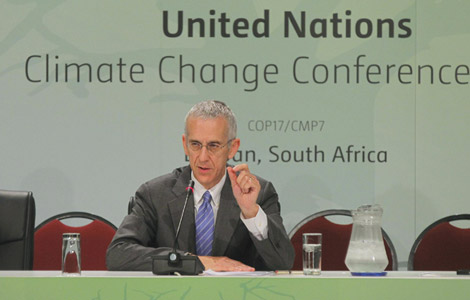
China has taken an active part in international climate change negotiations, playing a constructive role. It insists on the double-track negotiation mechanism of the UNFCCC and the Kyoto Protocol and upholds the principle of "common but differentiated responsibilities" in promoting the progress of international climate change negotiations. A UN climate change conference is scheduled for late November to early December, 2011 in the South African city of Durban. China maintains that the Durban climate change conference should put into effect the consensus reached at the 2010 Cancun Climate Change Conference, determine the arrangements of relevant mechanisms, continue with the negotiations on issues left unresolved at the Cancun Conference, and strive for positive results on the basis of consensus already reached.
1. China's Principled Stand in International Climate Change Negotiations
China adheres to the following principled stand in its efforts to promote progress at the Durban climate change conference in accordance with the Bali Road Map:
First, China upholds the basic framework of the UNFCCC and Kyoto Protocol, and strictly follows the Bali Road Map. The UNFCCC and Kyoto Protocol are the basic framework and legal foundation of international cooperation for addressing climate change. They represent the international consensus reached as well as the basis and guide to action in implementing the Bali Road Map. The Bali Road Map requires that the UNFCCC and Kyoto Protocol are comprehensively, effectively and continuously implemented, and the developed countries should undertake to achieve substantial emission reduction targets for the second commitment period under the Kyoto Protocol, and corresponding arrangements are made regarding mitigation of and adaption to climate change, as well as technology transfer and funding in this regard.
Second, China sticks to the principle of "common but differentiated responsibilities." Developed countries should be responsible for their accumulative emissions during their 200-odd years of industrialization, which is the main reason for the current global warming, and they should naturally take the lead in shouldering the historical responsibilities to substantially reduce emissions. With regard to capabilities, developed countries have substantial economic strength and advanced low-carbon technologies, while developing countries lack the financial strength and technologies to address climate change, and face multiple arduous tasks of developing their economies, fighting poverty and addressing climate change. Therefore, developed countries should, on the one hand, take the lead in reducing emissions substantially, and, on the other, provide financial support and transfer technologies to developing countries. The developing countries, while developing their economies and fighting poverty, should actively adopt measures to adapt to and mitigate climate change in accordance with their actual situations.
Third, China holds fast to the principle of sustainable development. The present development should not compromise the development capacity of future generations. Instead, it is necessary to take into overall consideration economic development, poverty alleviation and climate protection within the framework of sustainable development, actively promote green and low-carbon development, and strive for a win-win situation in both socio-economic development and response to climate change.
Fifth, China upholds the principle that the United Nations leads climate change negotiations as well as the decision-making mechanism of reaching unanimity through consultation. China does not object to informal or small-scale consultations on urgent issues outside the negotiations on the UNFCCC and Kyoto Protocol which are conducive to the negotiation progress, but these consultations should be supplements to rather than substitutes for the negotiation process of the UNFCCC and Kyoto Protocol. The principle of "reaching unanimity through consultation" is an important part of the spirit of the UN Charter. It conforms to the general and long-term interests of the United Nations, and plays a significant role in strengthening democracy, authority and legality of decision making. Therefore, it is imperative to uphold the decision-making mechanism of "reaching unanimity through consultation," and raise work efficiency through appropriate means under the premise of guaranteeing an open and transparent negotiation process with wide participation.
2. Prospects of the Durban Conference
China maintains that the Durban climate change conference should yield tangible results in three aspects:
First, clarifying absolute quantities for developed countries' substantial emission reduction in the second commitment period under the Kyoto Protocol. The Kyoto Protocol, the first commitment period of which is due to expire by the end of 2012, is one of the double tracks of Bali Road Map negotiation mechanism. The emission-reduction plan for developed countries in the second commitment period under the Kyoto Protocol should be made clear as soon as possible so as not to leave a space between the two commitment periods under the Kyoto Protocol, as is required by the Cancun Accord. This task, the most urgent at Durban, is vital to the conference's success.
Second, defining the emission reduction commitment under the UNFCCC for developed countries outside the protocol, which should be comparable with that of developed countries inside the protocol. Since developed countries inside the Kyoto Protocol have assumed their shares of emission reduction, developed countries out-side the protocol should also assume comparable emission reduction commitments under the UNFCCC, in accordance with the Bali Road Map. The commitment should be comparable in terms of the nature and scope of emission reduction, and the compliance mechanism. In such circumstances, developing countries should also actively reduce their emissions within the framework of sustainable development with funds and technological support from developed countries. Many developing countries have put forward their climate change mitigation plans by 2020. In accordance with the principle of "common but differentiated responsibilities," after developed countries assume their law-binding emission reduction targets under the UNFCCC and the second commitment period of the Kyoto Protocol, developing countries' similar targets should also be clarified in the form of law, and their efforts for emission reduction should also be recognized.
Third, specifying mechanisms and arrangements for adaptation, funding, technological transfer and capacity building, as well as measures to make the differences of emission reduction responsibilities transparent, measurable, reportable and verifiable between developed and developing countries. Most developing countries have taken active measures within their capacity to cope with climate change, and made important contributions. However, the international community still needs to provide effective support in a funds and technological transfer to developing countries. The latter will not be able to effectively carry out actions to mitigate and adapt to climate change without an effective mechanism, new, additional and abundant funds or technological transfer. The Cancun Accord specified the "measurable, reportable and verifiable" mechanisms and the principle of transparency. China maintains that specific arrangements should be made at the Durban conference regarding developed countries' emission reduction commitments, their support to developing countries in funds, technological transfer and capacity building, various "measurable, reportable and verifiable" responsibilities between developing and developed countries, as well as "international negotiation and analysis" of developing countries' voluntary climate change mitigation. The arrangements should also fully embody the principle of "common but differentiated responsibilities" between developing and developed countries.







Hot Topics
HIV/AIDS, Egypt protest, Thanksgiving, climate change, global economic recovery, home prices, high-speed railways, school bus safety, Libya situation, Weekly photos
Editor's Picks

|

|
|

|
|

|