Hard work nets Huaxi a towering success
Updated: 2011-11-26 10:15
By Wang Chao (China Daily)
|
|||||||||||


 |
|
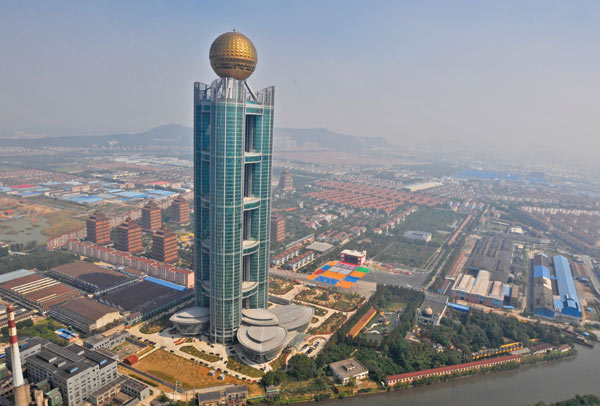
Jiangsu province's Huaxi village, the richest village in the country, caught the public's attention by building a 328-meter-tall luxury hotel worth 3 billion yuan ($470 million) this past month. [Provided to China Daily] |
JIANGYIN, Jiangsu - Huaxi village is turning to new pastures for profit as the old avenues lose their sheen.
The richest village in China, it has an annual revenue of 51.2 billion yuan ($8 billion). It counts a 328-meter-high hotel and two helicopters among its prized possessions.
Everyone in the original families in the village has at least one house or villa, cars and more than $250,000 in the bank.
They work in business communes. They receive free medical care, and the village pays their costs for any domestic or foreign travel and gives them villas to live in, not to mention stock options and bonuses.
A lot of hard work and planning went into acquiring all that wealth in Huaxi, which is in Jiangyin, a city in Jiangsu province less than 90 minutes' drive from Shanghai.
Wu Xie'en, the village chief, says it is his dream to develop Huaxi Group, the village's business entity, into a company that will last for hundreds of years.
"We want to secure a future with healthy, sustainable development, and have happy and content residents," says Wu, who took the helm from his father, Wu Renbao, nine years ago.
Two months ago, a 328-meter-high five-star hotel, costing 3 billion yuan, was completed. The Long Wish has 16 presidential suites, 800 standard rooms and luxury clubs decorated in pure gold and silver.
Last year the village saw about 3 billion yuan in profit from the steel plants and textile factories it built in the 1980s.
"We have eight major industries and more than 70 factories," says the village chief Wu Xie'en, who is also the president of the Huaxi Group Corp, which controls all Huaxi businesses.
Wu, 47, says the company used to be ranked the 76th-largest company in China. Despite the fast growth of giant State-owned enterprises in China, it was still the 127th in 2010.
The Wu factor
Wu Xie'en's father was Huaxi village chief from 1961, when the village was established, until 2003.
The elder Wu says that the village was successful because it "followed the path laid out by the central government".
In the 1960s and 1970s, when other villages were putting their efforts into farming, Wu started a farm tool plant to make money for the village.
"Many people criticized me for following a capitalist path," Wu says.
When the government stopped collective farming and distributing land in the 1980s, Wu kept the village's land as a collective asset and built steel and textile-processing factories.
The village benefited from these industries for decades, but times change.
"As early as 2003, we realized the risks of the steel companies I felt that the bubble would soon burst," Wu Xie'en says.
Since then, Huaxi has reduced steel production and turned to more profitable steel products with higher added value.
A fresh wind
The winds of change are blowing through Huaxi again.
Wu Xie'en says the village is reducing the proportion of traditional industries and increasing services, such as tourism, financial services, and ocean shipping.
"Our goal is to establish a new economic growth model by the end of 2020 and have heavy industry and services as the two pillars," Wu Xie'en said.
One difficulty has been the expansion of Huaxi. The village has gone from containing 600 inhabitants in 0.96 sq km to, through the addition of other villages, containing 35,000 residents in 35 sq km.
Yang Yongchang, president and general manager of Jiangyin Huaxi Steel, says the steel company is changing course to get into maritime shipping, buying 13 cargo ships since 2009. "We bought the ships during the financial crisis, when ships were cheap," Yang says.
The company plans to continue buying ships and become one of the top ocean-shipping companies in China by 2015.
Keven Hsu, general manager of Jiangsu Huaxi International Trade, the village's import and export business, said the company is also changing direction. Previously it had imported expensive equipment and exported manufacturing products.
"As we have sufficient capital in Huaxi, we import raw materials, too. We process them and then sell (them) in foreign markets."
"This brings Huaxi Group more revenue," Hsu said.
Looking ahead
Under the village committee's plan, financial services will be another pillar industry in the next 10 years.
"We've obtained licenses to provide financial services, including credit and guarantee services, and bought shares from several banks and securities companies," said Wu Xie'en. "We'll also lend surplus capital to small- and medium-sized enterprises in the nearby regions."
As Huaxi's wealth accumulates, so does its fame. At the village's 50th anniversary in October, the village greeted more than 500 reporters from throughout the world and thousands of tourists.
As for Huaxi's future, Wu Xie'en says: "My father's generation became rich by working hard. Now, we have to maintain the prosperity by thinking hard".
Related Stories
Skyscraper hotel takes Huaxi village to record new heights 2011-10-10 11:49
Huaxi Building 2010-05-22 11:00
Huaxi Special: 'Number one village under the sky' continues moving forward 2009-10-20 10:08





Hot Topics
HIV/AIDS, Egypt protest, Thanksgiving, climate change, global economic recovery, home prices, high-speed railways, school bus safety, Libya situation, Weekly photos
Editor's Picks
|
|
|

|
|
|