Oil and money: a match made in Kazakhstan
Updated: 2011-12-09 08:13
By Zhao Shengnan and Cui Jia (China Daily)
|
|||||||||||


|
 |
|
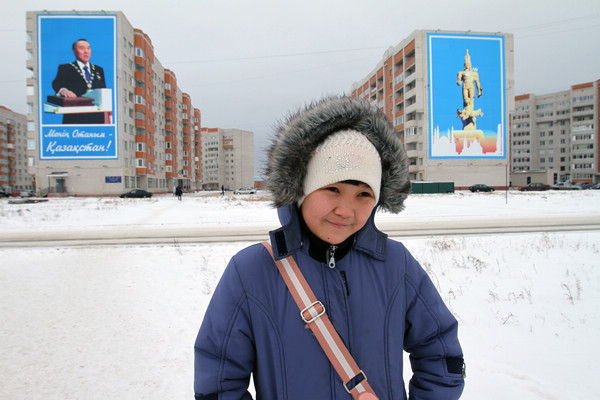
Banners marking Kazahkstan's 20 years of independence form a backdrop for this girl in Aktobe. The anniversary of the country's split from the Soviet Union falls on Dec 16. Jiang Dong / China Daily |
Related video: A trip to Kazakhstan
AKTOBE, Kazakhstan - Cooperation is?natural. Kazakhstan has energy to spare and China needs more. Plus, they share a border 1,700 kilometers long.
Sun Bo, general manager of Trans-Asia Gas Pipeline Co Ltd, was speaking about cooperation at the company's headquarters in Almaty. "Just because the two countries' relationship is built on mutual trust and benefit," he said, "China could build several natural gas pipelines linking Turkmenistan's gas field and China under the heartland of Kazakhstan."
It has taken time, but the relationship built by the two countries has produced more than fuel and revenue. Jobs have been created, and some scholarships for college students. A greenhouse helps feed people in one area, and residents no longer have to burn cow dung for heat.
|
 |
The cooperation can be felt in western Kazakhstan's Aktobe, the capital of Aktobe oblast and the nation's fourth-largest city, with a population of 278,000.
The key players are China National Petrol Corp, which is China's biggest oil producer, and Aktobe Munai Gas, which is Kazakhstan's fourth-largest oil company. CNPC holds 89.17 percent of shares in AMG, and together, they form the pillar of Aktobe region.
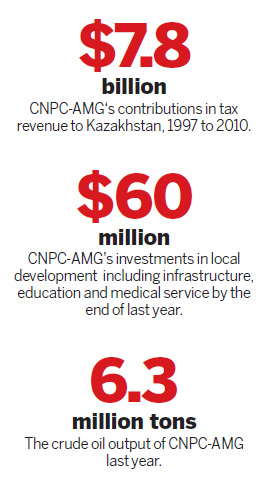
CNPC-AMG contributed $7.8 billion in tax revenue to Kazakhstan from 1997 to 2010, and provides more than 70 percent of the oblast's tax revenue. It also is projected to provide nearly 5 million tons of oil to China this year, making it the most important source of Kazakhstan-China oil, said Xu Keqiang, general director of CNPC-AMG.
In the beginning . . .
AMG had not yet shown such potential in 1997, when it became the first oil and gas project China acquired in Central Asia. It was on the verge of bankruptcy, Xu said. "The company could not afford over 10,000 employees' salary for eight months then."
But CNPC had its own shortages then, he said - of money, talent and overseas experience.
CNPC began seeking to develop overseas oil sources when China became a net oil importer in 1993 and grew increasingly dependent on foreign oil. But this was shortly after opening-up, and China seldom had much in foreign exchange reserves and CNPC's mergers and acquisitions experience was almost zero, Sun Bo said.
"Meanwhile, out of national sentiment, Aktobe officials and employees were not highly cooperative to us at first," Xu said.
According to the UK's Financial Times, China began buying Kazakhstani oil fields in the late 1990s, but secured smaller fields than the major Western oil companies that had gotten there first. Over the past three or four years, China made up for lost time, handing huge, much-needed loans to Kazakhstan in exchange for a stake in a local oil producer and a pledge of future oil supplies.
The worldwide financial crisis forced Kazakhstan to change its economic structure, Xu said. What made CNPC-AMG "a model of Sino-Kazakh cooperation", as Kazakh President Nursultan Nazarbayev said, is its surging output and contribution to local socio-economic development.
A fallow field and flowers
The crude oil output of CNPC-AMG has soared from 2.6 million tons in 1997 to 6.3 million tons last year. Two million of those tons came from the Kenkiyak oil fields, which Xu said had been left undeveloped for 20 years.
The Kazakhstan government offered the Kenkiyak oil field to CNPC for free after domestic and big Western oil companies determined that the field's complicated geography made it impractical to exploit the resources, he said.
"Our technology and efficiency saved Kenkiyak and, more important, benefited local welfare and dispelled public concern about Chinese enterprises," Xu said.
In 2000, CNPC-AMG built a pipeline delivering gas to Aktobe residents at a 75 percent discount. Now, few of them heat their homes in winter with dung as the fuel.
The next year, the company established Kazakhstan's first greenhouse, in Aktobe. It covers 4,400 square meters and now provides 90 tons of vegetables to Aktobe throughout the year. In 1997, Xu said, Chinese employees had found only one cabbage in the whole city to celebrate Chinese Spring Festival.
The greenhouse also spreads Chinese agricultural technology as a demonstration project, said Chen Shouping, 47, a Chinese agricultural expert there. "Now we are trying to produce flowers for local residents, given that presenting flowers as benediction is a tradition here," he said.
By the end of 2010, CNPC-AMG had invested $60 million to local infrastructure, education, medical service and other public services.
'Join hands'
Azhar Orazgaliev, a 86-year-old Red Army soldier who survived World War II, worked for AMG from 1948 to 1977. She lives with her family in a three-bedroom apartment given to her by CNPC-AMG and local government.
"I've worked with different ethnic groups. I don't think any ethnicity is better or worse than the other. China and Kazakhstan, as friends, should join hands to properly develop resources," she said.
Orazgaliev said she hopes her 22-year-old granddaughter, who majors in energy at a college in Almaty on a CNPC scholarship, will work for CNPC-AMG after graduation, like most of her relatives.
More than 98 percent of CNPC's jobs are offered to talented locals in Kazakhstan. Among 6,900 employees in CNPC-AMG, only 117 are Chinese nationals, said Song Xicheng, an administrative chief with the company.
Xu said the company has paid for 135 Kazakhstanis to study in China, but its hiring of high-level employees is not rapid enough, while enhanced production efficiency has made the current staff scale a little redundant.
"But out of responsibility, we have promised not to fire any employee, even in the most difficult 2009," Xu said.
Branching out
Kazakhstan grew rapidly on the back of booming oil and metals prices from 2000 to 2007, but the global financial crisis ended years of double-digit growth for Central Asia's biggest economy.
According to Reuters, Kazakhstan was hit hard by the global recession. Economy Minister Bakhyt Sultanov vowed to do more to make it easier for foreigners to enter local markets when he addressed foreign investors and bankers in 2009.
Speaking at the same meeting, President Nazarbayev urged foreign companies to invest more of their profits locally to help diversify the Kazakhstani economy.
It was time for foreign companies to look at opportunities in other sectors, he said.
From 1991, when it gained independence from the Soviet Union, to 2009, Kazakhstan attracted more than $50 billion in foreign direct investment, mainly in its oil and metals sectors, Reuters reported.
Xu said CNPC-AMG's top task in the near future remains oil exploration that meets the ballooning demand of China. However, he said, he has realized that CNPC-AMG has to diversify its investments and accelerate its downstream service and manufacturing, as in chemicals.
Mutual benefit
Ambassador Zhou Li told China Daily at the Chinese Embassy in Astana that Kazakhstan's increasing emphasis on non-energy sectors means opportunity for China, whose better development in many other sectors can boost cooperation between the two nations.
BBC reported last year that Chinese investors' growing presence in Kazakhstan has aroused public concern. But experts from both sides said that close cooperation is the best strategy.
Instability in southern and western Asia makes Russia and China the best potential gateways to overseas markets for landlocked Kazakhstan, said Zhang Yao, an expert on Central Asian studies from Shanghai Institute for International Studies. He noted that the country has been independent of the Soviet Union for 20 years and is probably reluctant to be subject now to Russia.
China has an enormous market, financial and technological advantages in and out of the energy sector, and political trust to share with Kazakhstan, he said.
Konstantin Syroezhkin, chief researcher at Kazakhstan Institute for Strategic Studies, said the presence of Chinese enterprises in Central Asia is mutually needed. In most cases, he said, Chinese companies have supported the political establishment at the highest level in Kazakhstan and elsewhere in the region.
As a crucial and positive force to maintain a dynamic regional economy, China will undoubtedly increase its economic presence in Central Asia and particularly in Kazakhstan, he said. "I don't regard it as a threat but a process that is completely objective and even mutually beneficial.
"The only thing Kazakhstan needs to do is to guarantee China's presence to be in favor of socio-economic development of Central Asia."
You can contact the reporters at zhaoshengnan@chinadaily.com.cn and cuijia@chinadaily.com.cn




Hot Topics
HIV/AIDS, Egypt protest, Thanksgiving, climate change, global economic recovery, home prices, high-speed railways, school bus safety, Libya situation, Weekly photos
Editor's Picks

|

|
|

|

|

|