Project rallies for China-US friendship
Updated: 2011-12-17 09:01
By Mike Peters (China Daily)
|
|||||||||||


Can a collection of "new China hands", people who recently have spent time studying and working in China, rally a new wave of students to come to Beijing to study?
|
 |
|
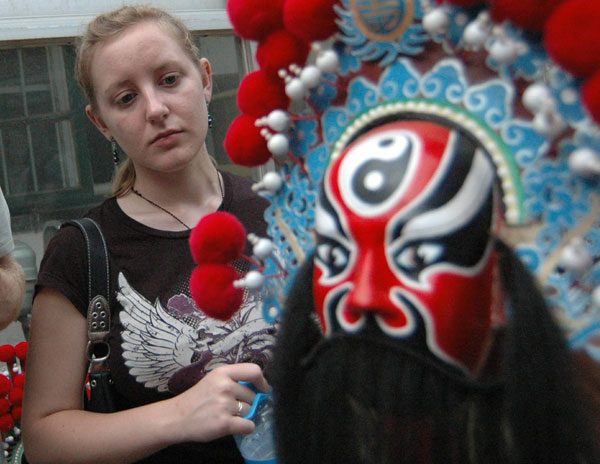
American student Katherine Jones is attracted by a Peking Opera mask during her visit to a craftsman's house in Shandong province. Zhang Zhenxiang / for China Daily |
US President Barack Obama is betting on it, and this week a privately funded initiative launched by Secretary of State Hillary Clinton sounded a clarion call to US expats in China.
After a basketball tournament and writers' panel kicked off the launch of Project Pengyou, US Ambassador Gary Locke rallied a crowd of "China alumni" in Beijing to show the way to the next generation of American students.
"I may hold the official title of US ambassador to China," Locke said last Saturday night, "but you are the everyday US ambassadors, people who are working all over this country in business, in education and in government relations."
Holly Chang, director of Project Pengyou ("friend"), says it was launched with funding from the Ford Foundation to support Obama's "100,000 Strong Initiative". That campaign is designed to boost the number of young Americans who come to study in China and "help individual members strengthen connections, forge new networks, develop career opportunities, share insights, expand knowledge and enrich their China experiences," she says.
An attention-getting week of cross-cultural festivities wraps up on Saturday with a concert at the National Indoor Stadium featuring will.i.am, apl.de.ap, Shunza, Sa Dingding, CoCo Lee and John Legend.
But that's just the beginning, Chang says.
"Project Pengyou is just starting to build the community," she says. Her website team has launched a "Share Story" feature that allows US expats and former expats to sign on as members and post their stories about living in China.
"We will gather all the best stories of amazing Americans to publish in a book," she says, which will be presented to Secretary of State Clinton next year.
Americans have much to learn about China, Locke says, noting that "while 150,000 Chinese students have come to the US to study in the US, only about 14,000 US students have come to Chinese universities."
The US State Department says 600 times more Chinese study the English language than Americans study Mandarin, and Locke says this imbalance in knowledge can undermine strategic trust between the two countries.
More people-to-people contact is essential, he says.
"There is virtually nothing in the world of any consequence that can be solved without the participation of the US and China."
"Your deep understanding of China will serve you and America very well. That's why we're looking for your help."
"Expat life is life-changing," says Chris Cooper, principal of China strategy in the US for Deloitte & Touche. "Ninety percent of the rush we all look for in daily life is just being here."
Jason Patent, the US co-director of the Johns Hopkins-Nanjing Center, says nothing gives people a better sense of other people than educational exchange programs.
"You can have a pomelo-peeling contest," he says, showing frenzied students yanking apart the big citrus fruits in a Power Point image. "It's not particularly academic, but the camaraderie it builds is tremendous."
John Fitzgerald, China representative of the Ford Foundation, says the foundation has invested $300 million in China since 1979 to promote education and exchange programs, and helped to rebuild social sciences in Chinese universities after the "cultural revolution" (1966-1976). Before that, he says, the Ford Foundation invested $80 million in the US during the 1950s, 60s and 70s to endow China studies programs in the US.
One measure of the foundation's success, he says, is that 50 of the top Chinese economists in a recent survey are experts who initially studied in Ford Foundation programs.
While Locke and other speakers worked Saturday night's crowd at the capital's Temple Theater like a pep-rally, online media expert Kaiser Kuo ended the event with a sense of urgency and concern.
"It wasn't long ago that encounters between the two countries were pretty much stage-managed," says Kuo, a New York-born rock musician and director of Baidu International Communications. "Sister cities were established, and trade delegations traveled back and forth."
Today, he says, the need for real people-to-people relations has become critical as China's rising power has become a topic of debate in US elections. While the US is experiencing a crisis of confidence, China is riding a surge of nationalism.
"Both nations have a great sense of destiny and a sense of exceptionalism," he says, and public opinion in both countries is more important than ever.
The Internet, he adds, is not always an asset in the relationship.
"The Internet was supposed to make us all hold hands and sing Kumbaya," he says, "but in reality the average citizen in each country knows just enough about the other to be dangerous."
Kuo recalls the events of May 1999 when US planes bombed the Chinese embassy in Belgrade, an attack the White House said was a tragic mistake.
"At that time, there were 8 million people online in China," Kuo says, "and the outrage was immense".
"Imagine if that happened today, with 500 million Chinese online. The river of fire could overflow almost instantaneously, with people on both sides of the Pacific eager to think the worst of each other."
Such a climate of fear, other speakers said, was less likely if more people on both sides knew each other better.
Several speakers noted that the 100,000 Strong Initiative aims to increase not just numbers but the diversity of students studying in China. Reaching broader segments of society - not just the academically gifted - will give Americans across the country a more complete sense of contemporary China.
Allan Wu, the Chinese-American host of TV's The Amazing Race China Rush, tells the crowd that the stereotypes that most Asians have about Americans, and Americans have about Asians, are not rooted in hostility but in a lack of interaction.
He urges US expats in China to help American students "connect with the fastest-growing economy in the world," saying that educational exchanges are the best way not only to see differences between people but "to see how we're the same, how we can be collaborative and solve common problems."




Hot Topics
HIV/AIDS, Egypt protest, Thanksgiving, climate change, global economic recovery, home prices, high-speed railways, school bus safety, Libya situation, Weekly photos
Editor's Picks
|
|

|
|

|

|