President Hu outlines proposal on development
Updated: 2011-11-13 07:50
(Xinhua)
|
|||||||||||


 |
|
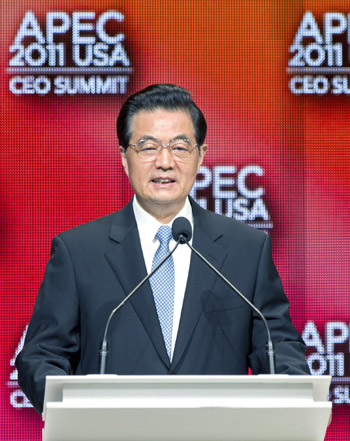
Chinese President Hu Jintao delivers a keynote speech at the APEC CEO Summit in Honolulu, Hawaii, November 12, 2011. [Photo/Xinhua] |
HONOLULU - Chinese President Hu Jintao on Saturday brought forward a four-point proposal on the economic development in the Asia-Pacific region and beyond.
In a keynote speech delivered here at the CEO summit of the Asia-Pacific Economic Cooperation (APEC), Hu called on economies in the region to be firmly committed to maintaining growth and promoting stability so as to add momentum to the regional economic development.
As his first point, Hu highlighted the importance to improve the mechanism for global economic governance and build an equal and more balanced global partnership for development.
The new mechanism should "reflect the changes in the economic landscape" and "observe the principle of mutual respect and collective decision-making and increase the representation and voice of emerging markets and developing countries," said Hu.
Second, APEC members need to implement the APEC Leaders' Growth Strategy adopted last year in Yokohama and achieve green and innovative growth.
The strategy, with green and innovative growth as the core elements, charts the course for the growth of the Asia-Pacific economy in the years ahead, said Hu.
And APEC members should actively promote the idea of green development and respect the choice independently made by APEC members to pursue green growth on the basis of their resource endowment, stage of development and capacity, he said.
Third, Asia-Pacific economies need to uphold the multilateral trading regime and deepen regional economic integration.
They should fulfill their commitments, firmly oppose and jointly resist protectionism of all forms, and work to make the multilateral trading regime a balanced and inclusive one that benefits all, Hu noted.
As the fourth point, the Chinese president called on the business community to strengthen public-private partnership and jointly promote world economic growth and business cooperation.
Government departments should better appreciate the role of the business community in promoting growth, listen to its views and suggestions, and encourage its active participation in economic development and regional cooperation, Hu said.
The Chinese leader also voiced the hope that the business community will continue to be strategic and forward-looking in thinking and put forward suggestions on major issues such as trade and investment liberalization and facilitation, regional economic integration and the long-term development of APEC.
Dwelling upon China's development, Hu said that China will deepen economic structural reform, grow a green economy, enhance protection of intellectual property rights and open wider to the outside world.
Hu noted that while China's economy has grown steadily and the country is opening wider to the outside world, China still faces the major challenge of unbalanced, uncoordinated and unsustainable development.
China, he said, will continue to deepen reform and opening-up, improve people's livelihood and promote sustained, steady and fairly fast economic growth and social harmony and stability.
Hu then briefed the summit about China's four-pronged efforts to achieve the goals, with the first being that China will deepen economic structural reform and improve business and investment environment.
Second, China will honor its commitment to growing a green economy and promoting the conservation culture, Hu said.
From 2011 to 2015, China's investment in the environmental sector will double that of the previous five years to about 3.1 trillion yuan (about 488.5 billion U.S. dollars), Hu said, adding that China's green industry is a key area for foreign investment.
Third, China will step up protection of intellectual property rights and make itself a country driven by innovation, he said.
China will vigorously boost scientific and technological innovation and turn enterprises into major players of such innovation, while further improving the legal system for intellectual property rights protection, he said.
Fourth, China will open wider to the outside world and take an active part in global economic governance and regional cooperation, Hu said.
China, he said, will give equal importance to import and export and focus more on increasing import while maintaining a stable level of export.
Noting that China's development constitutes an important force driving regional and global economic growth, Hu said that China will work together with others to create a better future for the Asia-Pacific region.
With the theme of "The Future: Redefined," the two-day CEO summit, which was held ahead of the APEC Economic Leaders' Meeting, focused on advancing trade and economic policy and partnerships for the future of the APEC region.
High-profile participants, including government leaders, private sector chairmen and CEOs and other influential leaders from the Asia-Pacific, attended various sessions during the CEO summit.
Since its inception in 1989, APEC has grown to encompass 21 members spanning four continents and become the most economically dynamic region in the world, accounting for approximately 40 percent of the world's population, around 50 percent of the world GDP and about 44 percent of world trade.





Hot Topics
HIV/AIDS, Egypt protest, Thanksgiving, climate change, global economic recovery, home prices, high-speed railways, school bus safety, Libya situation, Weekly photos
Editor's Picks

|
|
|

|
|

|