Migrant workers working at home a new trend
Updated: 2012-01-19 21:11
(Xinhua)
|
|||||||||


HEFEI - Soon after the holiday season of Chinese New Year finishes, migrant workers leave their hometown and return to work, already looking forward to the next Lunar New Year and the opportunity it will bring to reunite with their families.
 |
|
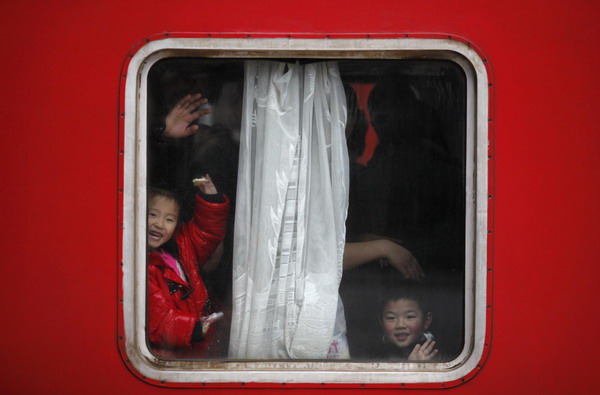
Passengers wave from a window of a train as they depart at the Shanghai's railway station, January 19, 2012. Chinese New Year, or Spring Festival, is the biggest of two "Golden Week" holidays, giving migrant workers their only chance of the year to return to their home provinces with gifts for their families. More than 200 million people are expected to take to the railways over this year's holiday, the biggest movement of humanity in the world. [Photo/Agencies] |
This once was the stereotype of thousands of millions of Chinese migrant workers, travelling far and living apart from their loved ones.
However, with the rapid development of central provinces, a growing number of migrant workers do not need to work far away from their homes. Latest statistics from Anhui province, for example, show that, by the end of September in 2011, around 10 percent of all migrant workers from the area had returned home to start their own businesses. A larger number had found jobs near home.
Lu Weidong, 41, is one such returnee. From Zhufoan town in Anhui, he was once a farmer and did odd jobs in faraway Shanghai for nearly 10 years. Three years ago, though, he returned to his hometown and co-founded a company making bamboo products.
"I no longer need to queue up for days and nights to get a ticket for the train home at Spring Festival," Lu says. "It's so nice to work near home, and I can take care of my parents and children."
Lu is currently busy making last-minute checks ahead of Chinese New Year, calculating the salary and year-end bonus for his 150 staff, most of whom are locals.
Processing 500,000 sticks of bamboo, Lu's company earns an annual total of 20 million yuan ($3.17 million) and gives out more than 3 million yuan as salary to workers. The annual profit of the successful business reaches more than six million yuan.
The workers receive 2,000 yuan a month, a bit less than working in big cities, but living expenses cost less as they live at home.
"Generally, workers can save 10,000 yuan a year, at the same level as working outside," Lu says.
As a migrant worker, Lu was anxious during the years working far away from home. At one point he arranged for his children to join him in Shanghai. But he ended up sending them back as finding education, and summoning the energy to look after them after long hours of work, proved difficult.
Lu was also attracted back home by the rich bamboo resources and the incentives policies of the local authorities. The town government encouraged farmers to come back to create their own businesses from the rich resources of more than 10,000 hectares of bamboo.
Cheng Hong, deputy secretary of the town government introduced a scheme under which business premises built by the government are rented out to returned migrant workers at a low price as a support to their enterprises.
"We don't charge the companies that rent our plants for the first year. We charge 50 percent of the rent for the second year and around 80 percent for following years depending on their benefits," Cheng explains.
According to statistics provided by Zhufoan town government, among 28,000 locals over the age of 18 and capable of labor, more than 20,000 choose to stay at home to work as farmers or in other jobs.
Li Shaohong, 35, worked on construction sites in Beijing, Shijiazhuang and Yangzhou for more than 10 years. He used to come back home only once a year, during the Spring Festival season.
"I would feel guilty if I continued to work far from home as my mother is almost 80 years old," Li says. "We don't live just to make money."
Li was surprised at the work opportunities in his hometown, Hefei, capital of Anhui. He now works as a driver for a construction enterprise, with an income of 2,000 yuan a month.
"It's much better than working far away. I can look after my parents and child when I have time," he says.
Wang Kaiyu, the celebrated socialist studying Chinese migrant worker issues, says that more migrants choose to work near home because of the rapid development of the local economy as well as the attraction of living close to their families.
Those returned migrant workers with experience have become a major factor in the development of Chinese inland provinces, Wang adds.
Lu's partner, Zhou Meijun, tells Xinhua that Lu learned much during his stay in coastal cities. He is now in charge of sales of their bamboo products.
"The bamboo chopsticks have been sold to Japan and we believe we can do better," Zhou says.
Related Stories
China's migrant workers share stories through hands 2011-09-24 07:57
China enables migrant workers better blend in urban life 2012-01-05 14:01
China urges railway safety for Spring Festival rush 2011-12-10 21:43
China holds Spring Festival gala for overseas Chinese 2012-01-13 16:33








Hot Topics
Kim Jong-il, Mengniu, train crash probe, Vaclav Havel, New Year, coast guard death, Internet security, Mekong River, Strait of Hormuz, economic work conference
Editor's Picks
|
|

|

|

|

|