|
|||||||||


BEIJING - In the 1950s, his plan to prevent modern development in the ancient city of Beijing was nipped.
Three decades after his death, famous architect Liang Sicheng's former courtyard home in downtown Chinese capital met the same fate.
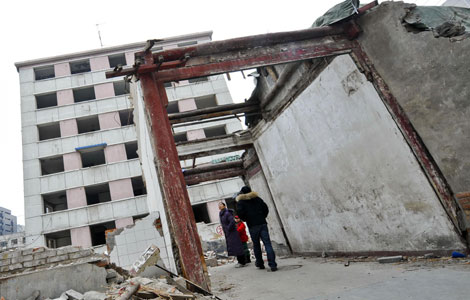
Liang's "siheyuan," the traditional courtyard home, ?was reportedly bulldozed by a real estate developer on Thursday in the name of preservation.
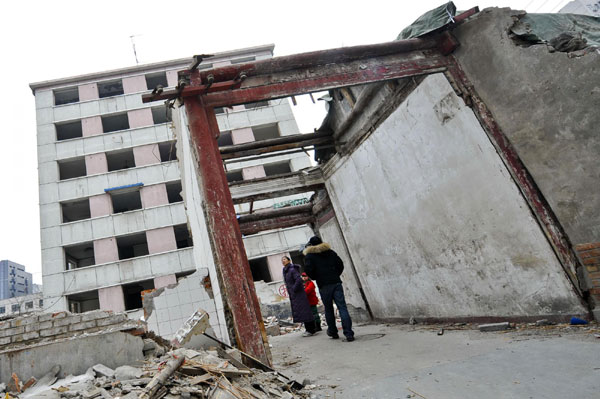
The former rectangle brick structure in Beizongbu hutong where Liang and his also architect wife Lin Huiyin (Phyllis Lin) resided and started the unprecedented profiling of ancient Chinese architecture during the 1930s was reduced to piles of rubble surrounding a lone wooden gate.
|
 |
|
Liang's "siheyuan," the traditional courtyard home, was demolished to piles of rubble surrounding a lone wooden gate. [Photo/Xinhua] |
The government said Saturday that the demolition was not approved by the cultural heritage authorities and officials would investigate and deal with the case in accordance of the law.
The destruction was the latest ancient architecture lost in the Chinese capital's rush to modernization at the expense of cultural heritages.
Over the past decades, ?high-rising office buildings, apartment blocks, and sprawling shopping malls mushroomed in the heart of Beijing, replacing the maze of "siheyuans" and "hutongs" -- the narrow alley lanes -- which used to be the signatures of the city.
Liang's former residence was partially destroyed in 2009 but the demolition was halted after the public outcries for ancient architecture protection.
|
 |
|
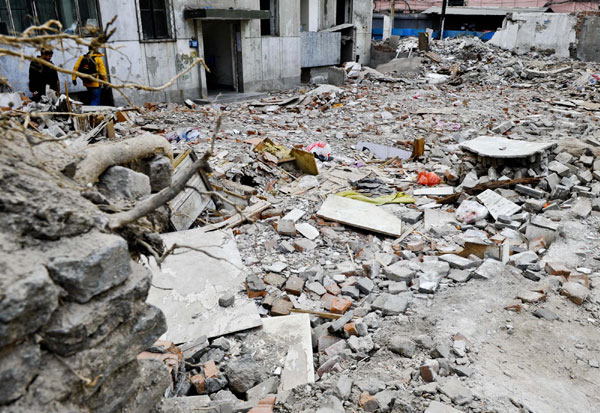
Liang's "siheyuan," the traditional courtyard home, ?was demolished to piles of rubble. [Photo/Xinhua] |
Since then, the site has been designated as a cultural relic, though a low-level one, that requires approval from the cultural heritage authorities for any redevelopment, said Wang Yuan, an official with the district culture bureau.
The official said the developer Fuheng Real Estate, a subsidiary of China Resources, claimed that it tore down the dilapidated architecture on safety grounds and pledged to have it restored in better preservation.
Wang said the municipal government had made it clear that Liang's courtyard home would be rebuilt and had ordered the developer not to remove anything from the rubble.
But the weak defense touched off a wave of criticism from the media and the public, lashing out at the apparently ridiculous logic.
A commentary posted on the government's china.org called the demolition in the name of preservation a "hoax."
In an online survey initiated by the popular microblogging site Sina Weibo, 89 percent of the 6,500 participants by Saturday night said the courtyard home should not be demolished because it has high historic value.
"In the blind pursuit of economic growth, China has not paid enough attention to the value of its culture," said another commentary posted on the People's Daily's website. "We need to enhance the cultural relics protection in order to prevent the tragedy from repeating."
The Chinese public was shocked by the demolition of Liang's former residence as the architect, born in 1901, was considered "Father of Modern Chinese Architecture" for his extensive researches on Chinese architecture and pioneering role in advocating the preservation of ancient architecture.
Liang was particularly known for his proposal with another architect Chen Zhanxiang to preserve the ancient city of Beijing and build a complete new city to the west of it after the Communist Party of China seized the power and made Beijing the capital of the new republic.
But the proposal was vetoed. ?The country's leaders back then opted for the alternative plan to build a political, economic, and cultural center within Beijing's historical core.
Traffic jams, air pollution, and disappearing ancient architecture linked to poor urban planning in recent years had led more and more people to feel nostalgic for Liang's ill-fated plan.






Hot Topics
Kim Jong-il, Mengniu, train crash probe, Vaclav Havel, New Year, coast guard death, Internet security, Mekong River, Strait of Hormuz, economic work conference
Editor's Picks
|
|
|

|

|
|