|
|||||||||


It was just 15 years ago that City'super launched its first store in Hong Kong's Causeway Bay in the then relatively new Times Square shopping mall.
Thomas Woo, president of the management group behind the store, says the path to its current success started when the company realized that more people in Hong Kong - and now the Chinese mainland as well - were willing to spend a portion of their disposable income pampering themselves. City'super was conceived not simply to sell quality products, he says, but to sell a lifestyle.
|
 |
|
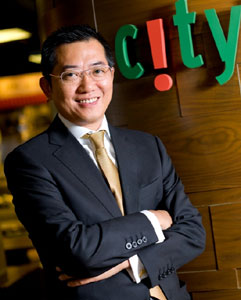
Thomas Woo, the mind behind City'super. Provided to China Daily |
Ernst & Young saluted the success of Woo and his company by naming him "Entrepreneur of the Year 2011 China" in consumer products category for Hong Kong/Macao.
According to the assessment criteria for the award, this means that Woo and City'super show "entrepreneurial spirit, good financial performance, strategic direction, national or global impact, innovation, and personal integrity and influence".
For the newly empowered consumers that City'super targets, Woo says, "The first phase is wanting to buy brands. Then we move to the second pampering stage: living better, eating better, and treating yourself better," says Woo.
Woo is a self-professed workaholic but has made a conscious effort in the last few years to make sure he takes time off for himself and his wife, Yumi Takahashi.
Woo's mentor, former boss, and one of the founding members of the management team at City'super, Masashi Ishikawa, passed away suddenly in 2002, and his death changed the way Woo viewed work and his life.
Ishikawa was his first boss at Tokyo's Seibu store. When Woo was studying at Eastern Oregon State University, he had the opportunity to be an exchange student for a year in Lyon, France, and then a year in Tokyo, Japan.
While in Tokyo, a friend told him that they had seen an ad in the local English-language paper that Seibu, a large high-end Japanese department store, was hiring foreigners.
Woo applied and was invited for an interview. He heard nothing from Seibu after his interview, but just to follow-up, he called their human resources department the day before he was set to fly back to the United States to find out what had happened to his application.
After a 10-minute wait, they informed him that he had been hired. Pleasantly surprised, he told them that he was still a student and needed to return to the US to finish his final year at university. They were willing to wait for him to graduate. It was the start of Woo's career in the retail sector.
Ishikawa's passing had a profound affect on how Woo started to view his life. Woo felt Ishikawa died before the team could enjoy the fruits of their labor from building the City'super name. After Ishikawa's death, Woo took a good look at his life to decide what was really important to him.
In those days, Woo worked from 7:30 in the morning to 10 in the evening for about 10 years. The company faced tough times during that decade, including the Asian financial crisis in 1998. As the business became more established, Woo has learned that "working to death" was not the way to live. He now maintains a better work/life balance - starting with an early morning meditation session - and feels that he is living life fully.
Meditating each day is difficult, he says, "but it helps to give you inner peace. I like that kind of thing," he says.
Woo says challenges are part of his typical day. "I'm quite easy-going. Not that I'm not serious about things though," says Woo. "If you has the self-confidence then you don't panic. Even if you don't have the answer."
After his morning meditation, Woo reads his newspaper, and heads to the office. He is usually the first or second person to arrive.
Woo and his wife love to travel and he makes sure that they fit that into their schedules. They both love nature and quiet, and spend time exploring places on their weekends. They are currently living in Shanghai because City'super has opened a store in the IFC mall in Pudong, and they like to drive out of the city to places like Moganshan to relax and recharge.
Woo says that Europeans used to visit Moganshan as a summer retreat about 120 years ago. They built bungalows to stay in and those bungalows have been developed into resorts.
"It's the perfect retreat" he says, and "looks just like a Chinese painting" there. Woo says that when the temperatures soar in Shanghai, in Moganshan it is still very pleasant.
Woo also believes in destiny. According to him, you can't plan everything in your life, "A lot of things are just destiny," he says.
One example: He had met his wife at Seibu in Tokyo when they both worked there. He left Seibu and was working at another company when they ran into each other on the shinkansen (high-speed train) one day. She was on her way to Kyoto, and he was on his way to Osaka. Both were traveling for work. They started dating soon after, and the rest, as they say, is history.
You can contact the writer at sundayed@chinadaily.com.cn.
For China Daily
- Russia, China veto Syria draft resolution
- Rise of Asia signals greater balance
- Iran calls on EU to review decisions
- Pollution costing China dear: report
- Online orders surge after big festival
- Chinese naval drill legitimate
- Hu vows to boost Sino-German ties
- China not out to purchase Europe: Premier Wen






Hot Topics
Kim Jong-il, Mengniu, train crash probe, Vaclav Havel, New Year, coast guard death, Internet security, Mekong River, Strait of Hormuz, economic work conference
Editor's Picks
|

|

|

|

|

|