Borrowers face costly payback
Updated: 2012-02-14 09:46
By Li Jing and He Na, and Xu Junqian (China Daily)
|
|||||||||


Open to abuse
Without a proper monitoring system, however, experts warn that private lending poses a threat to the health of China's economy.
Private lenders enjoy no legal protection, meaning that unpaid loans often result in disputes and, in extreme cases, violence. Meanwhile, the existing system is also open to money launderers.
Authorities have been cracking down on the illegal practice since October, when a number of Wenzhou bosses fled or killed themselves to avoid paying back high-interest loans. Now that the tap has been turned off, small business in the city has been hit even harder. The owner of a shoe factory, which has been in operation since 2003, told China Daily that this year is the first time he has been unable to restart the production lines immediately after the Spring Festival holiday.
"We just don't have enough money," he said, on condition of anonymity. "Without cash flow, we cannot and dare not hire people and receive orders."
With the rising costs of labor and materials and the tightened bank policies, he said that the government crackdown on private lending had been the last straw. "We just hope something concrete can be done sooner or later," he added.
According to Zhou's association, Wenzhou until recently had about 160 private lenders and "guarantee organizations", which are companies or individuals who stand as guarantor on loan applications. Today there are no more than 20.
One lender, who gave his name only as Fu, said he will not even lend money to relatives nowadays, explaining that once the money is "out of my hand, I have little chance of ever seeing it again".
Nine out of ten lenders mostly bankrupt bosses will take the money and flee, he said, adding: "It's a vicious circle."
Legalization of private lending is urgently needed, said Zhou, as well as moves to create more financing options for small and medium-sized enterprises, such as relaxing monetary policies on private banks.
He Tian, a real estate developer based in Zhejiang, agreed. "In some ways, we're luckier than the manufacturing industry, as we barely rely on private lending. Yet, we still need it for emergencies," he said. "The sooner it is regulated, the better and safer it is for both creditors and debtors."
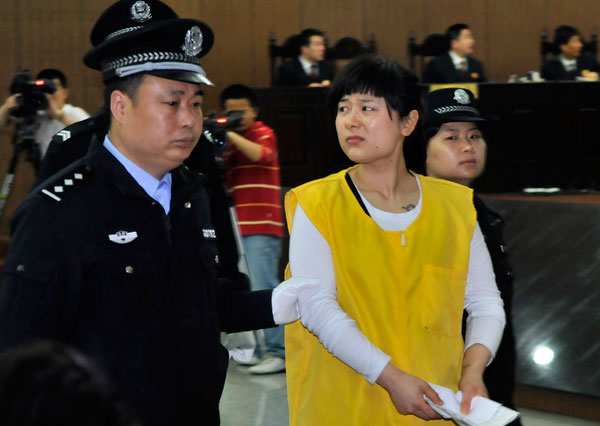
Economists, legal experts and sociologists from across China met to discuss the implications of Wu Ying's case at two seminars in February. Most echoed the call for legalization.
"Private financing has supported the development of China's private sector, so it is worth recognition by the authorities," said Hu at the Beijing Institute of Technology. "That's why Wu's case has attracted so much public attention."
|
 |
|
Chinese businesswoman Wu Ying was convicted of illegal fundraising and defrauding investors on April 16, 2009, after a trial at Jinhua Intermediate People's Court in Zhejiang province. She was later sentenced to death, a punishment that has raised questions among many experts. Hong Bing / for China Daily |







Hot Topics
Kim Jong-il, Mengniu, train crash probe, Vaclav Havel, New Year, coast guard death, Internet security, Mekong River, Strait of Hormuz, economic work conference
Editor's Picks
|

|

|

|

|

|