 |
|
|
 |
|
|
|||||||||
Sparking the growth in Chinese business schools has been the whirlwind of multinationals expanding operations to China over the past 10 years as foreign companies rush to get a grip on the next big consumer market. At the end of 2011, foreign direct investment in China topped $116 billion, and that number is only set to go up as foreign companies see growth back home slow due to economic problems.
"Because of the increasing importance of China and the growth that it represents in overall corporate performance among many multinationals, they no longer rely on growth coming from the developed markets," Quelch of CEIBS said.
With more than 260,000 foreign students, China is the fourth-leading destination worldwide for students studying abroad full time, behind France, the UK, and the United States, according to the International Institute of Education's (IIE) 2012 Project Atlas report. Around 30 percent of those students are pursuing MBA and EMBA degrees.
Those numbers are set to rise as efforts by the Chinese government to attract foreign students start to show results. With more than 800 million yuan going toward scholarships for international students in 2010, housing incentives and a jump in accredited schools - the China option is becoming increasingly attractive.
"China has been very strategic in providing financial incentives and information to attract more students," said Peggy Blumenthal, senior counselor to the president of IIE, a US-based NGO promoting international exchange.
Attracting students is not only valuable for China in terms of helping the world comprehend the often-misunderstood rising superpower, it is also profitable.
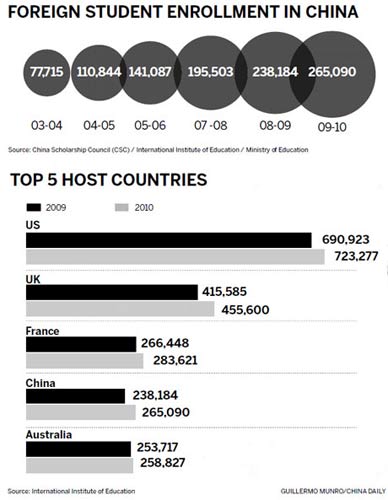 |
In the US, where education draws more than 700,000 international students a year, tuition fees brought into the country by foreign students accounts for $13 billion in the US economy.
But, while the benefits of studying in one of the world's fastest-growing economies may be numerous, the opportunities for foreign MBA graduates to work in China aren't always as plentiful as China's swelling market may suggest.
Despite a critical need to fill a gap in the managerial class six years ago - in 2006 McKinsey & Co estimated that China would need more than 75,000 top-level executives by 2010 - tens of thousands of Chinese students took up the call, enrolling overseas and returning home to fill those positions.
The result is that many companies, both foreign and domestic, prefer to hire Chinese graduates who have studied abroad and earned international experience when looking to expand operations.
"It's difficult to learn the intricacies of China's business culture just by studying in the country for two years. It's almost impossible," said Ben Leary, CEO of Column Associates, a Beijing-based talent management agency.
On the other hand, Chinese students studying abroad are able to grasp Western business concepts quickly and apply them to the Chinese way of doing business, he said.
In addition to having larger access to a pool of Chinese talent, a majority of positions being offered for foreign managers are senior, meaning that fresh graduates do not have the experience requirements to hold the available jobs.
"Multinational companies aren't necessarily looking to recruit fresh graduates for management positions. They want people who have been working in China for 10 years or more," Leary said.
This is the problem recent CEIBS graduate Eric Seidner is confronting.
The 31-year-old American first came to China during its economic upswing seven years ago.
He said that when it comes to applying for jobs, the language barrier and Chinese human resources practices often give Chinese applicants the upper hand.
"Those who have the biggest advantage from what I've been seeing are the ones who have gone abroad and studied and returned - they have the international experience, the exposure to Western education and are still fluent in the language and culture," he said.
But, just as Chinese graduates who return to China after studying in the West have an advantage, foreign professionals who return home after studying in China have a unique edge.
For James Osterloh, who's enrolled in the two-year MBA program at CEIBS, choosing to go China was a way to distinguish himself in his pre-existing job as project manager at Standard Bank in South Africa.
"Going forward, I will be able to compete better with my peers in the bank by using the China expertise," Osterloh said.
The 31-year-old former British army captain said after he finishes his degree, he will return to the bank to play a bigger role in helping develop ties between China and Africa, a position his previous education and experience would have never allowed him to do.
"It really adds a dynamic to my profile that I didn't have before."
toddbalazovic@chinadaily.com.cn
Wu Ying, iPad, Jeremy Lin, Valentine's Day, Real Name, Whitney Houston, Syria,Iranian issue, Sanyan tourism, Giving birth in Hong Kong, Cadmium spill, housing policy

|

|

|

|

|

|