|
|
|
 |
|
|
|||||||||
|
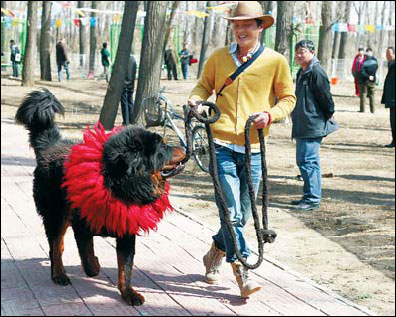
Huang Ding, secretary-general of the Mastiff Association of Tibet, walks his dog on Friday. Wang Jing / China Daily |
As the craze over the lion-like Tibetan mastiffs from the Himalayan plateau has swept over the country the last two decades, the percentage of dogs remaining purebred has witnessed a drastic drop, experts say.
"Mastiff fever has introduced the dogs, the treasure and guardian of the Himalayan plateau, to the whole country and also made its value rocket," said Huang Ding, secretary-general of the Mastiff Association of Tibet.
"This will lead to the extinction of the purebred ones if the market is not well managed and controlled," Huang said during a weeklong Himalayan mastiff exhibition that kicked off in the capital on Friday.
All 30 purebred mastiffs at the exhibit have gone through strict selection in Tibet, said You Wenfa, honorary president of the association.
The price of the dogs ranges from 200,000 yuan to 16 million yuan ($38,000 to $2.5 million).
"The valuations of all the mastiffs are some 80 million yuan," said You. "However, all the dogs are for exhibition and appreciation only this time, rather than for sale."
According to Huang, there are fewer than 300 purebred Himalayan mastiffs in the world.
Thirty purebred Himalayan mastiffs were brought to the city for exhibition after a five-day trip from the plateau. Some 40 Tibetan mastiff exhibitions will be held from March to April this year across the country.
The first Himalayan Mastiff Cultural Exposition will also be held in May in Lhasa, capital of the Tibet autonomous region.
According to Huang, many traders simply consider breeding the dog as a tool for building up fortunes and a road to economic prosperity - regardless of preserving its pure blood and genes - which results in an overflow of crossbred mastiffs.
"Many merchants, with insufficient knowledge about the dog, mate the purebred Himalayan mastiffs with other kinds of dogs, which simply results in a market of chaos and deception," said Huang.
In addition, some people mate the purebred ones with other breeds in pursuit of one that is better looking, taller or has shinier fur, which is 'stupid and foolish', according to Huang.
"Seriously, this kind of irresponsible mating might lead to the extinction of the purebred mastiffs," he said.
Huang is currently working with staff from the Mastiff Association of Tibet to help preserve the breed, which has a history of thousands of years.
"It's also a way of restoring Tibetan culture," Huang added.
According to Wang Yonggang, president of the association, Himalayan mastiffs are one of the three treasures to the Tibetan people. The others are the yak, a major food source for people on the plateau, and the vulture, the predatory bird believed to bring the spirit and soul of Tibetans to heaven after death through sky burial.
"The Himalayan mastiffs are very loyal and brave guardians of the Tibetan people," he said. "It has been of great significance in the culture of the Tibetan people."
Wang said to better preserve the purebred Himalayan mastiffs and regulate the market, it was necessary for the country to come up with a specialized institution, like the American Kennel Club in the United States, drafting a unified breeding and industrial standard.
"Most of the mastiff associations and farms around the country that mushroomed in the past few years are simply for the sake of making profit, with varying standards for dog evaluation," said Wang. "We are lagging so far behind Western countries in preserving purebred dogs, and proper regulation of the market would be of great help."
Wang also said the mastiff industry could become a new economic growth opportunity to local people if well developed. According to You, who also owns a mastiff farm in Beijing, the buyers of mastiffs are still the country's affluent middle and upper classes, who purchase the dogs as status symbols.
"Only those wealthy businessmen can afford a dog this expensive," said You. "To have a huge dog like this is absolutely a sign of identity and special taste."
Businessman Guo Jingshu owns a mastiff.
He said raising a mastiff at home is different from keeping a Chihuahua, just like those who drive a Mercedes are definitely of a different status from those in a Mini Cooper.
Liu Xulei, 32, a visitor to the exhibition from East China's Shandong province, as well as a mastiff lover who owns three mastiffs, said he was the poorest of all the mastiff fans he knows.
"Most of the mastiff owners I know are wealthy businessmen, either for a symbol of social status or as a means of investment," he said.
zhengxin@chinadaily.com.cn
(China Daily 04/07/2012 page1)
|
|

|

|

|
|