|
|
|
 |
|
|
|||||||||
Echoing Wang, Huo Feng acknowledged that the pressures existed. One case in point was that of the movie actor, Fu Biao, who died from late-stage liver cancer in 2005. Fu underwent two transplants, which stirred a public outcry after it was alleged that they only helped to extend his life by 15 months, while other patients, who could have lived for a further 15 years, were kept waiting.
"In fact, a person's economic situation can largely determine the right to life, because of the severe organ shortage. With money at hand, Fu could choose to have transplants to help him live a little longer and improve his quality of life," said Shen Zhongyang, the surgeon who performed the transplants.
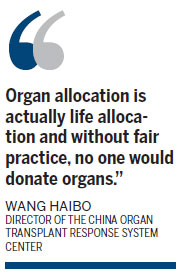
Wang Haibo said the new allocation system will mean that the situation doesn't arise again. Besides, "it actually makes it easier now for transplant doctors when responding to some patients' requests to undergo surgery earlier than others, because we will only work according to the system," he said. Although the system is still operating on a trial basis which is localized, "it has helped to achieve fair allocation within the hospital", he said.
However, not everyone believes that the new system will end the lottery of organ allocation. A veteran transplant surgeon in Beijing surnamed Shi, said that there are few acute cases among those awaiting kidney transplants, because, unlike patients suffering from liver problems, sufferers are often able to be treated by non-invasive procedures, such as dialysis. However, those on the kidney list are also subject to the usual criteria when organs are being allocated at the hospital where he works.
"In some cases, allocation can be flexible as long as it doesn't break the law and regulations. We human beings all have our feelings," he conceded, but stressed that the system "can't be abused for profit".
In addition, Shi expressed reservations about the quality of the organs received via the allocation system, noting that many of the donors had spent a long time in ICUs, which could result in damaged organs.
The system only allocates organs donated via the nation's organ donation system, and excludes those garnered from executed prisoners. In 2011, 227 kidney transplants were performed in Shi's hospital, with 200 of the organs coming from executed prisoners and just 27 from living donors.
Huo Feng said that during a donor's last days, hospitals use a process called "extracorporeal membrane oxygenation" to provide support and oxygenate the cardiac and respiratory systems of patients whose hearts and lungs are so severely diseased or damaged that they no longer function properly. The use of ECMO can ensure that organs destined for transplantation are kept in prime condition. However, Huo emphasized that the technology requires further research. "By showing respect for the death process, we can help donors to fulfill their promise of providing usable organs," he said. The use of ECMO adds between 30,000 to 50,000 yuan to the cost of treating each donor.
Chen Jingyu, deputy director of the Wuxi People's Hospital, said that he personally didn't agree with the use of ECMO purely for organ procurement. "It's kind of China unique and is considered a desperate solution," he said.
In China, where public awareness of brain death remains poor and it takes time to coordinate voluntary organ donations, ECMO is used as a means of maintaining the quality of organs for longer periods.
Without the use of ECMO, the quality of organs received after cardiac death is not as high as those harvested after brain death, he conceded.
By March 15, 206 people on the mainland had donated a total of 543 organs after cardiac death via the trial donation system, according to Hao Linna, vice-president of the Chinese Red Cross.
"The majority of them were from people in underprivileged rural families and 90 percent of the donor families have applied for humanitarian aid," she said. "We can hardly avoid the subject of the aid that is granted to make sure that the donation doesn't aggravate the financial situations of donor families," said Deputy Minister of Health Huang Jiefu.
"Given the small scale of the donations made so far, their demographic distribution is unable to represent how the picture will look when the donation system goes nationwide, and we receive a great many more donations," he added.
Francis Delmonico, president-elect of the Transplantation Society, said that unfair allocation creates a perception that the poor are donating organs to save the lives of the rich and powerful.
It's crucial to gain public trust and ensure the donated organs go to the right recipients, based on standards and principles recognized by all stakeholders, he said.
|
|

|

|
|
|