 |
|
|
 |
|
|
|||||||||
China's long-awaited regulations on school bus safety finally came into force on Tuesday, including an extensive list of measures aimed at reducing the risk of tragedy.
Among the biggest changes is that buses carrying students will be given priority in traffic, while companies and drivers will need licenses to offer school transport services.
 |
|
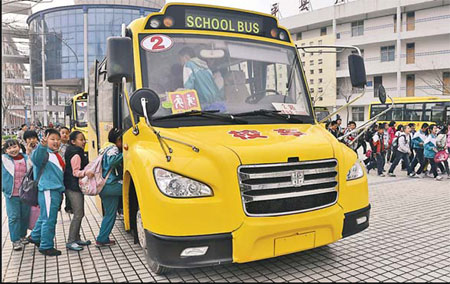
Pupils of the Chiping County Experimental Elementary School in Liaocheng, Shandong province, board a bus after school on Tuesday. Zhao Yuguo / for China Daily? |
Yet, despite the landmark legislation being approved by the State Council, experts and industry insiders say there is still a long way to go before the changes will make a difference.
"The regulations do not mean the problem of school bus safety has been solved," said Zhou Hongyu, a National People's Congress deputy involved in drafting the legislation.
The professor of education at Central China Normal University stressed that further progress now relies on stringent enforcement by traffic police and local authorities, as well as funding.
Officials have spent more than four months fine-tuning the regulations, during which time the country has been rocked by several fatal crashes involving modified and often overcrowded school buses.
The latest accident occurred on Monday in Yangchun, Guangdong province, in which three kindergarten pupils were killed and 14 others injured.
Although the regulations will take effect immediately, schools and bus companies will be given a 90-day grace period to come up to scratch.
Rules and funding
In the new rules, a school bus is defined as a vehicle with more than seven seats that is transporting children receiving the State's nine-year compulsory education (ages 6 to 15) to or from school. This can be extended to preschoolers if a parent or guardian is unable to take them to or from kindergarten themselves.
Vehicles matching this description must now be given priority in traffic congestion, and other drivers are forbidden from overtaking them when students are boarding and disembarking.
School buses must also operate in routes mapped out by authorities to ensure safety, the regulations state.
Devising safe routes for school buses is key, Zhou said, adding: "There would still be potential dangers if there are safe buses but bad road conditions. The road conditions must be improved and operation routes must be devised soon."
Meanwhile, county-level governments and above have been made responsible for ensuring that elementary and junior-middle school students attend the closest school to their homes and that public transportation can provide a service for them.
If all those conditions cannot be met, authorities will be required to provide a school bus service.
Chu Zhaohui, a senior researcher at the National Institute of Education Sciences, believes the item in the regulation that rules that local authorities must provide school buses when no public transport is available, and schools are located far from children, is aimed at solving school bus problems in rural areas.
"The choice of location of schools must be combined with consideration of school buses," he said. "Sometimes a better solution would be to build a new school."
Central authorities say they will establish channels for funding school buses, with the funds shared by local and central authorities.
The regulation does not cover further details of how the funding will be allocated between the central and local governments, only mentioning that a specific method will be devised by the finance authorities of the State Council.
"The source of funding for the school buses has to be solved as quickly as possible," NPC Deputy Zhou said, "or local authorities will not take too much initiative, as some may worry that what they invest might later be covered by the central government."
Zhou said he proposed that the allocation of funding for school buses could be different for provinces in the eastern, central and western parts of China, depending on financial situations.
Punishment
Companies and bus drivers who fail to meet the regulations face stiff penalties.
Drivers who breach the regulations will be fined 200 yuan ($32) and vehicles will be withheld from its owner if they have been found using it as an unlicensed school bus.
Traffic and education authorities in Beijing declined to comment on the question of enforcement on Tuesday.
However, some school bus service providers said they were waiting for more concrete policies from local authorities to be in place before applying for operating licenses for buses and drivers.
"Right now we don't know which government body to turn to and what paperwork is needed," said Zhang Hua, a manager at Wanjiabang Car Rental, which runs school bus services in Beijing.
He said they do not know which department is in charge of school bus regulation, a problem they've faced for more than 10 years.
However, Zhang said the company will train drivers about their new responsibilities and potential penalties in case they fail to meet the requirements.
All these measures increase costs for the business, Zhang said. Keeping drivers motivated and fairly compensated, paying for employees and buses that work only twice a day, and rising fuel prices do not help here, he said.
Rural areas
The qualification for school bus providers and drivers is far more urgent in rural areas, especially in the mountainous areas, researcher Chu said.
"Also, the school bus safety regulation has not been made once and for all," Chu said. "It must be revised over time and through the practice of establishing the system."
Zhang Yutang, 63, a retired professor of education from Sichuan Normal University, agreed and hopes more government aid will be given to rural areas, as he believes few schools can afford school buses.
He has been working with educational authorities to train school principals and parents in rural areas of Sichuan province about campus safety for five years. He has also been giving lessons to headmasters in Ya'an city in Sichuan this year.
"They told me 80 percent of primary schools and kindergartens in Ya'an are private, with limited financial means to afford their own school buses," Zhang said.
Smaller private schools and kindergartens may hire a non-professional driver with a casual verbal agreement, with no thought of hiring monitors on the bus, Zhang said.
"The regulation says all drivers must be licensed to drive school buses. But schools, especially in the rural areas, must be able to afford skilled drivers in the first place," he said.
Contact the writers at xuwei@chinadaily.com.cn and liyao@chinadaily.com.cn
|
|

|

|

|

|