|
|
|
 |
|
|
|||||||||
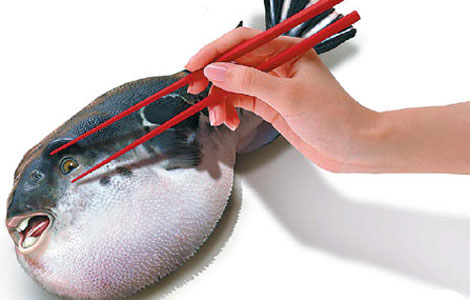
Legally, at least, no institution in Jiangsu is permitted to certify fugu chefs, says Peng Dongsheng, deputy chairman of the Jiangsu Cuisine Association.
The central government still considers fugu eating too much of a risk and has officially banned it from "entering the market" in the 1990-issued "arrangement on fisheries hygiene and safety". That same rule was later emphasized in several other national regulations and warnings.
In big cities like Beijing and Shanghai, restaurants found selling fugu will immediately receive a fine or even have their business licenses suspended.
But in Jiangsu, where eating fugu is still a traditional seasonal highlight, the hygiene department has sort of "turned a blind eye", says Qiu from Yangzhou.
With its local popularity and an influx of curious diners from all across the country, the province now consumes nearly 10,000 metric tons of fugu each year according to Peng from Jiangsu Cuisine Association. What makes it different is that fugu on the market today are mainly farm-raised.
Even the wild blowfish has fallen victim to rapid industrialization up and down the Yangtze with its growing number of ports and harbors, Qiu says.
The tidal flats and sandbanks along the lower reaches of the Yangtze - the natural spawning grounds for the blowfish - are also fast disappearing.
True gourmets lament the shrinking harvests of wild fugu. It has grown so rare that a total catch of about 100 wild fishes is already considered a surprisingly good catch. This has pushed the price of wild fugu to more than 20,000 yuan ($3,180) per kilogram.
This has prompted the rise of fugu farming in the province.
At least a few cities in Jiangsu, including Yangzhong and Hai'an, have made fugu farming a star industry.
In Yangzhong, an island city in the middle of the Yangtze River, the government has spent 50 million yuan establishing 20 fugu-rearing facilities. The city produces more than 1,000 metric tons of fugu a year, spawning a 10 million yuan industry.
Though farm-raised fugu are generally considered to be less tasty, they are considerably safer.
According to Peng from the Jiangsu Cuisine Association, the poisons inside fugu are derived mainly from the seaweeds they eat. So, through changing their food supply, "poison-control breeding" can effectively reduce the toxicity, reportedly by as much as 95 percent.
"If properly prepared, these fugu can be guaranteed to be poison-free," Peng says. The ban on farm-raised fugu is out of date, he believes.
In Japan, according to Reuters, the laws regulating strictly licensed fugu chefs in exclusive restaurants may now be relaxed. New regulations coming into effect from October will open up the trade to even restaurants without a license.
But, the Chinese government remains cautious.
Last June, in response to nationwide calls by fugu farmers to lift the ban on fugu eating, the State Food and Drug Administration issued a notice saying that "related departments are conducting research, and before policy adjustment, food service providers are strictly banned from preparing fugus".
Peng agrees that the lifting of the ban must be carefully thought out, but he has a practical suggestion.
He thinks the government should first lift the ban in regions where strictly trained chefs should be allowed to prepare and sell farm-raised fugu. If the experiment is successful, he says, it can be allowed in the rest of the country.
"Fugu preparation techniques are part of Chinese culinary culture," he insists. "We shouldn't give up making innovations for fear of trouble. What we have to do is to safely offer the delicacy to our consumers. In the long run, it'll be a huge contribution to China's culinary scene."
Contact the writer at hanbingbin@chinadaily.com.cn.
Yang Yao contributed to this story.

|
|

|

|
|

|