|
|
|
 |
|
|
|||||||||
 |
|
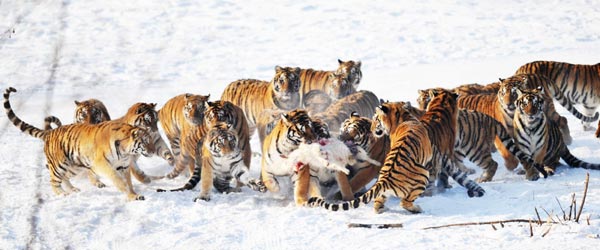
Siberian tigers fight for a sheep at the Heilongjiang Siberian Tiger Park. [Photo/ Xinhua] |
Thanks in large part to the work of China and Russia, the population of Siberian tigers and Amur leopards is rebounding, said Jiang Guangshun, a leading expert with the World Wide Fund for Nature.
"Because of the countries' protection efforts, Siberian tigers are frequently seen around the border between China and Russia," said Jiang, who has studied tigers for more than 20 years.
"China and Russia have overcome their national boundaries to protect nature."
He said the work is needed to prevent the rare species from going extinct.
According to data published by the Jilin provincial forestry department last week, the number of Siberian tigers and Amur leopards living in the wild has increased in recent times. Also, the big cats' habitat has expanded and is now three to four times larger than it was in the late 1990s.
"We are cooperating with Russia and many international organizations over the long term, which benefits us a lot."
At a news conference last week, Qiao Heng, deputy director of the Jilin provincial forestry department, spoke highly about the cooperation between China and Russia.
During the past several years, China and Russia have worked hard to protect the rare animals. They have also made many information, technical and academic exchanges.
Moreover, the Russian Far East project office for protecting Siberia tigers has offered China GPS receivers and other technical equipment to help it study the big cats.
The Chinese government created the Hunchun Tiger Leopard Reserve in 2002, thereby providing a 1,000-square-kilometer habitat along China's border with Southwest Primorye, a region in Russia.
According to Xie Yan, an official with the Wildlife Conservation Society China, Russia began to protect wild tigers as early as the 1950s, enabling the country to accumulate a wealth of experience in that sort of work. China, in contrast, started fairly late along the same path.
"So the cooperation with Russia can help China acquire better techniques and do more to protect wild animals."
Siberian tigers and Amur leopards mainly live in East Russia, Northeast China and mountainous areas in the Democratic People's Republic of Korea. Fewer than 500 Siberian tigers and 40 Amur leopards now live in the wild.
In 2010, China and Russia signed an agreement that called on environmental officials from Russia to work with their Chinese counterparts to do more to protect Siberian tigers and Amur leopards.
The agreement specified the methods that are to be used in protecting wildlife and provided the legal foundation for further cooperation between the countries.
Xie Yan said this is only the beginning of Chinese and Russian cooperation to protect wildlife.
"It could be closer in law enforcement or information sharing. This will require further negotiation between the two countries' governments."
Contact the writers at wuyong@chinadaily.com.cn and liuce@chinadaily.com.cn

|

|

|

|

|

|