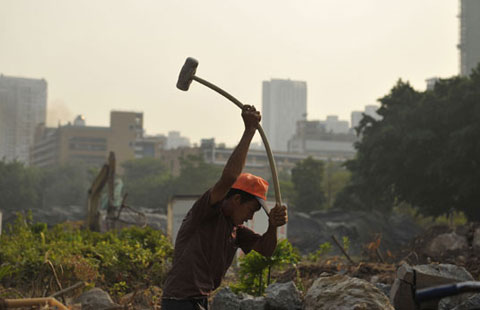
WASHINGTON - China will have to face a host of problems in its drive to realize "effective urbanization" in the next decade, with the most prominent challenge lying in accommodating the large number of migrant workers, said a US expert.
Anthony Saich remembered visiting China for the first time in 1976 when he was a student in London. "I hardly anticipated the process of urbanization that China would go through" in the next 30 years and beyond, he told Xinhua.
As a well-known US expert on China, Saich recently launched a project of Chinese public policy case studies at Harvard University's Kennedy School. He is also working on a new book with a Chinese economist on Chinese villages' new collective ownership amid globalization.
Like other countries, China will face a whole set of questions in this phase of urbanization, Saich said.
"Of all the big challenges, I think the biggest one is developing an effective infrastructure that can absorb these migration workers."
Millions of migration workers, particularly the second generation, are caught in a dilemma, feeling excluded from a lot of resources of urban environment where they live, but at the same time fitting no more into their home villages, he said.
An effective urbanization process should provide the same kind of services for those migrants that regular urban citizens enjoy. "Without that," he warned, "you will always risk the chance of jealousy, of unrest, of young people growing up alienated from the environment that are not healthy to long-term growth."
China's public policy has already changed significantly to address the problems with the rural areas and the rural population, Saich said, adding that the Chinese leadership has made serious efforts to extend more benefits to the countryside, including attempts and experiments to raise minimum living support and in rural medical insurance scheme and pension system.
"I think they have come to the conclusion that while the standard of living for many in China has risen, the reform has not helped everybody, and you need to identify the vulnerable population and think about putting the market and infrastructure into place to help them," he said. "This kind of notion of re-distribution is quite important."
While integrating migrants into urban environment, China also has to face problematic demographic issues like higher dependency ratio and ?unbalanced sex ratio, which are going to be "tremendous burdens" on the Chinese economy or have the potential to trigger huge social problems.
Despite that China's demographic dividend is already reaching its end, the Chinese economy is not likely to face a hard landing, said Saich, adding that the potential for development is still enormous in China given the huge domestic market still to be exploited.
"If China is still going to urbanize another 300 to 400 million people, that should generate reasonable growth for the next decade."
However, Saich warned real problems could come at about 2020 when growth slows down to 4-5 percent as a natural result at that phase of development, while a lot of investment in urban areas winds down and the demographics looks different.
China has to answer the question of whether it can get out of the "middle income trap" that developing countries inevitably has to face, he added.
Another risk to China's urbanization and economic growth is local government debt, he said.
"If it's sustainable, it's going to be very hard to maintain the same high level of urban investment that we have seen in the past, but unfortunately it's coming at a time when the urban challenges of development are still there," Saich explained.
Twelve years ago, when he came to teach at Harvard, only a few of his colleagues were interested in China, but now most of them are, said Saich.
"Now China is a very important country, you have to understand China if you want to be a global citizen."


Copyright 1995 - . All rights reserved. The content (including but not limited to text, photo, multimedia information, etc) published in this site belongs to China Daily Information Co (CDIC). Without written authorization from CDIC, such content shall not be republished or used in any form. Note: Browsers with 1024*768 or higher resolution are suggested for this site.
License for publishing multimedia online 0108263 Registration Number: 130349