
 Comments()
  Print
Print  Mail
Mail  Large Medium Small
Significant step in protecting territorial waters, expert says
A vow to boost oil and gas exploration in the South China Sea accompanied the launch of the country’s first domestically manufactured deepwater drilling rig.
The semi-submersible Haiyangshiyou 981, with an operating water depth of 3,000 meters, drilled its first well on Wednesday.
The well, Liwan 6-1-1, is located 320 kilometers to the southeast of the Hong Kong Special Administrative Region with a water depth of 1,500 meters.
|
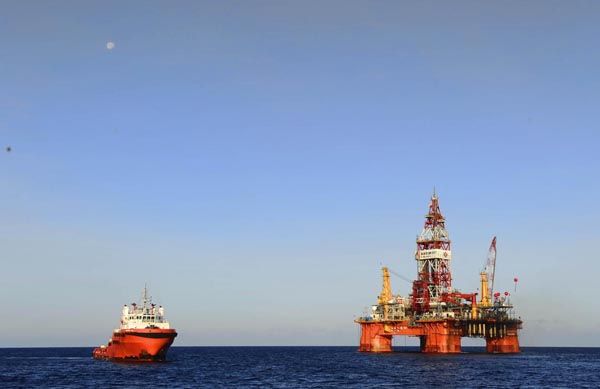 The first domestically manufactured deepwater rig started operations on Wednesday in the South China Sea. [Xinhua] |
Wang Yilin, chairman of rig operator China National Offshore Oil Corp, said that the rig will also protect the country’s sovereignty and territorial waters.
The deployment of the rig marks a significant step for the country’s deepwater strategy, Wang said.
“Our company will strive to protect the nation’s offshore oil interests,” he said.
Most of the company’s domestic oil production and exploration had previously been limited to a depth of about 300 meters.
Wang Min, vice-minister of land and resources, told a drilling ceremony in Beijing on Wednesday that the rig will play a strategic role in protecting China’s marine interests and guarantee its energy security.
The rig began operations as China and the Philippines continued a standoff over Huangyan Island.
On April 10 a Philippine warship entered the island’s territorial waters to harass Chinese fishing boats and attempted to detain Chinese fishermen. Chinese patrol boats came to the aid of the fishermen and are continuing to protect other fishermen from harassment.
The South China Sea is estimated to have about 16 trillion cubic meters of natural gas and up to 30 billion tons of oil, accounting for one third of China’s total oil and gas resources.
The surging demand for oil in countries around the South China Sea has escalated tension in the region.
However, compared with Vietnam and the Philippines, China’s search for resources lags far behind, said Feng Fei, director of the industry department at the Development Research Center of the State Council. More than 1,000 oil wells have been sunk by other countries, according to Chinese media reports.
This demands an acceleration in efforts to get resources, Feng, who is also a guest economist at China Daily, said.
The South China Sea is expected to be the world’s fourth-biggest deepwater region for oil and gas exploration after the Gulf of Mexico, Western Africa, and Brazil, said Zhou Shouwei, an academic at the Chinese Academy of Engineering.
The drill location is in the Chinese exclusive economic zone, Dong Manyuan, a researcher with the China Institute of International Studies, said and China’s attitude in the face of provocation reflects maturity.
Some countries, including Vietnam and the Philippines, have snubbed China’s goodwill gestures in proposing joint development.
“China drilling in the South China Sea is of deep significance, and ensures our energy security by reducing dependence on foreign oil,” he said.
Wu Shicun, president of the National Institute for South China Sea Studies, said the first rig is a landmark in developing oil and gas resources in the South China Sea and the scale will expand.
“Against a backdrop of some countries not responding positively toward China’s proposal of joint development, it is of supreme importance to finally solving sovereignty disputes,” Wu said.
“Setting aside disputes and embarking on joint development is the most effective way to solve the issue.’’
China depends on imports for more than 55 percent of its oil. China National Offshore Oil Corp set a target to boost oil and gas output to 120 million tons of oil equivalent by the end of 2020, double that of 2010, Yuan Guangyu, the company’s assistant president, said.
The company plans to have annual natural gas production of 10 billion cubic meters by the end of 2015 in deepwater areas in the eastern part of the South China Sea, according to Shi Hesheng, chief geologist of the company’s Shenzhen branch.
Contact the writers at zhouyan@chinadaily.com.cn and cuihaipei@chinadaily.com.cn

 Modeling contest part of China-US exchange
 Specially fertilized tea
 Simulator to support A320neo commissioned
 China's cultural sector sees steady growth in 2011
 Travel chaos after snowstorm hits NE China
 Inflation expected to rebound in November
 Grain output grows for 9th consecutive year
 White House-like buildings in E China city
Copyright 1995 - 2010 . All rights reserved. The content (including but not limited to text, photo, multimedia information, etc) published in this site belongs to China Daily Information Co (CDIC). Without written authorization from CDIC, such content shall not be republished or used in any form. Note: Browsers with 1024*768 or higher resolution are suggested for this site.
License for publishing multimedia online 0108263 Registration Number: 20100000002731