Understanding Beijing culture from Westerners' perspectives - that's the aim of 10 short films, shot by a group of undergraduates and graduates from the United States, together with their Chinese counterparts. Xu Lin reports in Beijing.
Markbradley Kitay, 20, a sophomore from Emory University's Goizueta business school, never expected that he would one day be in Beijing to shoot a short film about the city.
"It's my first time in China," Kitay says. "Beijing is so magnificent. It's old, but so much is new and on the rise."
 |
|
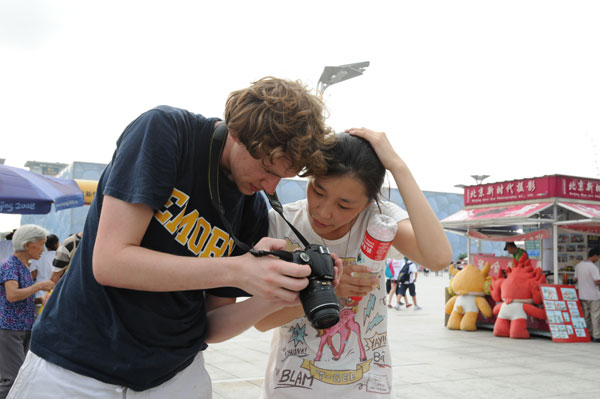
Markbradley Kitay and Lu Wenying collect materials near the Water Cube for their 10-minute production, Bottled Beijing. Xu Lin / China Daily |
Kitay is one of the 10 Americans who joined the 2012 Looking Beijing - Chinese and American Youth Summer Camping DV Project. They are students and graduates from Boston University and Emory University, who were in Beijing between July 19 and 21 to produce 10 digital videos about Beijing, together with 10 Chinese students from Beijing Normal University's school of art and communication.
The short films premiered on July 22 in the capital, featuring themes such as Chinese tea ceremonies, tai chi, coffee and bottled water.
Kitay's 10-minute production Bottled Beijing, is about the recycling of water bottles and how they affect the lives of bottle collectors and other people.
"I want to track the life cycle of the bottle and shoot it from various perspectives, including vendors and those who collect bottles on the streets," says Kitay, who arrived in Beijing on June 1, to join the Emory University's one-month program to learn Chinese language and culture. He then participated in the Looking Beijing program.
"I drink tap water in the United States. But I notice instantly it's different in China. These little bottles used to hold tea, coffee or water are everywhere," he says.
"It's also my first time holding a camera. I'm very excited. I want to thank my Chinese partner Lu Wenying, as I've learned many things about Chinese culture and shooting skills from her," says Kitay, who says he often acts in videos for his campus movie festivals but has never shot one.
Together with Lu, they filmed Beijing's iconic places, such as Tian'anmen Square, the National Stadium and Temple of Heaven.
"I think the bottle collectors are helping to keep the streets clean, but some may think they are just people going through trash," he says.
"It's a bit rough for me because I'm not a film major. But Lu makes it better as she tells me various things about Chinese culture and filming, shooting and editing," he adds.
Lu, 21, a junior student from Beijing Normal University, says Kitay's topic is unique and profound. Initially, Kitay wanted to shoot on the topic of mianzi (face), but they gave it up because it's difficult to shoot.
Both Lu and Kitay visited a garbage recycling factory to shoot their film - the first time for both of them. "It was an eye-opener for me," she says.
Wang Jingxin, 19, a freshman at Beijing Normal University, also experienced something she has never had seen before in China.
"I had never spent so much time in a traditional Chinese restaurant to observe customs," says Wang, whose film is titled The Beauty of Food.
It is set at Uncle Jia's Luzhu Restaurant in Qianmen, downtown Beijing, and the film centers on luzhu huoshao, a bean-paste stew dish with pieces of huoshao (dough dumplings), beancurd puffs and stewed lungs in it.
Co-directing the film is Scott Rosenkrantz, 20, a film and television graduate from the College of Communication, Boston University. "The film is about my attempt as a foreigner to look into the local eating customs, how the food is prepared, and to make some comparisons between the local residents and foreigners," says Rosenkrantz.
He says as food brings different people together, the restaurant becomes a meeting point for Western and Eastern cultures.
But he says there is room for improvement in his film.
"It's difficult for me to grasp the details due to my limited knowledge of Beijing eating culture. If I had more time, I would have done better!" he says, adding that he has learned a lot about China's history, which he will share with his friends back home.
Wang says she has also gained much from the cooperation. "We respect each other very much. It's a rare experience to co-produce a video with a foreigner. My oral English has improved greatly too," Wang says.
The Academy for International Communication of Chinese Culture at the Beijing Normal University (AICCC) started the annual project in 2011 with the aim of presenting Chinese culture from an American perspective.
"They've done a great job," says Huang Huilin, dean of the AICCC at the Beijing Normal University. "We are using 'Looking Beijing' as our brand name to promote culture in a modern way. Videos are both direct and simple."
Contact the writer at xulin@chinadaily.com.cn.
Copyright 1995 - . All rights reserved. The content (including but not limited to text, photo, multimedia information, etc) published in this site belongs to China Daily Information Co (CDIC). Without written authorization from CDIC, such content shall not be republished or used in any form. Note: Browsers with 1024*768 or higher resolution are suggested for this site.
License for publishing multimedia online 0108263 Registration Number: 130349 

