Comments()
  Print
Print  Mail
Mail  Large Medium Small
Herders of the Tibetan ethnic group are leading the charge in protecting grasslands and biodiversity in their communities, thanks to support from the government and environmental groups.
 |
|
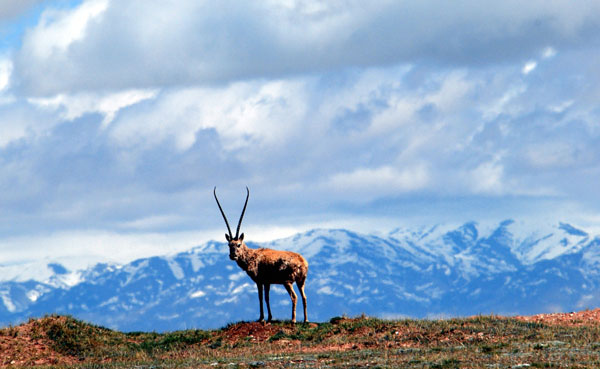
A Tibetan antelope grazes in the Hoh Xil Nature Reserve in Northwest China's Qinghai province. Xinhua |
In Tsochi village, Qinghai province, families have given up parts of their grazing land and removed fencing to create better habitats for wild animals, including the Tibetan antelope, wild yak and wild donkey.
The village lies in the Yushu Tibetan autonomous prefecture in the Three-River-Source Nature Reserve. The reserve, at an average altitude of over 4,000 meters above sea level, is where the Yangtze, Yellow and Lancang rivers originate, and covers 360,000 square kilometers.
Razi Karma, the village head, said 58 households have resettled in Qumarleb county and Golmud city, and about 140 families have stayed, living in summer tents on the pasture and in new government-subsidized houses in winter.
Nomads are encouraged to limit grazing land to protect pastures from degradation. They have received 90 yuan ($14) from the central government for every hectare they do not use for grazing since late 2011, when the State Council issued a ruling designed to promote sustainable development in herding areas.
Since 2004, more than 200 Tsochi residents have joined a volunteer group, Friends of the Wild Yak, which provides monitoring data of wild animals four times a year.
Their regular patrols around the village help prevent illegal hunting of wildlife such as marmots.
However, what herders fear most are mining and construction projects. Tsochi villagers blame gold-digging activities in the past for the deterioration of pastures. They have reported several cases of illegal gold and coal mining to authorities to force the miners to leave and pay fines, Razi Karma said.
"Without such disturbances, fish, shrimp and the grasslands have all flourished in recent years," he added.
The key is giving herders the right to intervene and protect their land, so that they are authorized to say "no" to people coming for illegal hunting, mining or construction, he said.
Having no access to caterpillar fungus, a major source of cash income for many Tibetan families, Tsochi villagers rely on livestock products, such as meat and wool, to make a living. The annual income per person is 1,500 yuan, Razi Karma said.
Their income is under threat because of climate change and damage caused by wildlife, he said.
More drastic weather conditions have been observed in the past. Sometimes the rivers have dried up. Villagers have to adapt to income fluctuations caused by severe winters or extremely hot summers. Brown bears and wild wolves go to herders' summer tents and destroy their belongings. They also attack and eat goats, cows and horses.
Although Razi Karma keeps track of the losses, there is no solution.
In the Tibet autonomous region, herders receive compensation from the government for damage caused by wild animals.
Early this year, the State Forestry Administration said 1,454 herding households in Damxung county, Lhasa, received a total of 2 million yuan in compensation for such damage, while 8.15 million yuan in compensation was allocated to Shannan prefecture.
Dawa Tsering at the Tibet Academy of Social Sciences said protection of ecologically fragile areas in the autonomous region include a ban on mining and major construction projects, pollution reduction and a limit on tourist visits.
Eco-tourism project
Protection of wild animals has been a major success. The numbers of Tibetan gazelles and wild donkeys have both exceeded 100,000, with government funding in ecological conservation increasing on a yearly basis, Dawa Tsering said.
Andreas Gruschke, a scholar from Leipzig University in Germany, has been to all but a few border townships in Qinghai on more than 50 research tours. He said more wild animals have been seen in the province in recent years, even near the main roads.
Wild gazelles used to keep some distance when seeing people. Now less afraid, they come a bit closer.
"They wouldn't go to the main roads unless they have a big population," Gruschke said, adding that the pastures "are certainly under stress" from an increasing number of wild animals and livestock.
The carrying capacity may vary from year to year because river sources and lakes can dry out. Rain is rare, but in June 2011, when he visited Qinghai, it had been a wet summer and had rained almost every day.
Gruschke has been offered a professorship at Sichuan University. He plans to develop a project on eco-tourism and start more discussions in China about how local residents can benefit from it.
Another study under consideration is waste disposal measures, especially in rural Tibetan-inhabited areas. Many drinking bottles can be seen, probably thrown away by truck drivers. Rural communities facing piles of uncollected waste should work with the administrators to find a solution, Gruschke said.
A three-river-source environmental protection association, which helps Tsochi village carry out its green initiatives, is also working on household garbage collection and medical waste disposal.
A team of villagers is in charge of garbage-collecting. They send the waste to a large pit near a river, where it smells, especially in summer, said Liu Ying, an accountant working for the association in Xining, capital of Qinghai.
Medical waste from rural clinics is usually burned or buried. It is difficult to collect because the clinics are located far apart. Some doctors are concerned about recycling syringes because tainted supplies could be reused and cause great harm to patients, Liu said.
In August, the association will invite doctors from Taiwan to train rural healthcare providers and will probably agree on a standard practice on how to collect medical waste, she said.
Contact the writers at liyao@chinadaily.com.cn and
daqiong@chinadaily.com.cn

 Modeling contest part of China-US exchange
 Specially fertilized tea
 Simulator to support A320neo commissioned
 China's cultural sector sees steady growth in 2011
 Travel chaos after snowstorm hits NE China
 Inflation expected to rebound in November
 Grain output grows for 9th consecutive year
 White House-like buildings in E China city
Copyright 1995 - 2010 . All rights reserved. The content (including but not limited to text, photo, multimedia information, etc) published in this site belongs to China Daily Information Co (CDIC). Without written authorization from CDIC, such content shall not be republished or used in any form. Note: Browsers with 1024*768 or higher resolution are suggested for this site.
License for publishing multimedia online 0108263 Registration Number: 20100000002731