Comments()
  Print
Print  Mail
Mail  Large Medium Small
 |
|
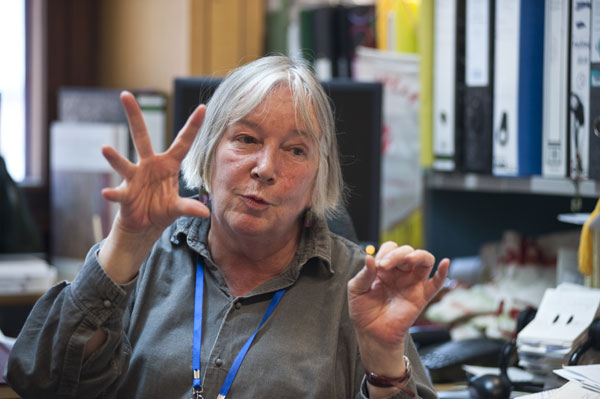
Frances Wood, head of the Chinese collection at the British Library, says she suspects Marco Polo's tales were a second-hand travel guide. Nick J.B. Moore / for China Daily |
A prominent UK China scholar tells Andrew Moody why she doesn't trust all those signs and suggestions that 'Marco Polo slept here'.
Frances Wood, head of the Chinese collection at the British Library, seems almost too unassuming to have exposed a celebrated figure in Chinese history as a possible fake. She remains best known, however, for her book, Did Marco Polo Go to China? , which argued he didn't and that the Venetian merchant explorer's tales were in reality merely a second-hand travel guide.
"Yes, people got very cross about it actually. Everybody likes him. Every schoolchild in China learns about this little man who walks all the way across the Gobi Desert," she says in her London office.
Wood, 64, draws an unlikely parallel between the Chinese attachment to Marco Polo and other figures who they have taken to their bosom such as former US president Richard Nixon and former British prime minister Edward Heath.
When she was a student in China in the 1970s, Wood says, her friends said they liked Nixon "because he recognized China" and Heath for similar reasons.
"It is the same kind of thing with Marco Polo," she says with a wry smile.
Wood argues that Polo, if he existed, was a remarkably unobservant traveler since he makes no mention of foot binding, tea drinking or chopsticks.
"People say he wouldn't have used chopsticks. They would have given him a spoon or something like that. In Europe at that time they were beginning to experiment with the fork and so you think he might have been interested in the way people ate," she says.
The eminent curator also points out that although he is famous in Venice now, no one made a fuss of anyone called Marco Polo at the time.
She says it is more likely The Travels of Marco Polo was some purloined database of Middle East traders who had a long history of doing business in China.
"Polo used either Persian or Turkish nouns for everything and not Chinese or even Mongol names. This might mean whoever created this thing was using a Persian guidebook for merchants since there had been many Persian people traveling and trading in China since the Tang Dynasty (AD 618-907)," she says.
Wood, who combines enthusiasm with a matter-of-fact manner, is curator of some of the most valuable Chinese printed works in the world, including the Diamond Sutra, the world's earliest printed book dating back to the 9th century, on which she has recently produced a book with conservationist Mark Barnard.
It was discovered in a cave in the Gobi Desert by British archaeologist Aurel Stein in 1907.
"I have done an enormous amount of work with that over the last 20 to 30 years because as China opened up, Chinese scholars wanted to come and look at the material. So we have done as much as we can to make it possible for them to do that," she says.
A large part of the British Library Chinese collection comes from Hans Sloane, the doctor and collector whose vast treasures formed the basis of the British Museum.
It also includes a collection of Oracle Bones that were discovered in Shandong province by missionaries in the 19th century and bought by the British government.
"They are the Shang Dynasty (c. 16th century to 11th century BC) archive or records, if you like. They are about 3,000 years old," she says.
Some of the British Library collection comes from the looting of the Summer Palace in Beijing by Anglo-French forces in 1860.
"Yes there are items from the Summer Palace, including one we bought from the French general in charge of the French troops," she says.
She insists, however, that most of the collection has been assembled by more acceptable means.
"The vast majority, you know, 99.9 percent of our collection was acquired perfectly legitimately through dealers. A lot was bought by Anthony Panizzi, the great librarian here, in about 1840 when he purchased a big collection of early Ming and Qing Chinese fiction which had come in from Paris," she says.
"We are still acquiring. We get a lot through dealers and also private people."
Wood, herself the daughter of the Keeper of Printed Books at the British Museum (the British Library became a separate entity in 1972), originally studied art in Liverpool but switched to reading Chinese at Cambridge.
"I was quite good at languages and I think I chose Chinese completely out of a hat, but I am terribly pleased I did."
Her first experiences of China were in the 1970s, which she chronicles in an engaging book called Hand-Grenade Practice in Peking: My Part in the Cultural Revolution. The throwing of hand-grenades, which were not live, was a Saturday morning compulsory sport.
"When I went in 1971, I remember waking up in the center of Beijing and hearing a funny noise outside and looking out of the window and seeing flocks of sheep being driven to market. It could have been a tiny country town," she says.
"I think the opening-up of China to the rest of the world is a good thing generally, although I am terribly sad that with globalization everything looks the same. You go to China and see the same shops you see here."
She is a foremost authority in her field and had the rare honor for a Sinologist, at least, of appearing on the BBC Radio 4 Desert Island Discs program usually reserved for those of celebrity status, in 2010.
She used to visit China three or four times a year but now less often. She maintains her Chinese by poring over Chinese documents every day - and hosting a lot of Chinese visitors and delegations.
Wood says China hasn't demanded any of its great printed works back, unlike the Greeks with the Elgin Marbles at the British Museum. The vast majority of valuable Chinese books remain in China, she says, and the British Library has concordats with Peking University and the National Library of China.
"I don't think people are of the view, 'it's ours, we must have it back'. They just want to know where it is and whether to make their own digital images. Books are not as sensitive as certain artifacts."
Huang Tiantian contributed to this story. Contact the writer at andrewmoody@chinadaily.com.cn.
Copyright 1995 - 2010 . All rights reserved. The content (including but not limited to text, photo, multimedia information, etc) published in this site belongs to China Daily Information Co (CDIC). Without written authorization from CDIC, such content shall not be republished or used in any form. Note: Browsers with 1024*768 or higher resolution are suggested for this site.
Registration Number: 20100000002731