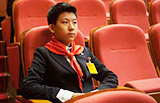
Wang Lijuan, a Chinese student from Washington University in St. Louis, faces more challenges than just the language and intensive courses during his first year of study abroad.
"It's hard to make friends at first, and most of my friends are Chinese, no different from home," said the 24-year-old business major. "I have to force myself to get used to how my classmates socialize with each other and find opportunities to meet new friends."
Wang is not alone.
According to Katherine Ratliffe, an associate professor at the University of Hawaii, though increasing numbers of Chinese students are going to the United States for study, many are confronted with differences in values, world views and socializing, especially students with poor English skills, difficult economic situations or divorced families.
"Many students have to struggle with cultural differences," she said at an East-West Center international conference held on Saturday.
"Some get assimilated, some integrated, some marginalized and some simply separated," she said.
Many young Chinese students struggle at making friends and understanding social customs, and some want to go back to China because of loneliness or poor grades, Ratliffe said.
According to a report on Chinese Students Studying Abroad 2011, by China Education Online, the number of Chinese students going to the US to study has grown by more than 20 percent for three consecutive years.
In addition to the increased value of the yuan, encouraging Chinese that the time is right for the investment, the rise of the Chinese middle class also contributes to the trend of overseas study, said Xu Jing of the University of California, Los Angeles.
"Chinese parents are more than ever able to afford the higher education abroad," she said. "Compared with domestic education, which has long been criticized, Chinese parents obviously prefer the to send their children abroad."
According to the Chinese Luxury Consumer White Paper issued in March by the Hurun report, nine out of every 10 Chinese whose assets exceed 100 million yuan ($16 million) plan to send their children abroad, and 85 percent of those with at least $1 million said they would send their children overseas for education. China's growing middle class also has aspirations to send their children abroad for education, according to the report.
Chinese parents will sacrifice almost everything they have for their children's education. Middle class families are more likely to spend their income on education than on leisure.
Despite all the shortcomings, American universities are seen by Chinese as emblems of the highest achievement, Xu said.
Wealthy Chinese parents believe the critical and quality-oriented teaching of a Western education works better than the Chinese schooling, which is sometimes rigid and mechanical, she said.
In addition, the friendly visa policy promotes the tendency, she said.
US Ambassador to China Gary Locke said at a conference that the US government funds more American students to study in China than in any other country and more students from China study in the US than those of any other country.
zhengxin@chinadaily.com.cn


Copyright 1995 - . All rights reserved. The content (including but not limited to text, photo, multimedia information, etc) published in this site belongs to China Daily Information Co (CDIC). Without written authorization from CDIC, such content shall not be republished or used in any form. Note: Browsers with 1024*768 or higher resolution are suggested for this site.
License for publishing multimedia online 0108263 Registration Number: 130349