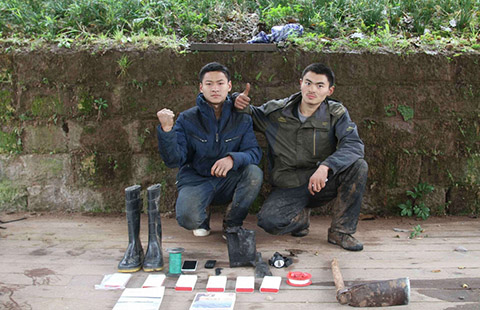
Sun Chunlong is awaiting the results of a DNA test on a body he found in a burial site for Chinese soldiers in Myanmar.
The remains were uncovered in early May in the backyard of a temple in Namhkan, where Chinese soldiers fought Japanese during World War II.
With the help of a resident of Chinese nationality, Sun and volunteers managed to take the remains to China and send them to a medical agency in Beijing for testing in July.
"We will make a record of the DNA sequences and collect the remains into a museum, where the offspring of the tens of thousands of soldiers killed can come for DNA identification," he said. "There must be lots of Chinese soldiers buried in the backyard of the temple, and we will go back to create a cemetery there."
Sun, 36, founded Shenzhen Longyue Charity Foundation, which focuses on the welfare of veterans and on soldiers killed in the War of Resistance Against Japanese Aggression (1937-45), and started to carry out his project to repatriate remains in May.
The goal is to return the bodies of soldiers who died in other countries to their homeland.
The number of Chinese soldiers killed in foreign countries during World War II is unknown.
Ge Shuya, a historian in Southwest China's Yunnan province, said there were nearly 100,000 Chinese soldiers killed in Myanmar from 1942 to 1945.
Most of their bodies were buried in Myanmar, and nearly all of their tombs were destroyed in the 1950s due to political reasons, Ge said.
Sun said he felt "heartbroken" when he visited the burial site at the temple in Namhkan.
"Before I visited the temple, I could imagine that the tombs might not be taken good care of, given the fact that ties between China and Myanmar had experienced decades of changes," he said.
"But I was stunned when I saw the burial site - all of the tombs had been flattened and there wasn't even a hump of earth in the barren land filled with weeds," Sun said.
Sun, a former journalist for Oriental Outlook magazine, started to focus on maintaining the tombs of soldiers sent to Myanmar to fight the Japanese invasion, known as the Chinese Expeditionary Force, since he visited a cemetery in Tengchong county, Yunnan province, in 2005.
A total of 9,618 soldiers were buried in the cemetery, which was poorly maintained since the Kuomintang's contributions to the War of Resistance Against Japanese Aggression were not given enough acknowledgement for decades, Sun said.
"We owe too much to the brave soldiers," Sun said.
Sun quit his job in 2011 and established the foundation to help "soldiers forgotten by history". Sun's foundation has raised 1 million yuan ($158,000) in just over a year.
Sun went to Myanmar many times to visit the burial sites of Chinese soldiers.
"There are scores of burial sites where battles of different scales occurred," he said. "All the places I visited were destroyed with no tombs left."
Wang Guangya, 96, a veteran of the Chinese Expeditionary Force who went to Myanmar in 1942 to fight the Japanese army, stayed in the mountainous region of Myanmar after World War II. Wang told Sun that nearly 70 years have passed and nobody has come to the region to look for the soldiers' remains.
Zhang Yushi, 94, a veteran of the 38th division of the Chinese Expeditionary Force, said that at least two or three bodies of Chinese soldiers could be found every 500 meters in the mountainous region.
"Lots of soldiers died from various diseases, snake bites, and so on," he said. "Their bodies were buried where they died, or were even discarded sometimes since the survivors had no strength to dig a tomb for the deceased."
The central government released a regulation in August 2011, which said that the protection of the memorial facilities for Chinese soldiers who died overseas should be carried out by the Ministry of Civil Affairs, the Ministry of Foreign Affairs and other agencies.
"Officials of the Ministry of Civil Affairs showed great interest in my suggestion to seek the remains of those soldiers," he said.
Sun said the help of the Ministry of Foreign Affairs is needed to get the soldiers' remains back from foreign countries, since it is difficult to take the remains across the border without permits.
"Lots of Myanmar residents were not very friendly to the Chinese Expeditionary Force, because they thought the Chinese army was sent to help the British army sustain its colony in the region in the 1940s," Sun said. "As a result, we came across lots of difficulties in dealing with the residents and governments in Myanmar."
An official from the publicity office of the Ministry of Civil Affairs said on condition of anonymity that the ministry has started to protect Chinese soldiers' tombs in foreign countries with the coordination of foreign affairs authorities.
"It is not the proper time now to publicize the activity officially," he said. "The fund for the protection of Chinese soldiers' tombs overseas has been set by the ministry."
Sun said that he is optimistic about the government's support and plans to establish a museum to collect DNA samples of the soldiers.
Their offspring will be able to go to the museum to seek their remains through DNA identification.
Contact the writer at anbaijie@chinadaily.com.cn


Copyright 1995 - . All rights reserved. The content (including but not limited to text, photo, multimedia information, etc) published in this site belongs to China Daily Information Co (CDIC). Without written authorization from CDIC, such content shall not be republished or used in any form. Note: Browsers with 1024*768 or higher resolution are suggested for this site.
License for publishing multimedia online 0108263 Registration Number: 130349