Comments()
  Print
Print  Mail
Mail  Large Medium Small
Chinese people have seen a decrease in leisure time in the past three years, a new study shows.
Insight China, a State-run magazine that looks into Chinese people's welfare, polled 1,007 people nationwide in August and September and found that 70 percent said they are unsatisfied about the amount of leisure time they have.
|
 |
|
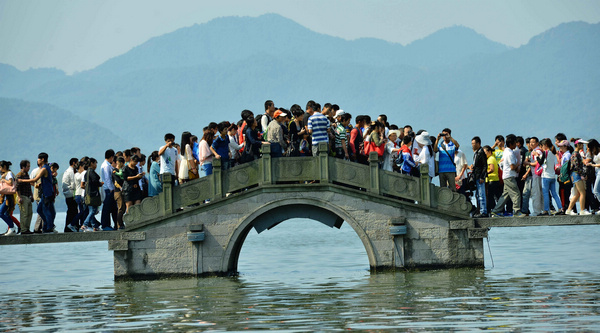
Tourists huddle together on the crowded Yongjin Bridge over West Lake in Hangzhou, the capital of Zhejiang province, on Oct 1 during the National Day holiday. Long Wei / for China Daily |
Sixty percent of people surveyed were between 23 and 42 years old, more than 70 percent earn 3,000 to 10,000 yuan ($480 to $1,590) a month, and 60 percent have a bachelor's degree or higher qualification.
Nearly 70 percent said they are overworked. More than 40 percent said they work 40 to 50 hours a week, with 1.3 percent saying more than 80 hours a week.
Only 30 percent of those polled said they work 40 hours a week, the statutory working hours stipulated by Chinese law.
|
 |
Other factors that affect enjoyment of leisure time include family income, individual interests, habits and characteristics, skills to enjoy leisure activities, and health.
The survey found that more than 40 percent spend less than 10 hours a week on leisure, and only 8 percent have more than 30 hours a week for leisure.
Chinese people have seen decreasing leisure time since 2010, and more than 40 percent of respondents said they have enjoyed less leisure time this year than last.
Among the activities people said they will spend their leisure time doing, the first choice was surfing the Internet, followed by taking a walk, climbing a mountain, visiting parks, watching TV and traveling.
Chinese people commonly feel they have insufficient leisure time because of the country's stage of economic development, said Wei Xiang, director of the Beijing International Studies University's center for China leisure economic research.
"China is still very much a labor-intensive economy, and in such a situation it's hard to offer plenty of time for people to enjoy leisure," he said.
"Our study found that most Chinese people want to earn money instead of taking vacations," he said.
"When China successfully reforms its income distribution and the overall social security system is built, the situation will change."
Wei said many people still put work at the center of their everyday lives, and surfing the Internet benefits work because online chatting and sending e-mails helps establish connections and improves relationships.
Compared with outdoor activities such as traveling, Web browsing at home costs much less, which is relevant as the per capita GDP in China is still not high, he added.
In fact, experts have been calling for an enforcement of the paid-leave policy to help people enjoy more leisure time.
A survey of approximately 2,400 people found 55 percent had never enjoyed paid leave from work, and only 22 percent said they could enjoy fully-paid leave every year, Guangming Daily reported. Of those polled, 46 percent had worked for more than 10 years.
The State Council endorsed a regulation in 2008 that allows workers to enjoy five days of paid leave a year after working for 12 months. People who have worked for 10 years could enjoy 10 days of paid leave and workers who have worked for 20 years and longer get 15 days.
Huang Yiqiang, who works at an accounting firm in Beijing, said his employer allows him eight days of paid leave each year but he has never fully enjoyed them.
"My work pressure is heavy so I have to finish my work before I can consider taking paid leave," said the 29-year-old, who has worked for the company for four years. "I wish there were more long holidays."
Currently, the State-mandated annual leave is 11 days in total. There are only two long holidays, the Spring Festival and National Day holidays, with three days each. Usually, the length of the two holidays can be extended to seven days including weekend, nicknamed Golden Week.
Wang Qiyan, a researcher of leisure economy at Renmin University of China, said it is necessary to bring back the May Day holiday, which was shortened from seven days to three days in 2008. He also suggests more efforts to enforce the paid-leave policy.
Government departments and large enterprises implement the paid-leave policy well but such welfare is still absent in many small and medium private companies, he said.
Labor authorities and trade unions should take action to make the policy better implemented to ensure workers' legitimate rights, he said.
chenxin1@chinadaily.com.cn

 Modeling contest part of China-US exchange
 Specially fertilized tea
 Simulator to support A320neo commissioned
 China's cultural sector sees steady growth in 2011
 Travel chaos after snowstorm hits NE China
 Inflation expected to rebound in November
 Grain output grows for 9th consecutive year
 White House-like buildings in E China city
Copyright 1995 - 2010 . All rights reserved. The content (including but not limited to text, photo, multimedia information, etc) published in this site belongs to China Daily Information Co (CDIC). Without written authorization from CDIC, such content shall not be republished or used in any form. Note: Browsers with 1024*768 or higher resolution are suggested for this site.
License for publishing multimedia online 0108263 Registration Number: 20100000002731