Young children pushed to learn far beyond their natural level
What should a 3-year-old child know about math? If they are unable to count from one to 100 should the child be viewed as unintelligent or not diligent?
According to the Ministry of Education, a 3-year-old only needs to be able to count one to five, and be able to calculate simple sums using these numbers.
In a rare move, the ministry released guidelines on early childhood education on Monday, in an effort to curb the growing practice of young children being educated in a way that pushes them beyond what children at their age should learn.
 |
|
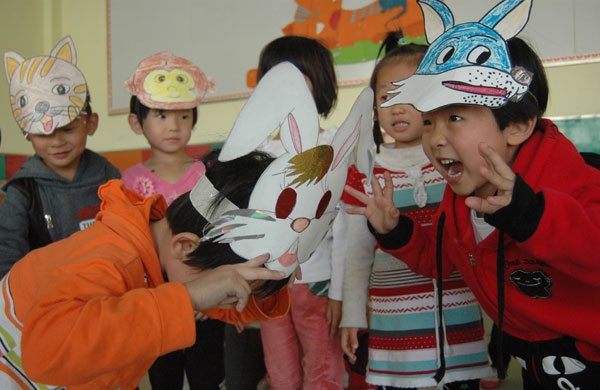
Children play a game at a kindergarten in Liaocheng, East China's Shandong province, on Oct 9. Zhang Zhenxiang / for China Daily |
The guidelines, published on the ministry's website, provide detailed development criteria for children aged from 3 to 6 in five fields, namely health, language, social ability, science and arts.
The health section states that a 3 to 4-year-old child should be able to run fast for about 15 meters, and know to reject strangers' invitation to go with them or their offer of food, according to the ministry.
A 5-year-old child should be able to tell the exact location of his or her hometown and able to name a few landmark buildings and specialties of the place.
The new guidelines are also designed to clarify to some parents what children at different ages should be able to do.
"Many people don't understand children's development, and believe that feeding children knowledge as early as possible is a good way to educate," said Liu Yan, a professor on early childhood education at Beijing Normal University.
It is common for kindergarten kids across the country to take advanced lessons, such as primary school courses, said Liu, also a member of China National Society of Early Childhood Education.
"The guidelines give teachers and parents a reasonable guide to children's development," Liu said.
|
 |
But she was quick to add that the chances of the guidelines easing the study burden on kindergarten children is slim unless there are changes by primary schools.
The education pressure on the more than 100 million children aged 6 and under across China has many parents feeling anxious.
Che Aiping, 35, the mother of a 5-year-old boy, said she feels uneasy about her son's entry into primary school, despite the child taking English, piano and chess classes and being exceptional among children at his age.
"I'm glad the authority is taking measures to cope with young children's educational problems, but I'm still caught up with my son's education," she said.
"I want to give my son a happy childhood, but I don't want him to lose a bright future and blame me when he grows up," she said. "Now, most families have one child, which puts a greater burden on the kid's education."
Che is looking for a primary school for her son but so far without success.
"Although authorities suggested children enter schools that are near to their homes, I still want to make an effort to choose a better school for my child," said the mother who has spent a lot of time reviewing potential primary schools.
Some schools now require children to pass intelligence and physical examinations. Some children even have a resume before starting school, a fact that Che said has made her even more anxious.
Mao Jing, a kindergarten teacher from Nanxi Kindergarten in Shanghai, a national model kindergarten, said some children in her class were able to count from one to 100 in Chinese and in English.
Mao's class has 25 children aged from 3 to 4. She said only one or two children in the class would not have taken math classes before entering kindergarten.
Mao said the guidelines are just a suggestion, not a requirement.
"Every child is different. There shouldn't be a single standard to evaluate all children's development," she said.
But Mao said she believes that the guidelines provide a useful tool, "like a dictionary", for parents and less experienced teachers.
Yuan Ailing, an early childhood education professor from South China Normal University, said that the guidelines provide a standard for educators and parents. "The number of private kindergartens is growing in recent years. But parents can only judge the kindergartens based on the hardware, such as the look of the campus and the tuition fees. Investors don't have the criteria to evaluate the kindergartens they spend money on. The guidebook gives an authoritative evaluation for all parties," Yuan said, adding that the guidelines provide a theoretical foundation to children's development.
She also praised the education suggestions in the guidelines. "Teachers and parents know exactly what to do to help and evaluate children's development," Yuan said.
Contact the writers at luowangshu@chinadaily.com.cn and caoyin@chinadaily.com.cn



Copyright 1995 - . All rights reserved. The content (including but not limited to text, photo, multimedia information, etc) published in this site belongs to China Daily Information Co (CDIC). Without written authorization from CDIC, such content shall not be republished or used in any form. Note: Browsers with 1024*768 or higher resolution are suggested for this site.
License for publishing multimedia online 0108263 Registration Number: 130349