Comments()
  Print
Print  Mail
Mail  Large Medium Small
This year marks 20 years since the socialist market economic system was implemented in China.
During that time China has become the world's second largest economy. While the country's economic performance and restructuring has received wide acknowledgement, China also placed political restructuring in an important position in its overall reform and development agenda. It has successfully created the path of political development with Chinese characteristics.
In August, the State Council decided to remove or modify 314 administrative examination and approval items in order to clear obstacles for its social and economic development and curb corruption.
A total of 2,497 administrative approval items have been rescinded or adjusted over the past 10 years, accounting for 69.3 percent of the total.
|
 |
The removal of government's administrative approval items and a major institutional restructuring of the State Council that took place in 2008 were both important measures for administrative system reform, and the important components for political restructuring.
"Political restructuring has been strengthening along with the progress of China's economic restructuring during the past 30-odd years since the country carried out its reform and opening up policy," said Li Junru, a prominent theorist and former vice-president of the Party School of the Communist Party of China Central Committee.
"Incorporating political restructuring into economic restructuring has been a distinct feature of China's political restructuring," he said.
China has made efforts in reforming its political system during the last three decades.
China has eliminated de facto life tenure for leading officials, and realized orderly succession of organs of State power and leaders. The country has expanded orderly public participation in political affairs, and the people are extensively involved in decision-making.
China has upheld and improved multi-party cooperation under the leadership of the CPC, carried out political consultation, democratic oversight and participation in the deliberation and administration of state affairs. It has also developed a patriotic united front.
The country has set up a sound and dynamic personnel mechanism, which attracts large numbers of talented people and puts them to best use and prepares them for both promotion and demotion.
Moreover, China put in place a socialist legal system of laws with Chinese characteristics by the end of 2010.
Li Junru, also a member of the Standing Committee of the Chinese People's Political Consultative Conference National Committee, the top political advisory body, said: "Combining electoral democracy with consultative democracy is another distinct feature of China's development of political democracy especially in the past 10 years."
Democracy is always pursued within the CPC. As of this July, the leadership reshuffle of local Party committees at the provincial, city, county, and village-level had been completed. Promoting democracy and ensuring Party members' rights have featured the process of the reshuffle.
"Improving the elections of deputies to legislative bodies has been a major manifestation of the advancement of electoral democracy in the past 10 years," Li said.
In March 2010, the National People's Congress, the parliament, adopted the amendment to the Electoral Law with landslide votes, which grants equal representation in legislative bodies to rural and urban people.
It requires "both rural and urban areas adopt the same ratio of deputies to the represented population in elections of people's congress deputies."
It also raises the ratio of deputies from the grassroots level and sets more specified requirements for the elections to ensure justice and transparency.
"Meanwhile, the role played by political consultative bodies at various levels reflects the advancement of consultative democracy in the past 10 years," Li said.
In a speech delivered at the opening session of a workshop for ministerial-level officials on July 23 this year, President Hu Jintao said the Party has put political system reform in an important position in the overall reform and development agenda. He said significant progress had been made in that regard.
| ?
 |
|
The sun sets behind two cranes on a construction site in central Beijing October 11, 2012. [Photo/Agencies]
|
"Putting political system reform in an important position all along in the overall reform and development agenda" has summarized the experiences drawn from the reform and opening-up, Li said.
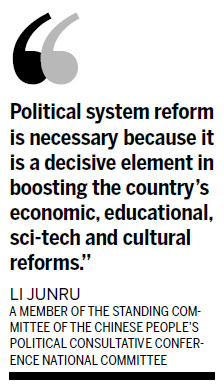
"Political system reform is necessary because it is a decisive element in boosting the country's economic, educational, sci-tech and cultural reforms," he said.
The reform of the political system has been far from achieving its goals, especially in terms of preventing individuals from acting willfully on their own or abusing their power.
"China will not copy Western-style political systems," Li said.
On the basis of China's national conditions, the country will continue to keep combining electoral democracy with consultative democracy, driving people's democracy by intra-Party democracy, and governing the country by law, he said.
Xinhua

 Modeling contest part of China-US exchange
 Specially fertilized tea
 Simulator to support A320neo commissioned
 China's cultural sector sees steady growth in 2011
 Travel chaos after snowstorm hits NE China
 Inflation expected to rebound in November
 Grain output grows for 9th consecutive year
 White House-like buildings in E China city
Copyright 1995 - 2010 . All rights reserved. The content (including but not limited to text, photo, multimedia information, etc) published in this site belongs to China Daily Information Co (CDIC). Without written authorization from CDIC, such content shall not be republished or used in any form. Note: Browsers with 1024*768 or higher resolution are suggested for this site.
License for publishing multimedia online 0108263 Registration Number: 20100000002731