Comments()
  Print
Print  Mail
Mail  Large Medium Small
If traffic officials in Shijiazhuang have their way, pedestrians will no longer be able to defy red lights and cross the streets any time they please without fear of punishment.
Authorities in the city, the capital of Hebei province, have begun imposing fines as high as 50 yuan ($8) on jaywalkers as part of a trial campaign meant to stop people from crossing roads at the wrong times and places.
The new rules treat pedestrians attempting to move across large and small intersections differently. When groups of pedestrians cross large intersections in defiance of red lights, the first three of their members will be fined; at smaller intersections, all jaywalkers will be punished, Wu Ruiqi, director of the Shijiazhuang traffic management bureau, was quoted as saying by Legal Daily.
|
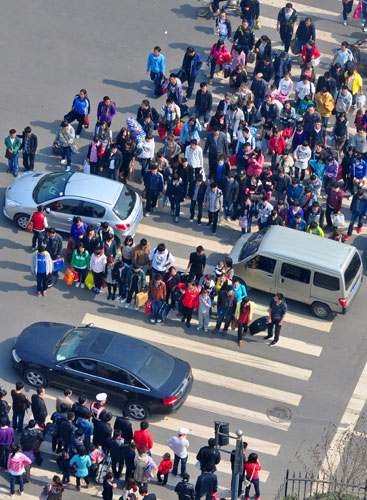 A group of pedestrians jaywalk across a road in Taiyuan, capital of Shanxi province. Deng Yinming / for China Daily |
The trial comes in response to a heated debate that arose online in China about the "Chinese style of crossing the road", a term referring to the tendency of large crowds of people to cross roads in disobedience of red lights.
The controversy became more heated after someone posted a comment on Sina Weibo, a micro-blogging site, saying "the Chinese way of crossing roads is to cross them without taking traffic lights into consideration, so long as you are part of a crowd".
In a China Central Television news program this month, a video showed more than 600 people walking through red lights over one hour at a crossroads in Shijiazhuang.
Some said the Chinese believe authorities are reluctant to punish large numbers of people at once and thus don't mind violating the rules in groups.
"I believe that imposing fines is not the ultimate purpose of this campaign," said Zhang Yanchen, a 25-year-old resident. "This will at least have the effect of changing people's notion that offenders can avoid being punished."
Zhang Yajun, an employee at a telecommunication company in Shijiazhuang, said she still sees people who disobey red lights in places downtown - even at times when police are obviously stationed at crossroads.
"It will be difficult to identify who the first three rule-breakers are when a group of people walk through a red light. In these sorts of case, there could be disputes when the police try to fine offenders and that could lead to traffic jams."
Zhang Yajun said the new policy will help to moderate the behavior of pedestrians, cyclists and motorcyclists, a goal that she says is more important than helping them save a few seconds.
The argument also raised questions about how long pedestrians should be kept waiting at red lights.
"The waiting time in front of a traffic light can affect pedestrians' behavior," Ni Ying, a member of a research team at Tongji University's School of Transportation Engineering, was quoted by Xinhua News Agency as saying. "They are more likely to ignore the light when the time they have to wait is longer than they can stand."
From 2008 to 2010, Ni's team conducted research on pedestrians' waiting times at various road crossings and found a correlation between jaywalking and the length of time they had to halt their progress before the light changed.
Their study found the Chinese to be "very patient", saying they would wait up to 90 seconds on average for the light to change. The British, in comparison, would wait 45 seconds and the Germans 60 seconds.
But Chinese people's apparent greater patience may not be enough. The study noted many red lights last for more than 90 seconds.
Ni said the design of traffic lights in China is better suited to regulating automobile traffic, thus tempting pedestrian to break the rules.
Zhang Changqing, director of Beijing Jiao Tong University's Institute of Transportation Law, said the new policy violates the spirit of the law, saying everyone should be treated equally.
Zhang also called for a greater use of public transport. That, he said, will help relieve road congestion and prevent pedestrians from spending great lengths of time at intersections waiting for the light to change.
Zheng Jinran contributed to this story.
tanzongyang@chinadaily.com.cn

 Modeling contest part of China-US exchange
 Specially fertilized tea
 Simulator to support A320neo commissioned
 China's cultural sector sees steady growth in 2011
 Travel chaos after snowstorm hits NE China
 Inflation expected to rebound in November
 Grain output grows for 9th consecutive year
 White House-like buildings in E China city
Copyright 1995 - 2010 . All rights reserved. The content (including but not limited to text, photo, multimedia information, etc) published in this site belongs to China Daily Information Co (CDIC). Without written authorization from CDIC, such content shall not be republished or used in any form. Note: Browsers with 1024*768 or higher resolution are suggested for this site.
License for publishing multimedia online 0108263 Registration Number: 20100000002731