He is tilting at windmills that will power the future of Chinese musical theater, but Joseph Graves tells Chen Nan that this is what makes him happiest.
In one of the last moments of the play, Man of La Mancha, Cervantes is being led away from prison to be questioned by the Spanish Inquisition. One of the prisoners says to him as he starts to leave, "I think you, Cervantes, and Don Quixote have much in common." Cervantes smiles and says, "God, help us, we are both men of La Mancha."
 |
|
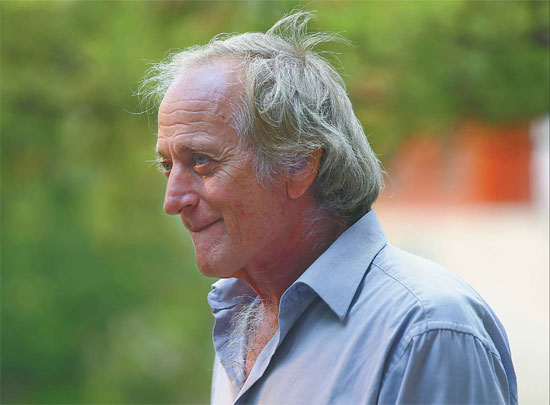
Joseph Graves says theater for him has never been a career, but a way of life. Zou Hong / China Daily |
This scene is one of Joseph Graves' favorites and he likes to believe that he, too, is a man of La Mancha.
Since his late teens, Graves, 57, has spent most of his adult life acting, directing and writing for the theater and for films, in Britain, the United States and in many other countries around the world.
As he says: "Theater for me has never been a career, but a way of life."
And now this life is based in China. Graves, who comes from Arkansas in the US, set the base for his theater dreams in China a decade ago. He works as the artistic director at Peking University's Institute of World Theater and Film.
In 2002, he accepted an invitation from Cheng Zhaoxiang, dean of the School of Foreign Languages of Peking University, and a Shakespeare scholar, to work with students on Shakespeare's play, The Tempest.
"He told me that he had a strong passion to bring Shakespeare to life, to bring theater to life, rather than just read and study about it. I love the idea of doing that," he recalls. "I am very interested in seeing how different cultures mix in a play."
Cheng posted a notice on the university website and some 4,000 students auditioned.
Nourish dreams
"Some of the students had never acted onstage and some had never seen a play. But they wanted the experience of creative activity," says Graves, describing that experience as life changing.
"I was deeply moved by the students' passion, talent and intelligence when we worked together and that, coupled with my experiences with the professional theater artists of China, made me want to live and work here."
Graves received his professional training at the London Academy of Music and Dramatic Art, and he has directed more than 36 shows, including Richard II and Hamlet, written 20 original scripts and acted in some 60 stage productions.
He says his grandfather, who was a missionary, loved reading lines of Shakespeare's plays after work, which influenced Graves since he was young.
He is now busy with the second presentation of the musical Man of La Mancha, which was successfully staged in June 2012 in Beijing and will be performed from November 2012 to January 2013 again, in the capital.
As he puts it, Man of La Mancha is not only a hugely successful musical, a 1965 Broadway musical that won five Tony Awards, but a deeply moving play about the importance of sustaining and nourishing dreams while standing opposed to the materialistic greed and selfishness that the world too often displays.
Yang Jiamin, 25, whose company produced the musical of Man of La Mancha, was a former English major student under Graves. She recalls that it was Graves who helped her develop an interest in theater.
"His class is never boring. He would ask us to perform as actors and produce a play by ourselves," recalls Yang. "He does share something in common with Don Quixote."
Besides working on classical Western plays, Graves also directed an English language version of The Monkey King, which was performed in Beijing and then toured the US with an all-Chinese cast.
Hu Xiaoqing, a former student of Graves and now a successful director and writer for the theater in China and in the US, wrote the play.
Cheng, the dean who invited Graves to Beijing, says: "He is a dedicated theater professional, and as a teacher, he helped shape the lives of many students."
Cheng and Graves both believe that China's higher education is lacking in giving its students the mind-opening experience of artist creativity.
In 2005, they founded the Institute of World Theater and Film, which facilitates exchange programs between China and other countries and helps establish performing arts departments in universities all over China.
"The performing arts departments are not geared so much toward turning out professionals but primarily give exposure to all students, such as students of economics, biology and history," Graves says.




Copyright 1995 - . All rights reserved. The content (including but not limited to text, photo, multimedia information, etc) published in this site belongs to China Daily Information Co (CDIC). Without written authorization from CDIC, such content shall not be republished or used in any form. Note: Browsers with 1024*768 or higher resolution are suggested for this site.
License for publishing multimedia online 0108263 Registration Number: 130349