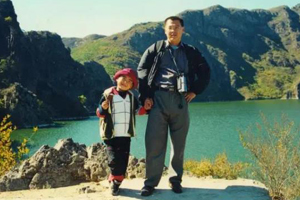
As general secretary of the Chinese Alumni Association of Tanzania, reports Liu Xiangrui, the fluent Mandarin speaker Swai Mosses is well positioned to further improve relations between the two countries.
The 59-year-old Tanzanian Swai Mosses practices Mandarin every day and after nine years of doing so thinks of the Chinese as his "brothers and sisters". He works in Dar es Salaam as an assistant general manager at the Tanzania-China Friendship Textile Company, a Sino-Tanzanian joint venture, and has done so since 1997.
 |
|
Swai Mosses and his wife (right) celebrate their son Emanuel Mosses' graduation in Beijing. Photos Provided to China Daily |
"My work involves dealing with people. It is challenging, especially in a joint venture as I have to pull people from different cultures together," explains Mosses, who adds that his Shanghai master's degree research from 1993 to 1995 has been a big help.
"I learned how to deal with common problems in joint ventures and applied that to my work," Mosses says. "It was a bit difficult at first because of different cultural backgrounds. But after years of cooperation, we have learned to understand and appreciate each other more. Our working efficiency has been greatly improved."
Mosses has played an important role in assisting his company's Chinese colleagues, by teaching them to speak English, inviting them to his home and assisting them when they needed help - thereby winning over their trust.
Every February he helps his Chinese friends celebrate the Lunar New Year by applying for permits to hold events.
"After working with my Chinese colleagues for 15 years, I have found that they can adapt quickly to local customs and culture," he says.
As trade and cultural exchanges have grown between China and Tanzania, increasing numbers of Chinese have moved to the African country. The growing Chinese community has introduced many new technologies and jobs.
Mosses says he first went to China in 1985 and studied the language for four years in Beijing, after receiving a scholarship backed by the Chinese and Tanzanian governments.
Life was tougher for foreigners in Beijing in those days, Mosses says. Few Chinese could speak English and they tended not to mix.
"It was difficult for us to talk with local people as we had never studied Chinese before," he says, which made it a struggle in the first few years. "When we started speaking Chinese was when we started making friends with local people."
After graduating he returned home, but went back to China to further his studies and enrolled at Tsinghua University for a postgraduate diploma in engineering. In October 2010, the Chinese government picked Mosses as an overseas graduate representative for the 60th anniversary of China.
In 2011 he participated in a project about teaching Chinese as a foreign language, in Xiamen.
"Every year I go to China, I find change," he says, pointing to a recent student activity between Chinese and foreign students at Peking University. Foreign students were performing traditional Chinese cultural programs, like acrobatics.
"It's very different from when I studied in China years ago. Up until the 1990s, such things were not common."
Mosses recalls foreign students used to dine in separate cafeterias and didn't mix much. It's all changed now, he says.
In 2010, he and some other Tanzanians who studied in China established the Chinese Alumni Association of Tanzania. As its general secretary, Mosses shares information about China back at home, especially to those who are interested in studying and doing business in China.
"We often meet and exchange ideas. I help anyone who wants to learn more about China," he says, adding Chinese companies often get in touch with his organization when searching for local employees.
Now Mosses' son has followed in his footsteps and started studying in China, in 2006.
"We saw a lot of opportunities in China and my father suggested I came," says 27-year-old Emanuel Mosses, who works as a Swahili language broadcaster at China Radio International, after graduating in 2011.
"I didn't realize there were so many foreigners here and that Chinese are so friendly. Besides, my father recommended many of his friends and connections here to me. They helped me a lot during the first days."
The pair work together helping Tanzanians succeed in China and vice versa, which has further inspired Emanuel. He eventually intends to start his own business in Tanzania, though he plans to stay in China for a while longer.
"I love my job because it helps me understand more about China. Sometimes I get the opportunity to travel around and have interesting interviews and meetings," Emanuel says.
So central has China been to Swai's life, he says his younger son will also come to study in China soon too. You can't have too much of a good thing, he says.




Copyright 1995 - . All rights reserved. The content (including but not limited to text, photo, multimedia information, etc) published in this site belongs to China Daily Information Co (CDIC). Without written authorization from CDIC, such content shall not be republished or used in any form. Note: Browsers with 1024*768 or higher resolution are suggested for this site.
License for publishing multimedia online 0108263 Registration Number: 130349