Comments()
  Print
Print  Mail
Mail  Large Medium Small
More than 100 cities to benefit once project is up and running
A navigation system, capable of almost pinpoint accuracy, will cover more than 100 cities and benefit at least 200 million people across the nation, Vice-Minister of Science and Technology Cao Jianlin said.
The Xihe system, named after a god in ancient China, will be introduced by 2020. Recent tests showed that it was accurate to within one-tenth of a meter outdoors and 3 meters in enclosed spaces.
"The accuracy of navigation satellites is about 10 meters," Cao said.
|
 |
| Cao Jianlin is vice-minister of science and technology. |
"But with a chip loaded with Xihe on a GPS device, the accuracy (for civilian use) will be within 1 meter outdoors and 3 meters indoors, so you will never get lost — even inside a large shopping mall," he said.
Xihe integrates technology to receive and send signals from all four major navigation satellite systems — China's Beidou, the Global Positioning System from the US, Russia's GLONASS and the European Union's Galileo.
Once connected to all the major navigation satellites, the Xihe system will increase the accuracy of all four systems and cut the cost for users of mobile devices, Cao said.
"For a highly accurate navigation device, the price will be cut by at least 50 percent."
Pilot projects are in progress in Jiangsu province, Tianjin and Beijing to develop applications of Xihe, and chips and handsets are under research and development.
"We have broken through the core technology. In 2013, we will finish the R&D on applications for smartphone users," Cao said.
Different from existing navigation systems, Xihe provides solutions for accurate indoor navigation, Cao said, adding: "There's a global race on for indoor navigation technology."
In August, 22 international companies, including Nokia, Samsung and Sony Mobile Communications, formed an alliance to develop indoor navigation technology.
The Japan Aerospace Exploration Agency is also researching an indoor navigation system.
According to the ministry, the number of cell phone users in China increased by 70 percent in 2009 and 100 percent in 2010. The sector's market value is worth more than 80 billion yuan ($12.8 billion).
 |
|
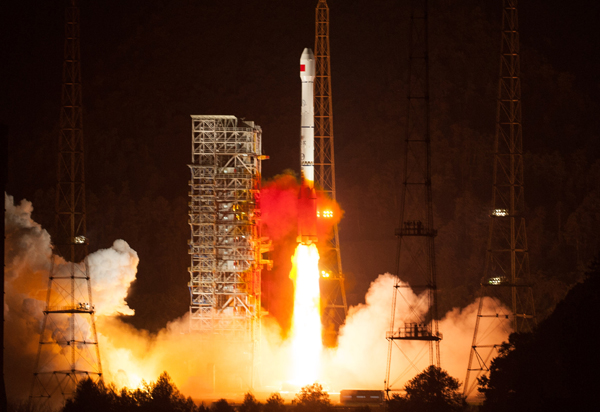
China successfully launches its 16th satellite for the Beidou system, a global navigation and positioning network, into space on Oct 25 from the Xichang Satellite Launch Center in Southwest China's Sichuan province. Liu Chan / Xinhua |
A 30 to 40 percent annual increase is expected in the next five years, which means the output of industries related to navigation services will reach 225 billion yuan by 2015 and 400 billion yuan by 2020, according to official estimate.
Similarly, British vehicle consultancy firm SBD estimated that by 2015 China could be the world's largest navigation market.
"If we piece together indoor and outdoor navigation services seamlessly to meet the huge demand, China may become the industry leader," Cao said.
However, this is only part of the plan to develop everyday use of the Beidou navigation satellite system.
The system currently includes 16 satellites and many ground operation centers and control centers.
According to Cao, the ministry is planning to develop more services from Beidou.
"For example, most navigation devices now receive signals but don't reveal the user's position. We can develop special positioning devices for older citizens and children, which allow family members to find them if they are missing," the vice-minister said.
On Oct 25, a 16th satellite was added to the Beidou system, paving the way for the network to provide services to the Asia-Pacific.
China has successfully launched six satellites for Beidou this year to eventually weave a constellation of 35 satellites by 2020, at which point it will rival GPS and GLONASS for services around the planet.
"We are now adapting the number and layout of the satellites to complete a global network for better civil use," Cao said.
"Different from other systems, Beidou is an open system. It allows operations with other satellite navigation systems.
"We also welcome international companies to develop devices and services for users based on Beidou, we welcome the competition brought by foreign companies," he said.
Contact the writers at chengyingqi@chinadaily.com.cn and zhuzhe@chinadaily.com.cn

 Modeling contest part of China-US exchange
 Specially fertilized tea
 Simulator to support A320neo commissioned
 China's cultural sector sees steady growth in 2011
 Travel chaos after snowstorm hits NE China
 Inflation expected to rebound in November
 Grain output grows for 9th consecutive year
 White House-like buildings in E China city
Copyright 1995 - 2010 . All rights reserved. The content (including but not limited to text, photo, multimedia information, etc) published in this site belongs to China Daily Information Co (CDIC). Without written authorization from CDIC, such content shall not be republished or used in any form. Note: Browsers with 1024*768 or higher resolution are suggested for this site.
License for publishing multimedia online 0108263 Registration Number: 20100000002731