Bad behavior is more a result of social pressures on Chinese tourists than personality, experts suggest. Liu Zhihua finds out why they say nurture overcomes nature.
Bad manners in public are due to many factors, and not just individual personality. Experts say society, historical circumstances and the environment must all be taken into consideration.
"People are relatively tolerant and polite in their daily lives toward acquaintances and friends, but when placed in a crowd or in a strange place, such as when traveling abroad, chances are that people will be more prone to anger, to be rude, aggressive or even violent," says Han Xueqing, director of clinical psychology at the Beijing Tongren Hospital.
 |
|
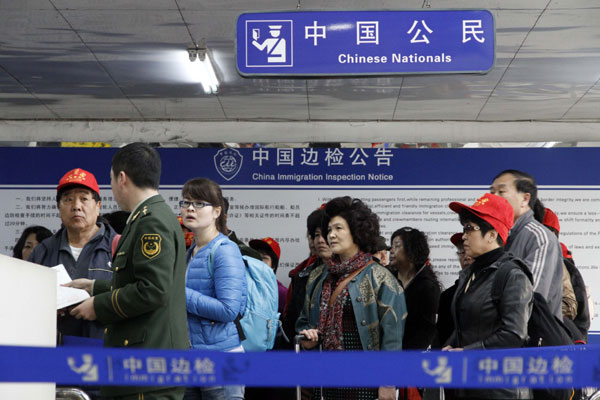
Chinese have become some of the most sought-after tourists because of their spending power. Statistics suggest they will take 80 million overseas trips in 2012. [Photo by Chen Hao / for China Daily] |
She points to the case of an old man who died of a heart attack after he quarreled with two young women in the Beijing subway during rush hour.
"Studies have shown that in a noisy place people tend to become rude and angry," he says. "That is because they feel insecure or threatened. It is human nature to switch into self-protection mode and look out for their own well-being."
In a society that boasts of a 5,000-year-old civilization formed by the doctrines of Confucius and Mencius, civic education starts early.
At school, children are familiar with the tale of Kong Rong, who gave his siblings the larger fruits and kept the smallest for himself, when his father asked him to share out some pears.
Kong Rong had been taught that, as the youngest, he had to give way to his elders.
Many Chinese are aware of teachings such as these, and that politeness and kindness are marks of a civilized society.
But for many, these values were thrown out of the window during the "cultural revolution" (1966-76), a period of social turbulence and moral decline.
In the past few decades, blind worship of material success has also affected moral values and complicated behavioral paradigms, experts say.
 |
|
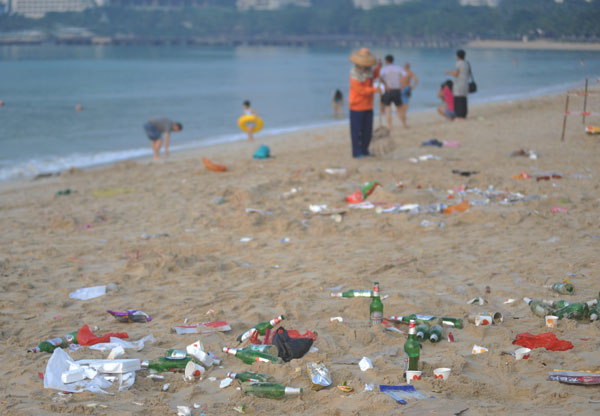
Tourists litter a sandy beach at Dadonghai Resort in Sanya, Hainan province, during the National Day holiday. [Photo by Meng Zhongde / for China Daily] |
 |
|
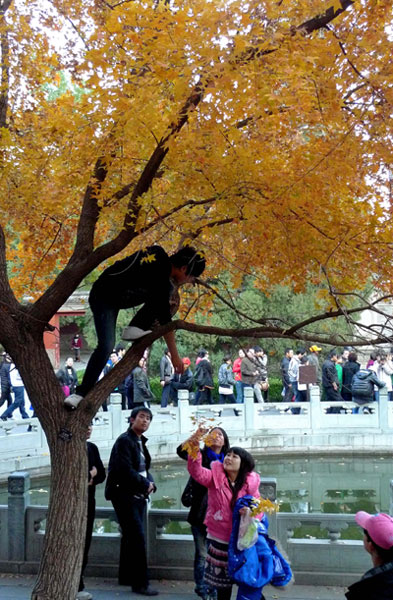
A tourist climbs onto a tree and hands down red autumn leaves to his companions at Fragrant Hills, Beijing. [Photo by Li Wenming / for China Daily] |
"It is not that the Chinese cannot behave. The society we live in, the phase of social development we are going through, and the social network we belong to all decide our behavior in public," says Cheng Lehua, a social psychologist with the department of psychology at Sun Yat-sen University.
For one, people are more inclined to be rude if they feel their personal space is being violated. For another, when social resources are limited, and there is no actual penalty mechanism for improper behavior, it becomes a free-for-all. Finally, identity plays an important role, Cheng adds.
"Travelers are a good example in such extreme cases," Cheng says.
"They are more likely to behave badly than locals. They are in a strange place and they are in a hurry to get the most out of the limited stay, while locals have more time and opportunity, relatively, to do the same.
"The better educated, those with higher social status, are more likely to be polite and control themselves in public, because they have an identity and image to maintain. For this reason, too, you find that overseas Chinese cling to traditions more than those in China."
"It is all about the conflict between self-interest and limited resources, especially in a strange or crowded place," says Han Xueqing, the psychologist at Tongren Hospital.
"I believe such ugly behavior is temporary," she says.
It has been a steep learning curve for Chinese tourists abroad, but experts say as they slowly get used to being affluent, and their vision broadens with more frequent travel abroad, they will feel less pressure to grab as much as they can in as short a time as possible, and they will learn to relax and behave better.
But this improvement has to take place against a background where the authorities encourage and instill order, provide lifelong moral education, and penalize bad behavior in public.
Contact the writer at liuzhihua@chinadaily.com.cn.



Copyright 1995 - . All rights reserved. The content (including but not limited to text, photo, multimedia information, etc) published in this site belongs to China Daily Information Co (CDIC). Without written authorization from CDIC, such content shall not be republished or used in any form. Note: Browsers with 1024*768 or higher resolution are suggested for this site.
License for publishing multimedia online 0108263 Registration Number: 130349