Majority of cross-border fraud cases originate in Southeast Asia countries
Beijing judges and experts said China urgently needs to reach agreements with other countries on legal cooperation to curb cross-border economic crimes.
Since 2003, Beijing No 2 Intermediate People's Court has dealt with 118 cases of cross-border economic crimes involving at least five victims in each case, and the number of such cases is still rapidly increasing, according to a report by the court published on Monday.
 |
|
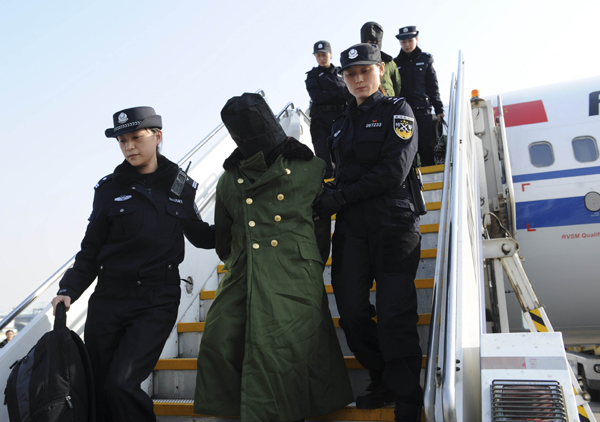
Twenty-four suspects in a transnational telecom fraud case are escorted by police from the Philippines to Beijing on Feb 2, 2011. [Photo/Xinhua] |
The amount of money involved in these cases reached 4.9 billion yuan ($787 million), and the total number of victims was more than 94,600, the report said. In 2009, a forestry contract fraud case brought economic losses to more than 23,000 people across the country.
The criminals signed fake contracts with victims and made online pyramid sales, convincing people to invest in illegally registered government administrations and international companies, the report said.
Among the cases that have been solved, 24 criminals were from overseas, the report added.
"It was rare to hear cross-border economic cases involving so many victims a decade ago, which might be due to our country's economic development at that time," said Tan Jinsong, a senior judge responsible for handling such cases in the court, at a news conference on Monday.
"Cross-border cases are difficult for judges to deal with and usually bring huge legal challenges for police to investigate, as they are committed from foreign countries which have different legal systems," he said.
He told China Daily that most of the cross-border cases occurred in countries in Southeast Asia, such as Thailand and Malaysia, and it has also become common over the last three years to see Chinese go aboard to commit economic crimes.
The majority of economic crimes from overseas are related to telecom fraud, and the Internet has been the main tool used to commit them, he said.
Previously, many security investment deals were signed face-to-face, but with the development of the Internet, such agreements are now mainly managed online, which brings convenience as well as risks, according to Tan.
In one case, criminals from overseas called Chinese mainland residents randomly, posing as credit card companies, Tan said. Using computer software, the criminals made the phone calls appear as if they were coming from the Chinese mainland.
When the victims called the number back, an automated machine asked them to enter their credit card account and password, giving the criminals access to their account.
Some criminals registered shell companies and convinced people to invest and make transactions, he said.
In 2011, a man from Malaysia established a company in Beijing without a permit from the State Administration of Foreign Exchange. He claimed to be able to help people invest in overseas foreign exchange markets and illegally gained 60 million yuan.
In 2010, a group of criminals, including two from Hong Kong, registered a security investment company without a permit from the China Security Regulatory Commission. More than 1,000 people invested in the company and lost their money.
Liu Lin, a lawyer specializing in economic cases from Shuangli Law Firm in Beijing, said it is not rare to hear of people going aboard to make illegal transactions.
"In this way, they can escape responsibility under Chinese laws," he said.
"Our country has not yet signed extradition agreements with some Southeast Asian countries. It has become a loophole for these criminals, especially for those who are Chinese but have committed crimes overseas," he said. "That is why it is necessary to build up more legal cooperation with other countries."
The lawyer added it is urgent to enhance online supervision in these countries.
Zeng Xinhua, a researcher in criminal law at Beijing Normal University, agreed with Liu, saying legal cooperation agreements will be the most effective way to curb cross-border cases.
Currently, the punishment for economic crimes is not harsh enough to deter criminals, Zeng said.
"The most severe penalty for fraud is a life sentence," he added.
To help people avoid being victimized by economic criminals, Bai Shanyun, vice-president of the Beijing No 2 Intermediate People's Court, said they will provide legal advice to administrations with supervision loopholes, such as the forestry, industrial and commercial departments.
Contact the writer at caoyin@chinadaily.com.cn



Copyright 1995 - . All rights reserved. The content (including but not limited to text, photo, multimedia information, etc) published in this site belongs to China Daily Information Co (CDIC). Without written authorization from CDIC, such content shall not be republished or used in any form. Note: Browsers with 1024*768 or higher resolution are suggested for this site.
License for publishing multimedia online 0108263 Registration Number: 130349