Brief History of the Communist Party of China
(china.org.cn)
Updated: 2010-09-07 16:58
 Comments()
  Print
Print  Mail
Mail  Large Medium Small
A New Era of Socialist Modernization Construction (October 1976-April 1991)
With the victorious overthrow of the Jiang Qing counterrevolutionary clique in October 1976, China entered a new period of socialist modernization construction.
In the first two years of the new period, the Party still was not able to free itself from all the disturbances of the "Left" mistakes. The Party's work progressed hesitantly.
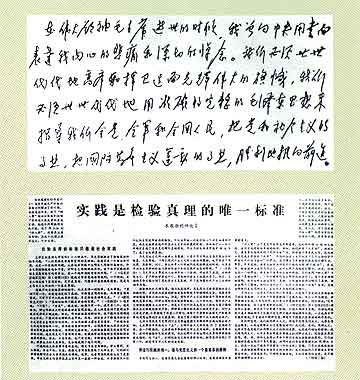
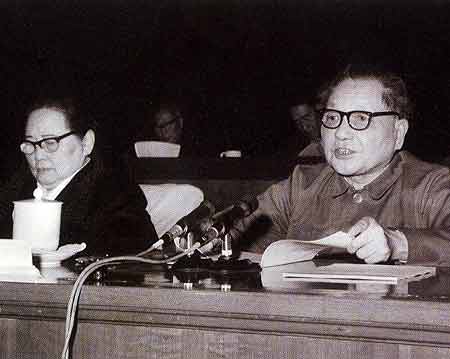
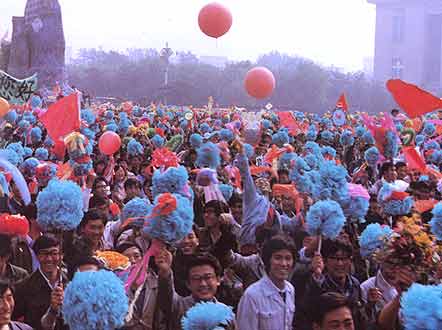
In December 1978, the Third Plenary Session of the Eleventh Party Central Committee was held. The Party then fundamentally ridded itself of the prolonged hard bondage of "Left" errors and reaffirmed the ideological, political and organizational line of Marxism. The session decided to shift the emphasis in the Party's work to socialist modernization construction. It also formulated the general principle of reform and opening to the outside world. The measures completed a great turning point of far-reaching significance in the history of the Party since the founding of the People's Republic. With Deng Xiaoping as the core of the leadership, the CPC Central Committee led the work of resolutely setting right the wrongdoings of the past in guiding ideology and practical work. Step by step, the Party established the basic line of adhering to the Four Cardinal Principles and adhering to the policy of reform and opening to the outside world, with economic construction at the centre of the work, and a series of other principles and policies. The Twelfth National Congress of the CPC adopted a grand program for a socialist modernization drive. The Thirteenth National Congress of the CPC expounded systematically the theory of the primary stage of socialism and the basic line of the Party. By summing up experiences, the Party has embarked on a correct path of building socialism with Chinese characteristics. Under the guidance of the line, the principle and the policy formulated since the Third Plenary Session of the Eleventh Central Committee of the CPC, China has concentrated on socialist economic construction, and has gradually reformed and improved the structures of socialist economy and politics, as well as the structures of education, and science and technology. It has strengthened the building of socialist democratic politics and an advanced culture and ideology. Thanks to the policy of reform and opening to the outside world, the Chinese economy is flourishing, the political life is becoming more lively and the national spirit is being further promoted. Overall, the national economy has expanded rapidly, the national strength has been enhanced unprecedentedly and the standard of living of all nationalities has improved significantly. China has made great achievements in its socialist construction and the cause of reform and opening to the outside world.
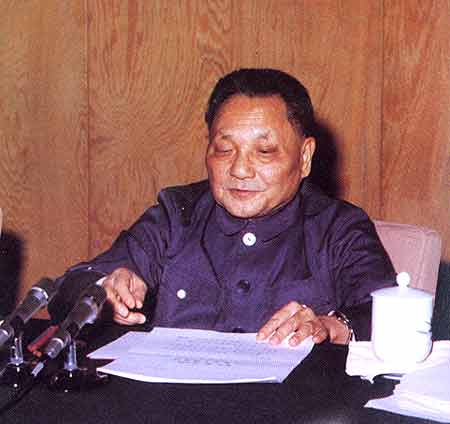
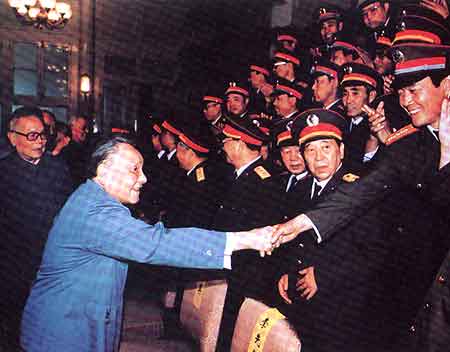
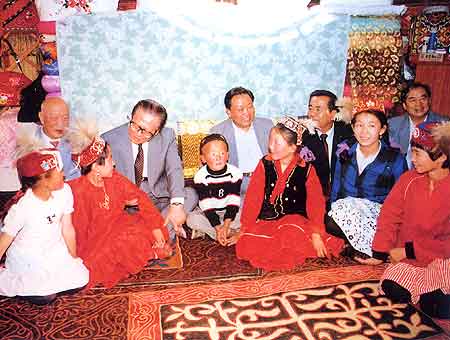
At the turn of spring and summer, 1989, under the influence of the international and domestic climate, there was a rampant tide of bourgeois liberalization, eventually leading to the turmoil and counterrevolutionary rebellion. Representing the fundamental interest of the people, the CPC Central Committee took resolute and timely measures to curb the turmoil and quell the counterrevolutionary rebellion. As a result, the fruits of the Chinese revolution and construction and the socialist system were safeguarded. At the Fourth Plenary Session of the Thirteenth Central Committee of the CPC, a new central leadership, with Jiang Zemin at the core, was elected. Since then, the Party has carried out the basic line of "one focus, two basic points" initiated by Deng Xiaoping. It has taken a clear-cut position of adhering to the Four Cardinal Principles, continuing with improving the economic environment and rectifying the economic order and deepening the reform. It has also strengthened the building of the Party and the ideological and political work. As a result, the socialist modernization construction is gaining further development. With full confidence, people of the whole country have united around the Party and are striving to build a powerful socialist modern country.
Video