Farmers harvest a crop of poetry
By Peng Yining (China Daily)
Updated: 2012-11-06 09:21
 Comments()
  Print
Print  Mail
Mail  Large Medium Small
Since middle school, Zhang has written more than 1,000 poems, scribbled in used textbooks and the margins of newspapers and old magazines.
|
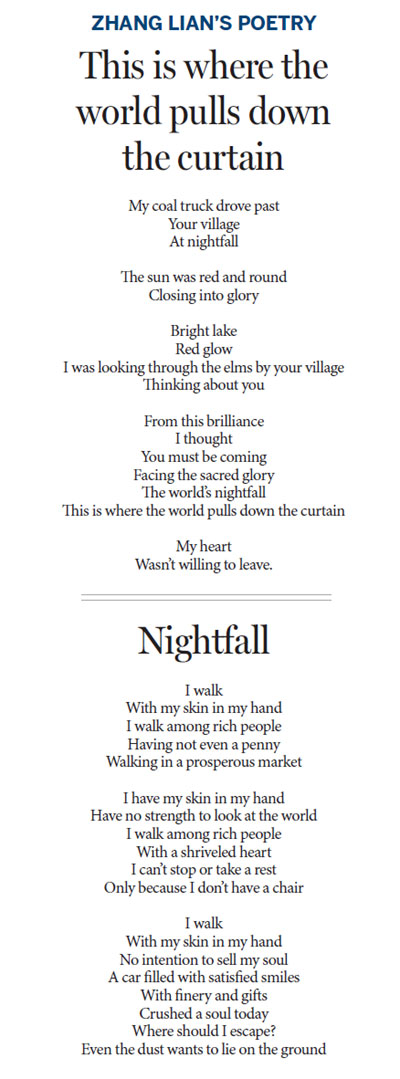 |
At first, writing was just a hobby. Later it became his livelihood.
Planting potatoes earned Zhang about 3,000 yuan ($480) a year. In 2000, he obtained a loan of 2,000 yuan from friends and printed 400 copies of his first collection of poems, Nightfall, and tried to sell them door to door.
"Hello. My name is Zhang Lian. I am a poet. Would you like to buy my book?" he asked, when knocking on strangers' doors during the slow season. He priced his book at seven yuan and sold 350 copies.
In 2008, he joined Ningxia's Writers Association and became a full-time writer. This year Zhang was chosen as one of the "Ten Best Rural Poets" by the Chinese Writers Association and published his eighth collection. He can earn around 30,000 yuan per annum from doorstep sales, enough to allow his family to move from their village to the local town.
A large number of impoverished writers live in this poverty-stricken province, including accomplished poets, novelists and winners of national awards. In south Ningxia's mountainous region, which the United Nations identified as one of the most uninhabitable zones in the world in the 1970s, these potato-planting literati struggle to feed their families but maintain their faith in writing. For them, literature is not just a spiritual quest, it may also lead to a better life.
Last year, Xiji, one of the poorest counties in the region, was designated "The Hometown of Literature in China" by the Chinese Writers Association and the China Literature Foundation, because of the popularity of literature in general and the many high-caliber works by local authors.
Their work is called Xihaigu Literature, a portmanteau derived from the names of some of the poorest southern counties, including Xiji, Haiyuan and Guyuan. It is a crucible of rural Chinese literature, acknowledged by the recent Nobel Prize awarded to one of its most representative writers, Mo Yan.
Solemn emptiness
Conditions in Ningxia can be brutal: The rugged mountain ravines, dry riverbeds, and solemn emptiness of the sandy plateaus often appear in Xihaigu Literature. Poverty and hunger are common topics as the writers describe their rural lives and culture.
"I used to complain about living in such a poor area and in a poor family," said Guo Wenbin, a 46-year-old writer who was born and raised in Xiji. "I often asked 'Why me'?"
He admitted that after years of eating potatoes and sorghum flour, the greatest luxury he could envisage as a young man was eating an apple, but that rarely happened.
"However, I wouldn't be able to write so many stories without those experiences," said Guo, who is deputy director of Ningxia's Writers Association. In 2007, he won one of the country's top literary awards, the Lu Xun Literary Prize, named after one of China's most renowned authors, with a short story chronicling the lives of two children in a remote village.
"Life experience makes for good stories, and in return, literature and writing change people's lives," he said.
Kang Pengfei's life changed when he was deeply touched by a novel he stole from a bookstall
"A person will be enlightened at some time in his life. How early that enlightenment occurs decides the person's fate," according to a character in Lu Yao's award-winning novel Ordinary World.
Kang said the sentiments stirred his soul.
Related Stories
The writer's hard life 2012-11-06 08:16
Writer Han Suyin dies at 95 in Lausanne 2012-11-05 15:48
Mo urges exposure for other Chinese writers 2012-10-31 17:29
Late writer's birthplace plans ambitious project 2012-10-26 15:58
Chinese writers sue Apple for copyright violation 2012-10-12 09:38
Top News
Xi emphasizes adherence to CPC Congress spirit
Top legislator urges implementation of congress spirit
Moderately prosperous China brings chances to world
Video